Fri, September 18, 2026

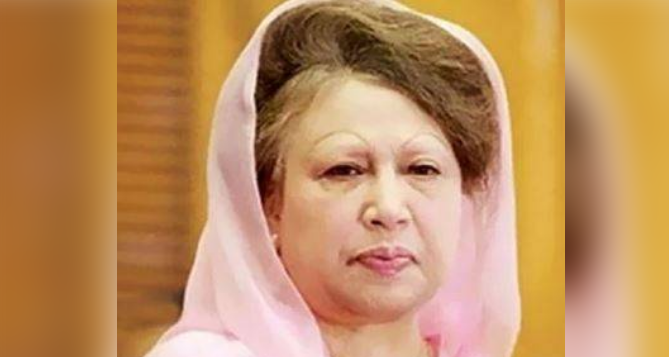
Dhaka (Web Desk): Khaleda Zia, the trailblazing politician who became Bangladesh’s first female prime minister and later defined the country’s politics through a long and bitter rivalry with Sheikh Hasina, died on Tuesday after years of illness. She was 80.
The opposition Bangladesh Nationalist Party (BNP) confirmed her death, saying she had been unwell for a long time.
Her physicians said she was suffering from advanced liver cirrhosis as well as arthritis, diabetes, and serious heart and chest conditions. Earlier in 2025, she travelled to London for treatment, where she remained for about four months before returning to Bangladesh.
Despite being out of office since 2006 and spending years either behind bars or confined to her home, Khaleda remained a powerful political figure, with her party continuing to enjoy widespread backing.
The BNP is widely viewed as the strongest contender ahead of parliamentary elections expected in February. Her son, Tarique Rahman, 60, who serves as the party’s acting chairman, returned to Bangladesh last week after nearly 17 years in exile and is regarded as a leading candidate for the premiership.
Bangladesh has been under an interim administration since August 2024, when a student-led mass movement forced Sheikh Hasina from power. The caretaker government is headed by Nobel Peace Prize laureate and microfinance pioneer Muhammad Yunus. In November, Hasina was sentenced to death in absentia over her role in the violent crackdown on those protests.
Often referred to simply as Khaleda, she was known in her early years as a reserved woman devoted to raising her two sons.
Her public life took a dramatic turn in 1981, when her husband, President Ziaur Rahman and a former military ruler, was killed during a failed army coup.
Three years later, she took charge of the BNP, the party her husband had founded, and pledged to pursue his vision of freeing Bangladesh from poverty and economic hardship.
She later joined forces with Sheikh Hasina, daughter of the nation’s founder and leader of the Awami League, to spearhead a popular movement that ended the military rule of Hossain Mohammad Ershad in 1990. That alliance soon unraveled, giving way to a fierce personal and political feud that earned them the nickname “the battling Begums,” using an Urdu honorific for prominent women.
To her supporters, Khaleda appeared courteous, traditional and understated, choosing her words with care. At the same time, they saw her as determined and unyielding when defending her party or confronting opponents.
Hasina, by contrast, was known for her outspoken and combative style, and the sharp contrast between their personalities helped fuel a rivalry that dominated Bangladesh’s political landscape for decades.
In 1991, Bangladesh held elections widely celebrated as its first truly free vote. Khaleda scored a surprise victory over Hasina with the support of the Islamist Jamaat-e-Islami, becoming the country’s first woman prime minister and only the second woman to head an elected government in a predominantly Muslim nation, after Pakistan’s Benazir Bhutto.
During her first term, she dismantled the presidential system in favor of a parliamentary structure that concentrated authority in the prime minister’s office.
Her government also encouraged foreign investment and introduced free and compulsory primary education. Defeated by Hasina in the 1996 polls, she staged a comeback five years later with a sweeping electoral win.
Her second period in office, however, was clouded by the emergence of militant groups and persistent accusations of corruption. In 2004, a grenade attack struck a rally addressed by Hasina, killing more than 20 people and injuring over 500. Although Hasina survived, Khaleda’s administration and its allies were widely accused of responsibility.
Years later, in 2018, Tarique Rahman was sentenced to life imprisonment in absentia over the attack, a verdict the BNP rejected as politically motivated. Although Khaleda later moved to curb extremist groups, her second term ended in 2006 amid street violence and political turmoil, when an army-backed caretaker government assumed control.
That interim administration jailed both Khaleda and Hasina on charges of corruption and abuse of power for about a year before releasing them ahead of the 2008 general election. Khaleda never returned to office.
With the BNP boycotting the 2014 and 2024 elections, her acrimonious rivalry with Hasina continued to shape national politics.
Clashes between their rival camps frequently led to strikes, unrest and loss of life, slowing development in Bangladesh, a densely populated, low-lying country of roughly 175 million people that is highly vulnerable to flooding.
In 2018, Khaleda, Rahman and several aides were convicted of embezzling around $250,000 in foreign donations to an orphanage trust established during her time in power.
She insisted the case was designed to bar her family from political life. Sent to prison, she was later transferred to house arrest in March 2020 on humanitarian grounds as her health worsened.
Following Hasina’s removal from office, Khaleda was released from house arrest in August 2024.
Early this year, Bangladesh’s Supreme Court cleared both Khaleda and Rahman in the corruption case that had led to their 2018 convictions. A month earlier, Rahman had also been acquitted in connection with the 2004 grenade attack.
Neo News | Copyright © 2026