Thu, September 17, 2026

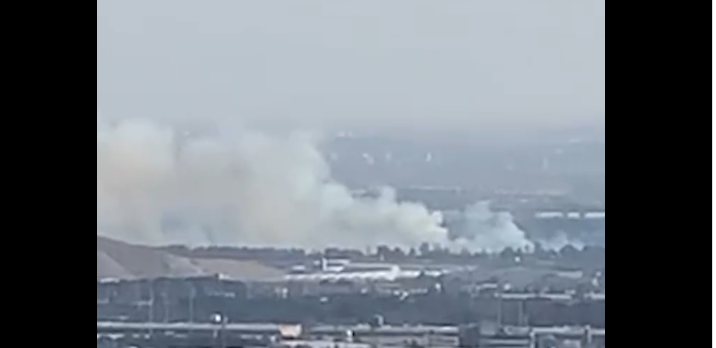
Tel Aviv (Web Desk): In a continuation of hostilities following Tehran's missile offensive, Israel carried out further airstrikes on Iran on Saturday, targeting additional Iranian military positions, including air defence installations.
Israeli military officials stated that the operations would persist "as long as necessary" in response to the Iranian retaliation that killed three and injured at least 91 people across central Israel.
The Iranian missile barrage came after Israeli strikes on Friday reportedly killed 78 people within Iran, among them senior commanders of the Islamic Revolutionary Guard Corps and high-level nuclear scientists. Iranian authorities confirmed that more than 320 others were wounded in the assault.
In the Greater Tel Aviv area, specifically the suburb of Ramat Gan, Israeli outlet Haaretz reported that nine buildings were destroyed and hundreds of apartments sustained damage, prompting the evacuation of approximately 400 residents due to unsafe structural conditions. Visuals emerging from the scene revealed extensive damage, showing burnt vehicles and flattened housing blocks.
Israel’s public broadcaster Kan confirmed that the number of Israeli fatalities increased to three following the death of a woman who had been critically injured during the initial Iranian strikes.
Two others had previously died from injuries sustained in separate attacks. Dozens remain hospitalized, with at least three patients in critical condition.
At the United Nations Security Council (UNSC) session on Friday, Iran's envoy, Amir Saeid Iravani, held the United States accountable for the escalating violence. “The United States is complicit,” he declared. “By aiding and enabling these crimes, they share full responsibility for the consequences.”
US officials acknowledged having prior knowledge of Israel’s plans but emphasized that American forces had no operational role. “Iran would be wise to return to negotiations,” said State Department official McCoy Pitt, adding that Tehran would face “dire consequences” if it targeted U.S. assets or personnel.
Former US President Donald Trump, speaking to The Wall Street Journal, confirmed he was informed about the Israeli operation in advance. “It wasn’t a heads-up.
It was, we know what’s going on,” he remarked. Trump also warned Iran that it should strike a deal before “there is nothing left,” while repeating his preference to avoid a larger military conflict.
Pakistan's Foreign Office issued a statement on Saturday condemning Israel's actions, labelling the strikes as “unjustified and illegitimate aggression” that infringed on Iran’s sovereignty.
“These strikes clearly contravene the UN Charter and fundamental principles of international law,” the statement read, asserting Iran’s right to self-defence under Article 51 of the UN Charter.
“Pakistan stands in resolute solidarity with the people of Iran and unequivocally denounces these blatant provocations, which constitute a grave danger and a serious threat to the peace, security, and stability of the entire region and beyond.”
The Foreign Office (FO) urged the global community and the UN to act swiftly to end the aggression and ensure accountability.
Pakistan’s Deputy Prime Minister and Foreign Minister, Senator Mohammad Ishaq Dar, also spoke by phone with Iranian Foreign Minister Seyed Abbas Araghchi on Friday. Dar condemned the “blatant Israeli aggression” and highlighted its violation of international norms and the UN Charter.
He reaffirmed Islamabad's "unwavering support" for the Iranian government and people, expressing “deepest sympathies” for the lives lost in the Israeli airstrikes and calling for the restoration of regional peace.
Meanwhile, Rafael Grossi, Director General of the International Atomic Energy Agency (IAEA), briefed the Security Council about the dangers of military actions near nuclear sites.
“Such actions endanger nuclear safety, safeguards, and regional stability,” he warned, offering the agency’s expertise for inspections and diplomacy.
At the same time, the humanitarian situation in Gaza continues to deteriorate. According to the Health Ministry in Gaza, more than 55,000 people have been killed since October 2023.
Since Israel resumed its military campaign on March 18, following the collapse of a short-lived ceasefire and prisoner exchange, at least 4,821 additional Palestinians have died and 15,535 have been injured.
Human rights organizations have described the relentless bombardment as part of a “systematic campaign of ethnic cleansing.”
In November, the International Criminal Court issued arrest warrants for Israeli Prime Minister Benjamin Netanyahu and former Defence Minister Yoav Gallant, accusing them of war crimes and crimes against humanity.
It is pertinent to mention that Israel is currently on trial at the International Court of Justice (ICJ) in a genocide case concerning its actions in Gaza.
Neo News | Copyright © 2026