Fri, September 18, 2026

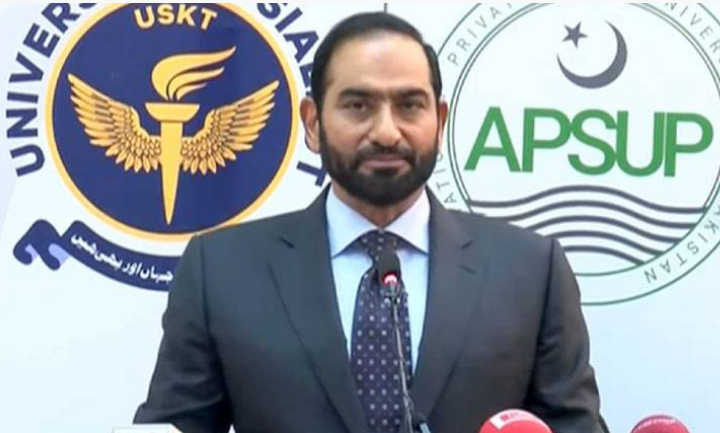
Sialkot (Web Desk): Chairman of the Punjab Group, Mian Amer Mahmood, has said that the process of equitable development in Pakistan has come to a standstill, stressing that the creation of new provinces is now inevitable to ensure efficient governance and fair distribution of national resources.
Addressing a special session titled "Pakistan 2030: Challenges, Imkanaat aur Nai Rahein" (Challenges, Possibilities and the Way Forward), at the University of Sialkot on Thursday, organized by the APSUP's nationwide awareness campaign, he said the existing provincial structure and the unequal allocation of resources have hindered the country’s overall progress.
Mian Amer Mahmood pointed out that Punjab’s size compared to other provinces makes it a unique example among federations worldwide. He observed that Balochistan, though the largest province by area, remains underdeveloped due to its small population and limited access of locals to available natural resources.
He added that despite the abundance of natural wealth, the province has struggled to achieve stability and growth because of inadequate resource distribution from the federal government.
He lamented that in the past seventy-nine years, only a handful of major cities in Pakistan have seen real progress.
“In Sindh, Karachi remains the only city with substantial development, while other urban centers face serious infrastructural deficiencies. In Punjab, most of the provincial budget is concentrated in Lahore, in Khyber Pakhtunkhwa (KP), Peshawar consumes the largest share of development funds; and in Balochistan, visible progress is limited to Quetta,” Mian Amer Mahmood stated.
He noted that although the performance of successive governments has varied, none succeeded in establishing an administrative framework that could ensure uniform development across the country.
The Punjab Group chairman emphasized that weak institutions breed corruption, asserting that without institutional strength, justice cannot prevail and ordinary citizens will remain vulnerable to the exploitation of powerful elites.
He said that the true purpose of governance is to protect citizens from the abuse of power and to safeguard their rights.
Criticizing the weak local government system, Mian Amer remarked that in Pakistan, local bodies are among the first institutions to be dissolved whenever democracy returns.
According to him, these institutions exist to serve the people and address their needs more efficiently. Ironically, he said, local governments are often strengthened during military regimes but abolished under democratic ones, thereby disrupting grassroots service delivery.
Mian Amer Mahmood stressed that Pakistan, despite being the world’s fifth most populous nation, has only four provinces. By contrast, China has 31, India 39, and the United States 50 states—each of which has improved its administrative efficiency through devolution.
He argued that Pakistan must follow suit by increasing the number of provinces to promote better governance and more equitable resource distribution.
Recalling historical data, Mian Amer said Pakistan’s first census in 1951 recorded a population of 33 million, which has now surged to nearly 250 million, while the number of provinces remains unchanged.
"Punjab’s population has grown from 20 million to around 130 million, Sindh’s from 6 million to over 55 million, Khyber Pakhtunkhwa’s to more than 40 million, and Balochistan’s from about one million to 15 million. Yet, development gaps between provinces remain stark," Mian Amer claimed.
He warned that unless the process of national development becomes balanced, Pakistan will continue to face new economic and social challenges.
The Punjab Group chairman called for urgent reforms to bridge provincial disparities, strengthen state institutions, revive the local government system, and consider the creation of additional provinces so that every citizen can have equal access to basic facilities, justice, and opportunities for progress.
Neo News | Copyright © 2026