Fri, September 18, 2026

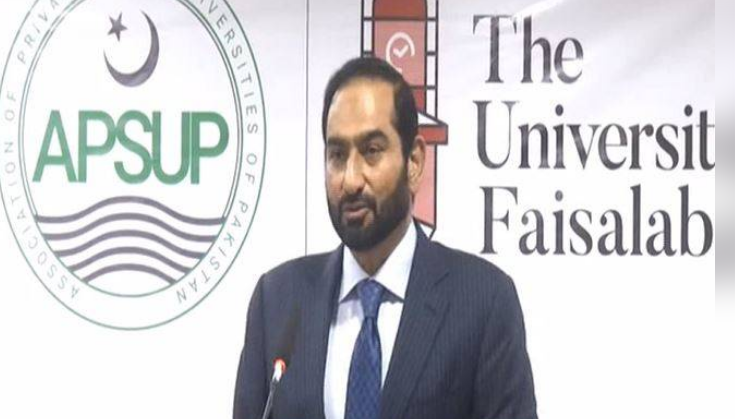
Faisalabad (Web Desk): Punjab Group Chairman Mian Amer Mahmood said that Pakistan needs smaller administrative units and empowered local government systems are necessary to ensure fair resource distribution.
He was speaking at an awareness seminar "Pakistan 2030: Challenges, Imkanaat aur Nai Rahein" (Challenges, Possibilities and the Way Forward), organized by the Association of Private Sector Universities Pakistan (APSUP).
Mian Amer Mahmood said that 250 years ago kingdoms thrived on wealth taken from the public until awareness laid the foundation of democratic nations, which sought to deliver resources to their citizens.
“A strong national government along with smaller units is essential to reach the people, yet Pakistan has failed to establish empowered local governments despite constitutional guarantees,” he said, adding that the provincial authorities refuse to devolve powers, leaving the people deprived.
Citing seven pillars that form the foundation of a state, Mahmood stressed public welfare as the foremost duty, urging reflection on schools, hospitals, law and order, and the justice system.
Referring to a World Bank report on Pakistan’s 100-year outlook, he warned that persistent mistakes will hinder progress and lamented that justice and rights are not distributed equally across regions.
Highlighting imbalances, he said Punjab represents 53 percent of the population while the other three provinces make up 43 percent. “We are a federation where one unit is larger than the rest combined, yet Punjab is denied fair treatment,” he remarked.
The Punjab Group chairman recalled that at independence Pakistan had 30 million people and four provinces, while today’s population has risen to 250 million with the same structure. He proposed Faisalabad as a separate province, noting the country now has 33 divisions.
He said true leadership comes from the middle class, but Pakistan’s system blocks such growth.
Mian Amer cited examples of Narendra Modi, who rose from modest beginnings through work in Indian Gujarat, and also praised athlete Arshad Nadeem for overcoming systemic hurdles to win international recognition.
Speaking on justice, he criticized lengthy trials, with murder cases lasting 16–18 years, saying the system, not judges, is to blame. Amer pointed out that a Supreme Court judge handles 4,000 cases while High Court judges face around 3,000, leaving little time for meaningful hearings.
Quoting surveys, the Punjab Group Chairman said that Pakistan ranks 140th on the Sustainable Development Index, 168th on the Human Development Index, and 109th on the Global Hunger Index.
He warned that 44 percent of children are malnourished, nearly half face food shortages, and 25 million remain out of school, putting the nation’s future at risk.
Mia Amer Mahmood stressed that improvement is only possible through smaller administrative units and the rule of law, where no powerful person can usurp others’ rights.
He said corruption thrives in weak institutions, arguing that good governance and transparency can only come through decentralization.
The Punjab Group Chairman added that politicians do not fear NAB, courts, or jails since they recover their losses after returning to power, but the real accountability lies with voters.
Calling corruption the country’s greatest disease, Mian Amer Mahmood said it eats away at society like termites, and urged voters to hold politicians accountable through the ballot.
More provinces, he argued, would bring fresh leadership and better governance.
Neo News | Copyright © 2026