Thu, September 17, 2026

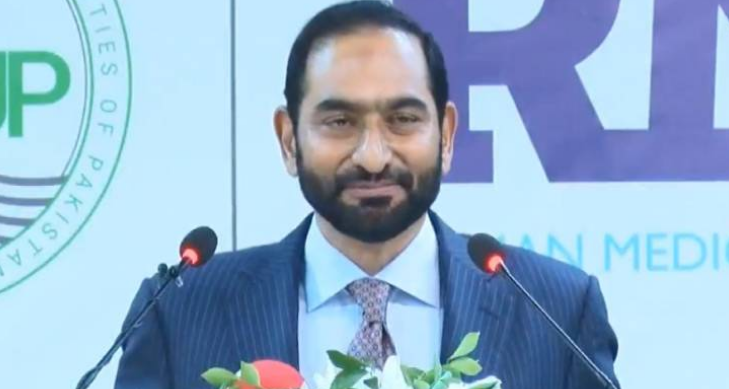
Peshawar (Web Desk) Punjab Group Chairman Mian Amer Mahmood has said that local governments are the true platforms for serving the people and addressing Pakistan’s deep-rooted governance and development challenges.
Speaking at an awareness session, titled, "Pakistan 2030: Challenges, Imkanaat aur Nai Rahein" (Challenges, Possibilities and the Way Forward), organized by the Association of Private Sector Universities of Pakistan (APSUP) at Rehman Medical Institute, Hayatabad, Peshawar on Wednesdsay, he offered an in-depth reflection on the country’s uneven progress and the urgent need for administrative reforms.
Mian Amer Mahmood observed that Pakistan, even after nearly eight decades of independence, continues to face severe development gaps, where progress appears limited to only a few urban centres.
“In Punjab, no city other than Lahore gives the impression of genuine development,” he said, lamenting that the country’s growth has been heavily centralized.
Mian Amer emphasized the need to draw inspiration from the governance model of Prophet Muhammad (Peace Be Upon Him), which ensured representation and accountability at the grassroots level. “
In the Prophet’s (PBUH) system, one Naqeeb was appointed for every ten households, and another for every hundred. This was a structure of governance built on inclusion and order — one that can still serve as a model for our society today,” he remarked.
Discussing Pakistan’s development trajectory, the Punjab Group chairman said that even after 80 years, the nation struggles with fundamental infrastructure and administrative shortcomings.
“Countries are created to ensure public welfare, yet our governance model still fails to serve that purpose,” he said, adding that the vast population and land area of existing provinces have created administrative bottlenecks.
Mian Amer proposed that forming smaller provinces would not increase expenses but instead enhance efficiency and service delivery.
Quoting a World Bank study, Mian Amer Mahmood noted that Pakistan’s development has been highly uneven. “In 79 years, only five major cities have seen significant progress.
In Sindh, beyond Karachi, development is almost invisible — and even Karachi’s condition is far from ideal. The rest of Sindh is plagued by slums and chronic neglect,” he said.
“The same holds true for Punjab, where apart from Lahore, cities like Faisalabad lack quality hospitals, universities, and schools. People are compelled to travel to Lahore even for basic healthcare.”
He pointed out that Punjab alone accounts for 52 percent of Pakistan’s population, while Balochistan occupies nearly half of the country’s total area, creating severe management and governance challenges.
“When Pakistan came into being, Balochistan’s population was barely over a million. Today, it has risen to around 15 million, further complicating its administrative needs,” he said.
Drawing comparisons with other nations, Mian Amer Mahmood cited examples of China, India, and the United States (US), which improved their governance structures by creating more provinces or states.
“India’s GDP and Human Development Index improved after it established new provinces — a lesson Pakistan must learn if it hopes to move forward,” he added.
He also expressed concern that only a handful of large cities in Pakistan enjoy basic urban facilities, while smaller cities remain deprived, causing migration and population pressure in major urban centres.
“Faisalabad, Quetta, and Peshawar still lack modern amenities, and people have no choice but to move to bigger cities for education and treatment,” he said.
Mian Amer Mahmood criticized the lack of genuine empowerment of local governments despite regular elections. “Elections are held, but powers never reach the grassroots. Without decentralization, the dream of effective public service will remain unfulfilled,” he asserted.
He reminded the audience that Pakistan conducted its first census in 1951, and now with a population of 250 million, the country still operates under the same outdated governance structure.
“We should consider turning every administrative division into a separate province to ensure balanced governance and development,” he proposed.
Mian Amer Mahmood called for new and visionary leadership, urging the inclusion of youth in politics to drive reform and revitalization. He also emphasized the need for assessing the GDP of each province individually to strengthen economic policymaking and improve the delivery of public services.
Neo News | Copyright © 2026