Fri, September 18, 2026

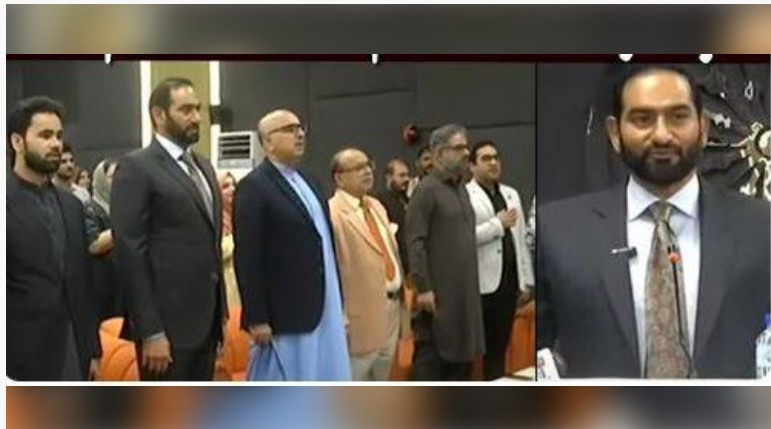
Lahore (Web Desk): A significant and insightful seminar titled "Pakistan 2030: Challenges, Imkanaat aur Nai Rahein" (Challenges, Possibilities and the Way Forward), was held at Superior University under the auspices of the Association of Private Sector Universities of Pakistan (APSUP).
The event featured prominent national figures, including the Chairman of the Punjab Group, Mian Amer Mehmood, and the Chairman of APSUP, Professor Dr. Chaudhry Abdul Rehman.
The seminar began with opening remarks by Professor Dr. Chaudhry Abdul Rehman, who emphasized the crucial role of private sector involvement in higher education as a driving force for national progress.
He highlighted that no country can achieve sustainable development without aligning its education system with future challenges and opportunities.
Addressing the audience as the chief guest, Chairman of the Punjab Group, Mian Amer Mehmood congratulated Professor Dr. Chaudhry Abdul Rehman for organizing the seminar and acknowledged his leadership in raising the important issue of administrative reforms and the creation of new provinces.
He asserted that the formation of new provinces is no longer just an option but a necessity for Pakistan’s future.
Referring to federal systems around the world, such as the United States (US) with its fifty states, he noted that Pakistan is currently operating with only four federal units, which is inadequate to serve a population of over 240 million.
Mian Amer Mehmood proposed that converting the country's 33 administrative divisions into provinces could improve governance, bring clarity to the roles of government institutions, and help resolve public issues at the grassroots level.
He asserted that smaller provinces would reduce the scope for corruption, increase transparency, and ensure that local needs are met more efficiently.
Mian Amer presented a detailed framework for this administrative transformation under the APSUP platform, explaining how decentralization would empower local governments to manage essential services such as sanitation, infrastructure, and public amenities more effectively.
He added that central authorities often lack the capacity to address every regional issue in a timely manner, and therefore provinces play a crucial role in managing localized concerns.
Drawing historical parallels, he noted that while ancient empires used taxation to wage wars, modern states must focus on welfare and accountability.
The Punjab Group chief stressed that true democratic systems distribute power rather than concentrate it, and that no single individual or institution should hold unchecked authority.
“Governance should be driven by robust policies rather than intentions alone,” he said.
Mian Amer Mehmood also emphasized the state’s responsibility to provide economic opportunities and basic services to its citizens, likening it to parents sacrificing for the well-being of their children.
He stated that if a government fails to create employment, it inadvertently fosters unemployment and disillusionment.
The event concluded with a collective call for stronger local governance, decentralization, and practical policy development to ensure that Pakistan is prepared to meet the demands and expectations of its people by 2030.
The seminar witnessed active participation from university students, who engaged in the discussion with thoughtful questions, reflecting their deep interest in the country's future.
In the closing remarks, Professor Dr. Chaudhry Abdul Rehman expressed gratitude to the guest of honour and presented him with a commemorative souvenir on behalf of APSUP.
This seminar is being regarded as a positive initiative toward fostering awareness among students and the academic community about Pakistan’s pressing challenges and potential solutions for the coming decade.
Neo News | Copyright © 2026