Fri, September 18, 2026

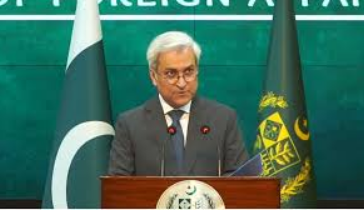
Islamabad (Web Desk): Foreign Office (FO) Spokesperson Tahir Andrabi said on Thursday that Pakistan’s diplomatic initiative aimed at easing tensions between the United States and Iran, which eventually resulted in a ceasefire, has received broad recognition from international leaders.
He reiterated that Islamabad remains firmly committed to advancing peace and stability in the region.
During his weekly media briefing, the spokesperson stated that Pakistan’s constructive engagement in reducing Washington-Tehran tensions had been acknowledged globally, underscoring the country’s consistent preference for dialogue and regional harmony.
Anndrabi added that under the leadership of Prime Minister Shehbaz Sharif and Chief of Defence Forces (CDF) and Chief of Army Staff (COAF) Field Marshal Syed Asim Munir, Pakistan kept communication lines open with both sides as part of its mediation efforts.
The FO spokesperson further explained that these diplomatic efforts played a role in bringing about the ceasefire and enabled formal peace discussions in Islamabad, where delegations headed by US Vice President JD Vance and Iranian Parliament Speaker Mohammad Bagher Ghalibaf held more than 21 hours of continuous negotiations.
The process, he said, was actively supported by Prime Minister Shehbaz Sharif, Deputy Prime Minister and Foreign Minister Ishaq Dar, and the army chief.
Andrabi also noted that the army chief had travelled to Iran a day earlier as part of ongoing diplomatic engagement, while the prime minister was currently on a three-nation regional visit scheduled from April 15 to 18 to deepen bilateral relations and promote peace initiatives.
He added that a number of world leaders contacted Prime Minister Shehbaz Sharif by telephone and praised Pakistan’s role in supporting regional stability. These included Qatar’s Emir Sheikh Tamim bin Hamad Al Thani, German Chancellor Friedrich Merz, Italian Prime Minister Giorgia Meloni, British Prime Minister Keir Starmer, Japanese Prime Minister Fumio Kishida, and Canadian Prime Minister Mark Carney.
Reaffirming Pakistan’s policy direction, Andrabi said the country would continue to play a facilitative role in encouraging dialogue and strengthening cooperation for peace.
He also strongly condemned Israeli forces’ entry into Al-Aqsa Mosque and renewed criticism of Israeli actions against Lebanon, terming them clear violations of international law that further destabilise the region.
On multilateral cooperation, he referred to Pakistan’s participation in the 45th session of the Shanghai Cooperation Organisation’s Regional Anti-Terrorist Structure (SCO-RATS), where member states discussed emerging security threats ad agreed on the need to enhance counterterrorism coordination. He added tat Pakistan will host the next SCO-RATS meeting later this year.
The FO spokesperson also highlighted that senior representatives from Pakistan, Saudi Arabia, Türkiye, and Egypt met in Islamabad under a four-nation consultative mechanism to review ongoing cooperation and prepare proposals ahead of an upcoming foreign ministers’ meeting in Türkiye.
Responding to media questions, Andrabi expressed concern over reports regarding the promotion of Indian Army officer Prasad Shrikant Purohit, who had previously been linked to the Samjhauta Express incident.
He said the development raised serious questions about accountability and reiterated Pakistan’s stance on what it describes as state involvement in terrorism, demanding that those responsible be brought to justice.
Andrabi further pointed to what he described as increasing incidents of violence against minorities in India carried out under the guise of cow protection laws, urging authorities to stop the alleged targeting of Muslim communities.
The spokesperson also condemned ongoing human rights violations in Indian Illegally Occupied Jammu and Kashmir and rejected New Delhi’s delimitation exercise in the territory, stating it was aimed at altering the region’s demographic balance. He also called the inclusion of Azad Jammu and Kashmir in such measures unlawful and without any legal validity.
Reaffirming Pakistan’s long-held position, Andrabi said the people of Indian Illegally Occupied Jammu and Kashmir (IIOJK) are entitled to self-determination through a plebiscite in accordance with United Nations Security Council resolutions.
Neo News | Copyright © 2026