Fri, September 18, 2026

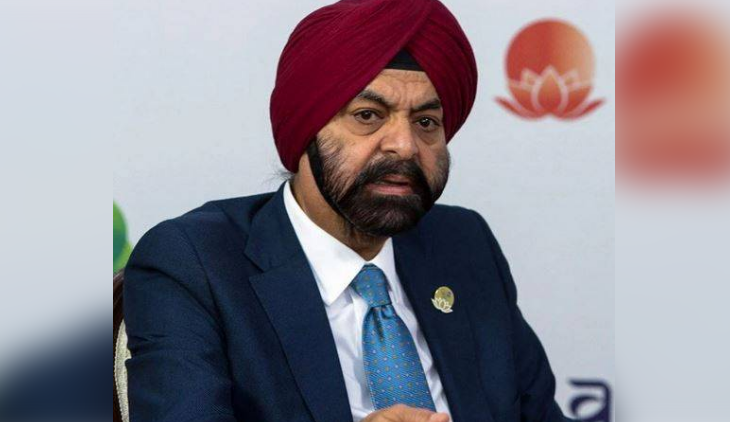
Islamabad (Web Desk): World Bank (WB) President Ajay Banga has underscored that the Indus Waters Treaty (IWT) between India and Pakistan does not permit a unilateral suspension, stressing that any alteration to the treaty requires the agreement of both nations.
His remarks follow India's announcement to unilaterally terminate the treaty after the recent Pahalgam incident, which has drawn sharp criticism from Pakistan and is widely seen as a breach of international commitments.
In an interview with CNBC-TV18, the World Bank chief said “There is no provision in the treaty to allow for suspension the way it was drawn up. It either needs to be gone, or replaced by another one, and that requires the two countries to want to agree.”
He clarified that the World Bank’s role does not extend to arbitrating disputes or enforcing the treaty’s clauses. Rather, the institution plays a facilitative role in case the treaty's dispute-resolution mechanisms are activated.
In case of a disagreement between the two countries, Banga explained, the Bank helps initiate processes such as the appointment of a neutral expert or the formation of a court of arbitration, but it does not take sides in the matter
He further explained the limited scope of the Bank's involvement, saying the treaty, which was signed in 1960 to manage the distribution of water resources between India and Pakistan, was brokered by the World Bank.
“We have to pay the fees of those guys through a trust fund that was set up at the Bank at the time of creation of the treaty. That's our role. We have no role to play beyond that,” Banga noted.
The treaty outlines control over river systems between the two countries and explicitly states that modifications can only happen through mutual understanding. “It's their decision,” he said, confirming that the World Bank has yet to receive any official notification from either India or Pakistan regarding the recent situation.
Following a terror incident in Pahalgam, India has proceeded to implement unilateral measures that affect major elements of the treaty. These include changes in the regulation of water flow to Pakistan, with particular focus on the Chenab River.
In addition, India has ceased the exchange of hydrological data required under the agreement and is reportedly planning to expand flushing operations at the Kishanganga hydroelectric facility, which sits on the Jhelum River.
Pakistan, in response to communications received from India on the IWT, has reiterated its stance that the treaty remains valid and binding under international law, the Foreign Office (FO) stated on Wednesday.
Foreign Office spokesperson Shafqat Ali Khan emphasized that Islamabad has clearly conveyed its objection to any breach of the treaty. "The Indus Waters Treaty is an international obligation that must be upheld," he said.
He further stressed that the agreement contains no clause that allows either party to unilaterally suspend it.
“There is no provision within the Indus Waters Treaty for it to be unilaterally suspended. It is fully in force and must be implemented in letter and spirit,” Khan reiterated.
The FO added that Pakistan intends to continue advocating for its rights under the treaty at all relevant international platforms.
Neo News | Copyright © 2026