Thu, September 17, 2026

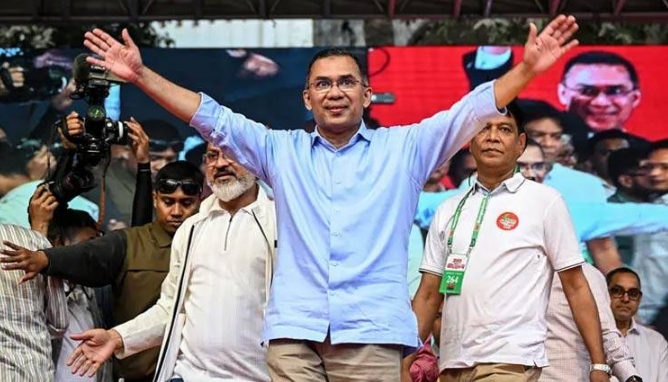
Dhaka (Web Desk/Agencies): The Bangladesh National Party (BNP) has swept to a powerful two-thirds majority in Thursday’s general election, a development many observers believe could steady the country after months of turbulence that followed the removal of former prime minister Sheikh Hasina in a youth-led uprising dominated by Gen Z activists.
Unofficial results broadcast by local television stations showed the BNP and its allies capturing at least 212 of the 299 seats contested in the Jatiya Sangsad, the national legislature. The rival Jamaat-e-Islami and its partners secured 70 seats.
After returning to power for the first time in 20 years, the BNP issued a message of thanks to voters as overnight ballot counting confirmed its majority. The party urged supporters to forgo celebrations in the streets and instead offer special prayers across the country for national unity and prosperity.
A clear-cut mandate had been viewed as essential for restoring order in the Muslim-majority nation of 175 million, where months of violent anti-Hasina protests disrupted everyday routines and dealt a blow to vital sectors such as the garment industry, in which Bangladesh is the world’s second-largest exporter.
BNP chief Tarique Rahman is widely expected to assume office as prime minister. The son of party founder and former president Ziaur Rahman, he returned to Dhaka in December after spending 18 years abroad.
In the interim period after Hasina fled to India in August 2024, Nobel Peace Prize laureate Muhammad Yunus, now 85, led the country as caretaker head of government.
Hasina, who is currently in exile in New Delhi, had long been a dominant force in Bangladeshi politics alongside Tarique Rahman’s mother, Khaleda Zia.
Ziaur Rahman, a key figure in the country’s independence movement, governed from 1977 until his assassination in 1981.
Election authorities said manual counting of paper ballots began immediately after polling ended on Thursday and was expected to continue until at least midday Friday.
With more than 200 seats secured, the BNP achieved one of its strongest performances ever, surpassing its 2001 victory when it won 193 seats. Nevertheless, Hasina’s Awami League — which ruled for 15 consecutive years and was barred from participating this time — had claimed 230 seats in 2008. Previous landslide victories by both major parties were frequently criticised as uncompetitive, boycotted or controversial.
As the scale of the BNP’s triumph became apparent, jubilant supporters gathered outside the party’s headquarters in Dhaka late into the night, chanting slogans and cheering.
Meanwhile, Jamaat-e-Islami leader Shafiqur Rahman acknowledged defeat and said his party would not engage in opposition for its own sake. “We will practice constructive politics,” he told journalists.
The National Citizen Party (NCP), established by young activists who played a significant role in Hasina’s ouster and aligned with the Jamaat-led bloc, won only five of the 30 constituencies it contested.
Voter turnout appeared set to exceed the 42 percent recorded in the 2024 election, with media outlets estimating that more than 60 percent of registered voters participated.
More than 2,000 candidates, including a large number of independents, competed under a record participation of at least 50 political parties. Voting in one constituency was delayed following the death of a candidate.
According to a private Bangladesh TV channel, over two million people voted in favour of proposed constitutional amendments in a referendum held alongside the election, while more than 850,000 voted against them. However, officials had yet to formally announce the outcome.
The proposed reforms would introduce a two-term limit for prime ministers, strengthen judicial independence, enhance women’s representation, mandate neutral caretaker administrations during election periods and establish an upper chamber in the 300-seat parliament.
Neo News | Copyright © 2026