Fri, September 18, 2026

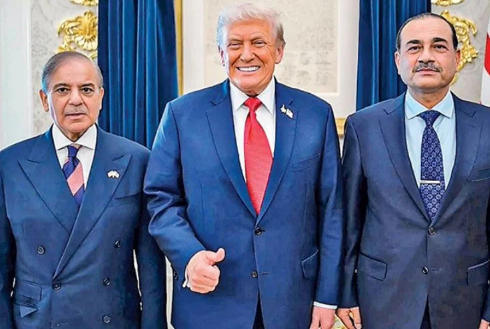
Islamabad (Web Desk): Due to successful diplomacy of Pakistan, President Donald Trump has agreed to a proposed two-week ceasefire between the US and Iran.
The significant diplomatic development emerged on Wednesday when the US President declared a halt to military action against Iran, announcing a two-week suspension of “bombing and attacks” shortly after an appeal from Prime Minister Shehbaz Sharif while
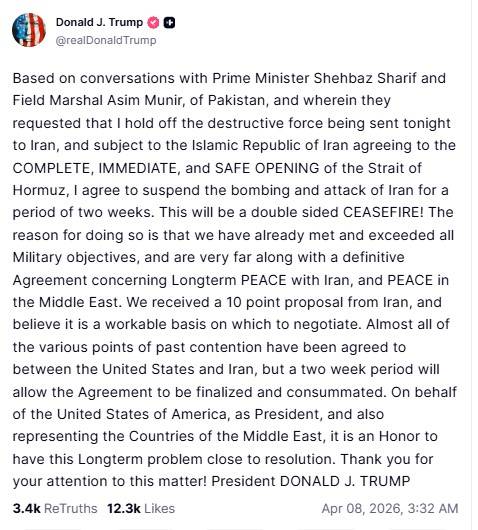
Sharing the decision on Truth Social, Trump said, “Based on conversations with Prime Minister Shehbaz Sharif and Field Marshal Asim Munir, of Pakistan, and wherein they requested that I hold off the destructive force being sent tonight to Iran, and subject to the Islamic Republic of Iran agreeing to the complete, immediate, and safe opening of the Strait of Hormuz, I agree to suspend the bombing and attack of Iran for a period of two weeks.”
Earlier in the day, PM Shehbaz had taken to X to appeal for more time, urging the US president to delay the deadline by two weeks to give diplomacy a fair chance. He also called on Tehran to reopen the Strait of Hormuz during this period as a gesture of goodwill.
The situation had been rapidly intensifying, with Trump setting an 8pm ET deadline for April 8 and warning of strikes on Iranian infrastructure if no agreement was achieved. Only hours before that cutoff, he had sharpened his warning, stating “a whole civilisation will die tonight.”
Announcing the pause, Trump termed it “a double sided ceasefire,” and noted that US forces had already fulfilled their military goals. He added that Washington was nearing a comprehensive agreement aimed at securing long-term peace with Iran and across the Middle East.
“We received a 10 point proposal from Iran, and believe it is a workable basis on which to negotiate. Almost all of the various points of past contention have been agreed to between the United States and Iran, but a two week period will allow the agreement to be finalized and consummated,” he said.
Reacting to the move, Prime Minister Shehbaz reiterated his earlier position, saying, “To allow diplomacy to run its course, I earnestly request President Trump to extend the deadline for two weeks. Pakistan, in all sincerity, requests the Iranian brothers to open Strait of Hormuz for a corresponding period of two weeks as a goodwill gesture.”
He further appealed to all sides involved in the conflict to observe a complete pause in fighting for two weeks, allowing diplomatic channels to work toward a lasting resolution and regional stability.
Diplomatic efforts for peaceful settlement of the ongoing war in the Middle East are progressing steadily, strongly and powerfully with the potential to lead to substantive results in near future. To allow diplomacy to run its course, I earnestly request President Trump to extend…
— Shehbaz Sharif (@CMShehbaz) April 7, 2026
Pakistan’s diplomatic outreach was reinforced by Ishaq Dar, who remained actively engaged with regional leaders, updating them on the evolving situation and Islamabad’s efforts to reduce tensions through dialogue.
Following the US decision, Iran signaled a conditional willingness to reciprocate.
Foreign Minister Seyed Abbas Araghchi, speaking on behalf of Iran’s Supreme National Security Council, acknowledged Pakistan’s role and indicated that Iranian forces would halt their “defensive operations” if attacks against the country stopped.
“On behalf of the Islamic Republic of Iran, I express gratitude and appreciation for my dear brothers HE Prime Minister of Pakistan Sharif and HE Field Marshal Munir for their tireless efforts to end the war in the region,” Araghchi wrote.
“In response to the brotherly request of PM Sharif in his tweet, and considering the request by the US for negotiations based on its 15-point proposal as well as announcement by POTUS about acceptance of the general framework of Iran’s 10-point proposal as a basis for negotiations, I hereby declare on behalf of Iran’s Supreme National Security Council: If attacks against Iran are halted, our Powerful Armed Forces will cease their defensive operations.”
He also stated that, for the same two-week period, navigation through the Strait of Hormuz would be facilitated in coordination with Iranian forces, subject to technical considerations.
Statement on behalf of the Supreme National Security Council of the Islamic Republic of Iran: pic.twitter.com/cEtBNCLnWT
— Seyed Abbas Araghchi (@araghchi) April 7, 2026
In another post on X, Prime Minister Shehbaz shared a broader update, stating, “With the greatest humility, I am pleased to announce that the Islamic Republic of Iran and the United States of America, along with their allies, have agreed to an immediate ceasefire everywhere including Lebanon and elsewhere, EFFECTIVE IMMEDIATELY.”
“I warmly welcome the sagacious gesture and extend deepest gratitude to the leadership of both the countries and invite their delegations to Islamabad on Friday, 10th April 2026, to further negotiate for a conclusive agreement to settle all disputes,” he added.
He expressed optimism about the proposed “Islamabad Talks,” noting that both sides had demonstrated wisdom and a constructive approach toward ensuring peace, and voiced hope for further positive developments in the coming days.
With the greatest humility, I am pleased to announce that the Islamic Republic of Iran and the United States of America, along with their allies, have agreed to an immediate ceasefire everywhere including Lebanon and elsewhere, EFFECTIVE IMMEDIATELY.
— Shehbaz Sharif (@CMShehbaz) April 7, 2026
I warmly welcome the…
Later that night, PM Shehbaz held telephone conversations with the foreign ministers of Türkiye, Egypt, Saudi Arabia and Morocco.
During these engagements, Ishaq Dar spoke with Türkiye’s Hakan Fidan, Egypt’s Badr Abdelatty, Saudi Arabia’s Prince Faisal bin Farhan, and Morocco’s Nasser Bourita, briefing them on the latest developments and Pakistan’s continued push for dialogue and de-escalation.
Earlier on Tuesday, Pakistan had strongly denounced missile and drone strikes attributed to Iran on energy installations in Saudi Arabia’s Eastern Region, expressing sorrow over the loss of lives and warning that such actions violated sovereignty and risked further destabilising the region.
Neo News | Copyright © 2026