Fri, September 18, 2026

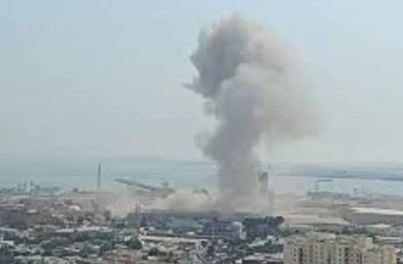
Kuwait City (Web Desk/Agencies): Kuwait International Airport was struck by Iranian drones on Wednesday, leaving parts of the facility damaged and several people injured, according to Kuwaiti authorities.
Following the attack, officials suspended all flight operations and redirected air traffic to other destinations until further notice.
The strike targeted Terminal 1, the airport’s main passenger hub. In a statement, Defence Ministry spokesman Saud Abdulaziz Al-Otaibi said the assault caused extensive damage to the terminal building and resulted in multiple injuries. Those hurt in the incident received medical attention.
He added that Kuwait’s armed forces were working closely with relevant agencies to monitor the situation and remained fully prepared for any further developments.
In response to the attack, Kuwait’s General Directorate of Civil Aviation activated emergency procedures at the airport. Earlier in the day, Iran’s Islamic Revolutionary Guard Corps (IRGC) announced that it had launched attacks against US military positions in Kuwait, describing the operation as retaliation for an American strike on Qeshm Island in southern Iran.
The latest exchange marked another escalation in Gulf tensions. Alongside the airport incident, the US military reportedly carried out operations near the Strait of Hormuz, while efforts to advance diplomatic negotiations between Washington and Tehran appeared stalled.
The renewed violence comes more than three months after the first wave of US and Israeli attacks on Iran. Despite a fragile ceasefire, the conflict remains unresolved, and maritime activity through the Strait of Hormuz continues to face major disruptions. Concerns over the worsening security situation pushed oil prices up by more than one percent.
Kuwaiti state media reported that the airport attack caused serious damage to several facilities and left a number of people injured, though officials did not provide additional details regarding the casualties.
Meanwhile, US Central Command said that two Iranian missiles launched toward Kuwait either failed to reach their target or broke apart during flight. It also reported that several other ballistic missiles aimed at regional locations malfunctioned, while three missiles directed at Bahrain were successfully intercepted.
Since the outbreak of the conflict, Iran has repeatedly targeted sites across the Gulf that host American military assets.
According to Central Command, US forces intercepted Iranian drones that were allegedly aimed at civilian vessels and military positions in Kuwait. The US military also carried out strikes on Qeshm Island after what it described as attempted Iranian attacks.
Iranian state media, however, presented a different account, claiming that the IRGC had launched missile and drone strikes against the headquarters of the US Fifth Fleet in Bahrain as well as an airbase and military helicopters in another country in the region. Tehran said the operation was carried out in response to a US strike on an Iranian communications tower near Qeshm Island.
US military officials insisted that the Iranian attacks failed to achieve their objectives and stated that American forces remained ready to counter any future threats.
Iranian media also reported that the IRGC targeted a vessel identified as “Panaya” with missiles after accusing the US military of attacking an Iranian oil tanker near the Strait of Hormuz. Iranian officials warned that any threat to the security of the crucial waterway would bring serious consequences for the United States.
Although both Iran and the United States announced last week that they had reached a preliminary understanding aimed at ending the conflict, a final agreement has yet to be signed. Iranian reports suggested communication between the two countries had slowed in recent days, while US President Donald Trump maintained that negotiations were still ongoing.
Trump has repeatedly stated that preventing Iran from obtaining nuclear weapons remains a key American objective. Iran continues to reject accusations that it is pursuing a nuclear bomb, insisting that its nuclear programme is intended solely for peaceful purposes.
The conflict, which erupted following US-Israeli strikes on February 28, has resulted in thousands of deaths, particularly in Iran and Lebanon, while also contributing to rising global energy prices and broader economic disruption.
The crisis has further intensified fighting between Israel and Hezbollah. Israel has carried out its deepest military operations inside Lebanon in decades, leading to significant civilian casualties, including women and children.
On Tuesday, Israeli forces continued striking several towns in southern Lebanon despite a US-brokered partial ceasefire announced a day earlier. Lebanese security sources said civilian areas and infrastructure were among the targets.
The ceasefire announcement has done little to ease fears among the population. More than 1.2 million people remain displaced, while reports of Israeli drone activity over Beirut have continued to unsettle residents.
Speaking from a displacement camp, Faten Al Chehime said her family had been forced to flee once again shortly after returning home. She described the repeated evacuation orders as a constant source of uncertainty and fear.
The conflict’s impact has also been felt across international shipping routes. Mediterranean Shipping Company (MSC) reported that one of its vessels was hit by two projectiles while docked at Iraq’s Umm Qasr port earlier this week.
The IRGC said the strike was carried out in retaliation for what it described as a US attack on an Iranian vessel in the Gulf of Oman.
Humanitarian agencies have warned that the ongoing crisis is disrupting vital aid operations. UNICEF said rising transportation costs and supply-chain difficulties are hampering efforts to deliver life-saving assistance to people in Gaza, Lebanon, Somalia, South Sudan, Mali, Nigeria, the Democratic Republic of Congo and several other countries.
Amid growing concerns over regional stability, Iranian Foreign Minister Abbas Araghchi and Saudi Foreign Minister Faisal bin Farhan Al Saud held a telephone conversation on Tuesday.
According to Iran’s Foreign Ministry, the two officials discussed recent diplomatic initiatives and exchanged views on efforts aimed at reducing tensions and promoting stability across West Asia.
Neo News | Copyright © 2026