Fri, September 18, 2026

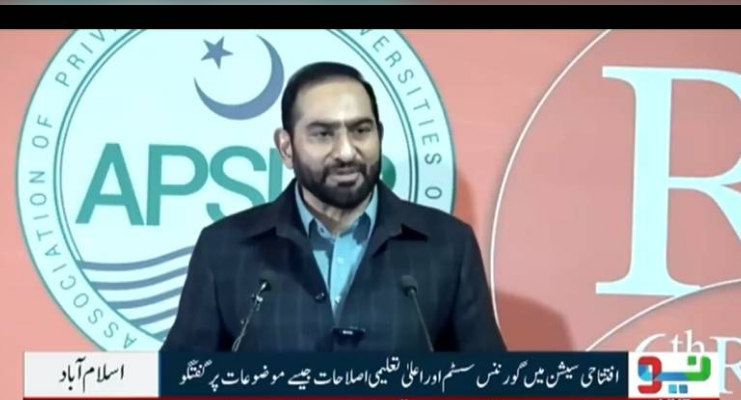
Islamabad (Web Desk): Punjab Group Chairman Mian Amer Mahmood has renewed his call for a comprehensive overhaul of Pakistan’s administrative system, emphasizing that the country’s current governance structure is no longer equipped to manage its growing population.
Speaking at the 6th Rectors’ Conference organized by the Association of Private Sector Universities of Pakistan (APSUP) in Islamabad, he addressed over 150 vice chancellors, academics, and students, urging a rethink of the provincial setup.
The gathering, which focused on leadership, governance, and reform, provided Mahmood a platform to propose a bold idea: expanding Pakistan’s four provinces into 33 smaller, more manageable administrative units.
Mian Amer argued that bringing governance closer to the people is essential for accountability and equitable development.
Highlighting the nation’s struggles in literacy, healthcare, and global development rankings, Mahmood warned that Pakistan consistently falls in the bottom ten percent worldwide—a reflection of structural weaknesses in the existing system.
He pointed out that the current model has failed to distribute development fairly, leaving major cities overwhelmed while much of the provinces remain neglected.
Citing the World Bank’s 2019 report Pakistan at 100, the Punjab Group chairman identified regional inequality as a major barrier to progress.
“Over the past 80 years, only five major cities have seen significant development, prompting large-scale migration. Lahore, for instance, continues to witness informal settlements grow as people from other areas move in search of education, healthcare, and employment,” he said.
Mian Amer further noted that institutions remain weak because individual leaders often accumulate excessive power, and local governments, historically dissolved by incoming provincial administrations, have failed to provide oversight.
To address these challenges, he suggested converting each administrative division into a province. Under this plan, Punjab’s 10 divisions, Sindh’s 7, Khyber Pakhtunkhwa’s (KP) 7, and Balochistan’s 6 would become autonomous provinces.
The Punjab Group chairman argued that smaller provinces would allow for more responsive governance, balanced development, and a pipeline of leadership from Pakistan’s educated middle class.
He dismissed concerns about rising administrative costs, explaining that smaller units actually lower per capita expenditure since departments scale according to population and area.
The Punjab Group chairman asserted that a functional province would need only 16 core departments, compared to more than 40 in some current provincial structures.
Mian Amer illustrated the urgency for reform with population data. He said that n 1951, Punjab had 20 million people, Sindh 6 million, KP 5.8 million, and Balochistan 1.1 million.
Today, Pakistan’s population nears 250 million, with Punjab reaching 130 million, Sindh 55.69 million, KP 40.85 million, and Balochistan 14.8 million.
Punjab now has a population larger than all but twelve countries, Sindh surpasses all but 31, and only 41 nations are more populous than KP, while Balochistan has more land than 172 countries.
Mahmood compared Pakistan’s provincial size with other countries, noting that China has 31 provinces, India has grown from 9 to 39 states, the United States (US) has 50, Indonesia 34, Nigeria 27, and Russia, with a similar population to Pakistan, manages 46 provinces, 22 republics, and nine territories.
He argued that Pakistan’s current provincial structure, designed for the 1950s, cannot effectively govern a population of this scale, and new provinces would help resolve long-standing grievances regarding resources, representation, and regional justice.
The Punjab Group chairman concluded by urging universities to create forums focused on governance and involve students in discussions on leadership and reform, highlighting the role of education in shaping Pakistan’s future administrators.
Neo News | Copyright © 2026