Fri, September 18, 2026

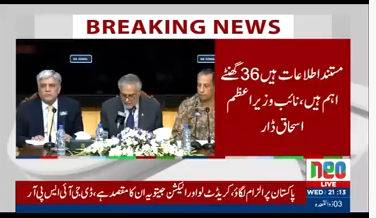
Islamabad (Web Desk/Agencies): Pakistan on Wednesday reiterating not to initiate, warned India of a strong response if it made any escalatory move as its armed forces of Pakistan are on alert to defend the country’s sovereignty and territorial integrity in case of any act of aggression.
“The world leaders have been requesting the exercise of restraint in recent days. I have made it very clear, on behalf of the government and the nation, that Pakistan will not be the first one to resort to any escalatory move. However, in case of any escalatory move by the Indian side, we will respond very strongly,” said Deputy Prime Minister and Foreign Minister Senator Mohammed Ishaq Dar while addressing a news conference in Islamabad alongside Inter-Services Public Relations (ISPR) Director General Lt. General Ahmed Sharif Chaudhry and Foreign Office (FO) Spokesperson Shafqat Ali Khan.
Brushing aside the Indian allegations against Pakistan following the Pahalgam incident without an “iota of evidence and with such dramatic speed,” he said Pakistan had nothing to do with it.
“We demand an independent and transparent probe by neutral investigators, as announced by Prime Minister Shehbaz Sharif. Any TORs in this regard should be credible and mutually agreed upon.
“Pakistan has neither any connection … nor is the potential beneficiary. At a time when the economy is stabilising and we are making significant progress against terrorism, we need to question why this situation is being created by India all of a sudden and what is the motivation behind it.”
He said holding in abeyance the Indus Waters Treaty by India was unilateral and illegal as the Treaty contained no such provisions and any amendment or termination required consensus.
In case of disagreements or issues, there are forums provided in the treaty which should be invoked,” he added.
“Pakistan is an agrarian economy, millions of people are dependent on the waters being regulated by this treaty. We gave up three rivers in this treaty and I can hardly find a water distribution treaty in the world whereby, a part of dealing with the distribution of water, the rivers could have also been given up.”
Dar said the National Security Committee had made it “very clear” that any attempt to stop or divert the flow of water belonging to Pakistan, as per the IWT and the usurpation of the rights of the lower riparian, would be considered an “act of war”.
The deputy prime minister said the entire region was facing a serious threat to its peace and stability as a politically motivated and highly provocative environment was being created by India in the wake of the Pahalgam attack in the Indian Illegally Occupied Jammu and Kashmir (IIOJK).
Expressing Pakistan’s concerns on the highly irresponsible and destabilized Indian actions and statements, Ishaq Dar said that “Indian media and political leaders are directing a similar discourse against Pakistan”.
Ishaq Dar warned that India’s highly irresponsible ploy for narrow objective gains was dragging the entire region towards extreme instability.
He said no cause or objective can justify taking the lives of innocent people. “This is our national policy and this is the Islamic policy too. Killing of the human being as per Quran is killing of the entire humanity and saving a life is tantamount to saving the entire humanity,” he added.
Dar said Pakistan, being a victim of terrorism itself, was concerned over the loss of lives in Pahalgam attack, and it also extended condolences being victims of terrorism as no one can feel the pain of those impacted but Pakistan.
In Pakistan, he said more than 80,000 lives had been sacrificed and over US$150 billion had been lost while the overall economic impact and indirect losses were close to $500 billion.
He said the countless sacrifices made by our valiant law enforcement agencies as well as common citizens, have helped address the threat of terrorism and contributed towards regional and international peace and stability.
The deputy PM informed that he had contacted dozens of foreign ministers and other high leaders of various countries to explain to them the recent situation in the region.
He highlighted that India’s illegal and unilateral action of August 5, 2019 reminded of the violation of the relevant UN SC resolutions and the fourth Geneva Convention as well as India’s own commitments.
Replying to a question, the deputy prime minister said PM Shehbaz Sharif was leading from the front, as he had been in touch with the relevant departments and authorities with regard to the current situation. He said Prime Minister Shehbaz Sharif also chaired the national security committee.
“He (PM Shehbaz Sharif) is leading from the front, and the military and civil leadership have been working day and night under his leadership,” Ishaq Dar said.
To another query, the deputy PM said the government and the stakeholders decided to re-engage Afghanistan, so he visited Afghanistan, which remained absolutely successful from the political point of view, from economic and trade point of view, and from refugees’ point of view.
He said during his call with the Chinese Foreign Minister, the Chinese FM supported Pakistan’s stance and offered an independent investigation.
Responding to another question, the deputy prime minister stressed that both countries being nuclear power needed to avoid any escalatory move that can lead to a direction that would be unsustainable not only between the two countries but also the entire region. “It is a combined responsibility of friends and the regional actors to make sure that India does not make this mistake,” he added.
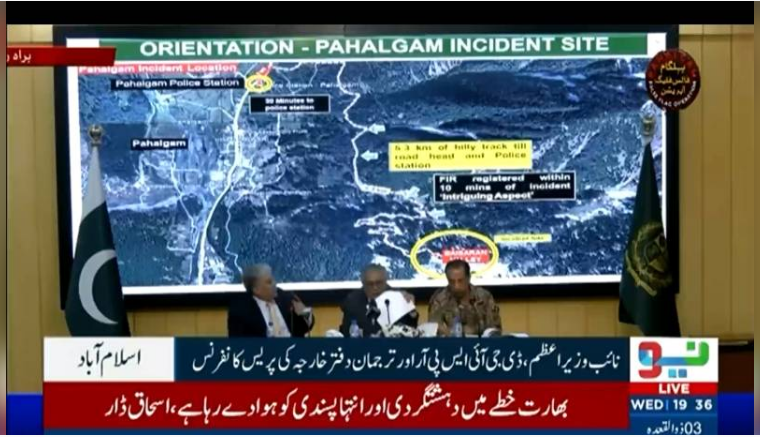
Addressing the presser, spokesperson for the Ministry of Foreign Affairs Shafqat Ali Khan briefed the media persons about the details of the Pahalgam and raised questions over the occurrence of the incident and the registration of the FIR.
He said about 26 people died and several were injured in the incident, but neither any arrest of suspects was made nor any evidence was shared. The place is located at a distance of 230 km from the Line of Control.
"The Indians using different social media platforms showed the same pattern of accusing Pakistan without any evidence and that within a short period of time," he said, adding the place of occurrence was located in the difficult terrains but after 10 minutes, FIRs was filed, which raised certain serious questions.
The deputy prime minister said the entire region was facing a serious threat to its peace and stability as a politically motivated and highly provocative environment was being created by India in the wake of the Pahalgam attack in the Indian Illegally Occupied Jammu and Kashmir (IIOJK).
Expressing Pakistan’s concerns on the highly irresponsible and destabilized Indian actions and statements, Ishaq Dar said, “Indian media and political leaders are directing a similar discourse against Pakistan”.
Ishaq Dar warned that India’s highly irresponsible ploy for narrow objective gains was dragging the entire region towards extreme instability.
He said no cause or objective can justify taking the lives of innocent people. “This is our national policy and this is the Islamic policy too. Killing of the human being as per the Quran is killing of the entire humanity and saving a life is tantamount to saving the entire humanity,” he added.
The deputy PM said Pakistan, being a victim of terrorism itself, was concerned over the loss of lives in Pahalgam attack, and it also extended condolences being victims of terrorism as no one can feel the pain of those impacted but Pakistan.
In Pakistan, he said more than 80,000 lives had been sacrificed and over US$150 billion had been lost while the overall economic impact and indirect losses were close to $500 billion.
He said the countless sacrifices made by our valiant law enforcement agencies as well as common citizens, have helped address the threat of terrorism and contributed towards regional and international peace and stability.
The deputy PM informed that he had contacted dozens of foreign ministers and other high leaders of various countries to explain to them the recent situation in the region.
He highlighted that India’s illegal and unilateral action of August 5, 2019 reminded of the violation of the relevant UNSC resolutions and the fourth Geneva Convention as well as India’s own commitments.
Replying to a question, the deputy prime minister said PM Shehbaz Sharif was leading from the front, as he had been in touch with the relevant departments and authorities with regard to the current situation. He said Prime Minister Shehbaz Sharif also chaired the national security committee.
“He (PM Shehbaz Sharif) is leading from the front, and the military and civil leadership have been working day and night under his leadership,” Ishaq Dar said.
To another query, the deputy PM said the government and the stakeholders decided to re-engage Afghanistan, so he visited Afghanistan, which remained absolutely successful from the political point of view, from economic and trade point of view, and from refugees’ point of view.
He said during his call with the Chinese Foreign Minister, the Chinese FM supported Pakistan’s stance and offered an independent investigation.
Responding to another question, the deputy prime minister stressed that both countries being nuclear power needed to avoid any escalatory move that can lead to a direction that would be unsustainable not only between the two countries but also the entire region. “It is a combined responsibility of friends and the regional actors to make sure that India does not make this mistake,” he added.
Addressing the presser, spokesperson for the Ministry of Foreign Affairs Shafqat Ali Khan briefed the media persons about the details of the Pahalgam and raised questions over the occurrence of the incident and the registration of the FIR.
He said about 26 people died and several were injured in the incident, but neither any arrest of suspects was made nor any evidence was shared. The place is located at a distance of 230 km from the Line of Control (LoC).
The Indians using different social media platforms showed the same pattern of accusing Pakistan without any evidence and that within a short period of time, he said, adding the place of occurrence was located in the difficult terrains but after 10 minutes, FIRs were filed, which raised certain serious questions.
The press conference comes amid rapidly escalating tensions between Pakistan and India following a deadly attack in the Pahalgam area of Indian Illegally Occupied Jammu and Kashmir (IIOJK) on April 22, where at least 26 Hindu tourists were killed in the scenic resort town, triggering a serious deterioration in relations between the two nuclear-armed neighbors.
In the aftermath of the attack, New Delhi promptly blamed Islamabad for orchestrating the assault, although it provided no evidence to substantiate the claim.
India responded by enacting a series of aggressive diplomatic and administrative measures aimed at downgrading bilateral relations.
These actions included suspending the Indus Waters Treaty, revoking the visas of Pakistani nationals, and closing the key Wagah-Attari border crossing. Pakistan strongly denied any involvement in the attack and dismissed India's accusations as baseless.
Islamabad also expressed its willingness to participate in a credible and transparent international investigation to determine the true perpetrators behind the incident.
As tensions continued to rise, Pakistan retaliated with diplomatic measures of its own. The government ordered the expulsion of Indian diplomats and military advisers stationed in the country, cancelled visas issued to Indian citizens—with the exception of Sikh pilgrims—and shut down the main border crossing from its side.
Pakistan's Defence Minister Khawaja Asif issued a stark warning that the situation could deteriorate further and possibly spiral into an "all-out war" if cooler heads do not prevail.
In response to the unfolding crisis, the United Nations (UN) urged both countries to exercise "maximum restraint" to prevent further escalation and avoid a potentially catastrophic conflict.
Meanwhile, Pakistan's Minister for Information and Broadcasting, Attaullah Tarar, issued a grave warning late Tuesday, stating that the country has received credible intelligence indicating that India is planning to carry out a military strike within the next 24 to 36 hours.
According to Tarar, the Indian government may use the Pahalgam incident as a pretext for aggressive military action based on "baseless and concocted allegations" against Pakistan. He emphasized that Pakistan's security forces are on high alert and prepared to respond to any act of aggression.
The rising military tensions were further underscored by the Pakistan Army's interception and destruction of two Indian surveillance quadcopter drones near the Line of Control (LoC) in Azad Jammu and Kashmir a day prior.
Neo News | Copyright © 2026