Fri, September 18, 2026

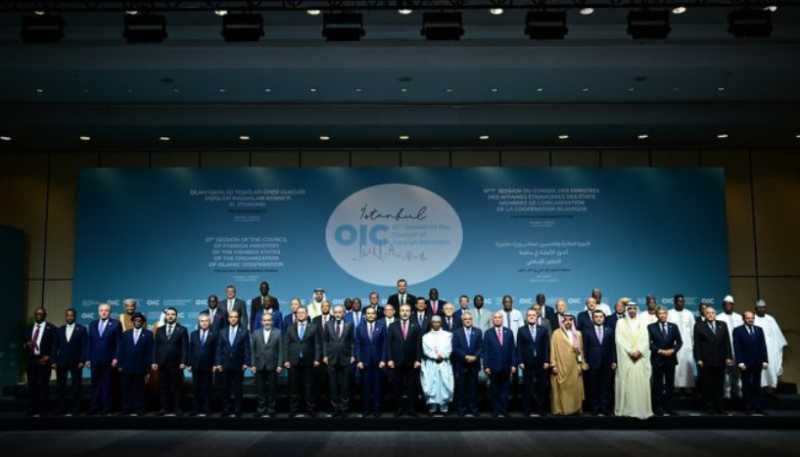
Istanbul (Web Desk/Agencies): Foreign ministers of the Organization of Islamic Cooperation (OIC) convened in Istanbul on June 21–22, 2025, for the 51st Session of the Council of Foreign Ministers under the theme “The OIC in a Transforming World.” The session concluded with the adoption of the Istanbul Declaration, which denounced Israel's aggressive actions in the region, including recent attacks on Iran, Syria, and Lebanon.
The ministers described these actions as blatant violations of national sovereignty and international law.
The gathering demanded an immediate halt to hostilities against Iran and emphasized the urgency of reducing tensions.
In this regard, the ministers announced the formation of an open-ended Ministerial Contact Group to maintain dialogue with regional and international stakeholders, support de-escalation efforts, and work toward a peaceful resolution of the conflict.
Concerns were raised over the broader implications of the escalation, including its impact on human security, the environment, and regional stability.
The foreign ministers voiced strong solidarity with Iran and warned of the dangers such hostilities pose to peace in the region.
During the meeting, the ministers also expressed full support for Pakistan and condemned the recent military strikes on various locations in Pakistan and Azad Jammu and Kashmir.
They called for maximum restraint from all parties and emphasized the importance of upholding the ceasefire agreement between Pakistan and India.
The council reaffirmed the necessity of adhering to existing bilateral arrangements, including the Indus Waters Treaty, and highlighted the importance of constructive bilateral dialogue to resolve all outstanding disputes.
The declaration reaffirmed the OIC's unwavering support for the people of Jammu and Kashmir and their legitimate right to self-determination, in accordance with relevant UN and OIC resolutions.
The foreign ministers condemned widespread human rights violations in Indian-administered Jammu and Kashmir and reiterated their concern over the ongoing crisis in the region.
On the issue of Palestine, the council reinforced the central importance of the Palestinian cause for the OIC and restated its full support for the creation of a sovereign, independent, and contiguous Palestinian state based on the 1967 borders, with East Jerusalem as its capital.
It reaffirmed that the two-state solution remains the only path to achieving lasting peace and stability in the region.
The ministers endorsed the call for a United Nations High-Level Conference on the Peaceful Settlement of the Palestine Question and the implementation of the two-state framework, under the joint leadership of Saudi Arabia and France. They urged all UN member states to take part in this initiative.
Grave concern was expressed over what the ministers described as a prolonged Israeli campaign of genocide in the Gaza Strip over the past 19 months, as well as the widespread destruction and violence in the West Bank and East Jerusalem.
The council underscored the need for an immediate, enduring ceasefire and stressed the importance of implementing UN Security Council Resolution 2735. The ministers also backed the Arab-Islamic recovery and reconstruction initiative for Gaza.
The foreign ministers condemned Israel’s use of starvation as a tactic of war by blocking humanitarian assistance and obstructing UN agencies from fulfilling their mandates.
They rejected any attempts at forcibly relocating the Palestinian population and urged the immediate opening of border crossings to allow sufficient humanitarian aid.
The protection of Palestinian civilians was also highlighted as an urgent necessity. The session voiced firm support for the work of the United Nations Relief and Works Agency for Palestine Refugees in the Near East (UNRWA) and rejected any efforts to displace Palestinians or destroy critical infrastructure in Gaza.
The declaration confirmed support for the Arab-Islamic Plan for the reconstruction of Gaza and voiced alarm at Israeli efforts to alter the historical and cultural identity of Jerusalem.
The ministers stressed the need to preserve the city's Arab and Islamic character and protect its status as a symbol of coexistence among the three monotheistic religions.
Participants in the session raised alarms about the growing global phenomenon of Islamophobia. They called upon the international community to take concrete steps to address hate speech, extremism, religious defamation, and ethnic stigmatization.
The ministers emphasized that no religion, race, or ethnicity should be associated with terrorism or extremism and called for unequivocal condemnation of such acts in all their forms.
The council welcomed progress in peace efforts between Azerbaijan and Armenia, including the conclusion of negotiations on a bilateral peace agreement, and urged Armenia to resolve remaining legal and political issues to finalize the deal.
The ministers also acknowledged the efforts of the Syrian interim government to reintegrate Syria into the global community and encouraged continued political and financial support to ensure the country’s long-term stability.
Further support was extended to the Muslim Turkish Cypriot community and the Turkish Muslim minorities in Western Thrace and the Dodecanese, emphasizing the importance of safeguarding their basic rights and freedoms.
The session concluded with a strong condemnation of ongoing human rights abuses against the Rohingya and other Muslim minorities in Myanmar.
It also criticized policies by Republika Srpska that threaten the sovereignty of Bosnia and Herzegovina and violate the Dayton Peace Agreement.
Neo News | Copyright © 2026