Fri, September 18, 2026

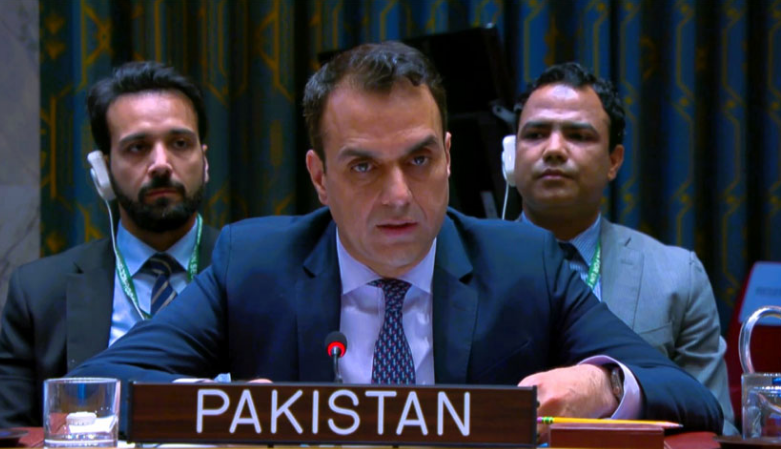
New York (Web Desk/Agencies): At a recent United Nations Security Council (UNSC) session focusing on the developments in Syria, Pakistan emphasized that the country stands at a critical crossroads, urging that national unity and an inclusive security structure are essential to achieving enduring peace.
Pakistan’s Deputy Permanent Representative to the UN, Ambassador Usman Jadoon, cautioned that the re-emergence of unrest in certain regions, particularly along the coast, highlighted the need to confront long-standing grievances and establish a path toward genuine reconciliation.
“The resurgence of violence in some areas, including in the coastal regions, underscores the urgency of addressing historical grievances and fostering genuine reconciliation,” he told the Council on Wednesday.
Speaking during the debate on Syria’s political and humanitarian conditions, Ambassador Jadoon acknowledged recent steps by the United States, European Union, and the United Kingdom to ease sanctions against Damascus, describing the move as a potential catalyst for reconstruction.
He noted that lifting sanctions could pave the way for revitalizing key infrastructure, attracting foreign capital, and reintegrating Syria into regional and international economic systems.
The punitive measures, most of which were enforced during the Assad administration, have been widely criticized for impeding recovery efforts in Syria’s war-ravaged economy.
According to Jadoon, nations such as Saudi Arabia, Turkiye, and Qatar are demonstrating renewed commitment by facilitating financial assistance to cover public sector wages, rehabilitate energy networks, and help Syria meet its obligations to international lenders.
Meanwhile, Syria's interim administration announced the creation of two significant institutions last week: a National Commission for Transitional Justice and another for locating Missing Persons. Ambassador Jadoon expressed cautious optimism about these developments.
“We must also remain vigilant against terrorism, and the presence of foreign terrorist fighters and groups,” he remarked, emphasizing the importance of upholding neutrality and transparency, ideally under the supervision of impartial international actors, including the United Nations.
Despite some institutional progress, he said the broader humanitarian landscape remains dire, with more than 16 million Syrians requiring assistance amid deepening poverty and worsening food insecurity.
He observed that as displaced Syrians gradually return to their communities, the demand for aid will inevitably rise.
“Funding remains insufficient,” Jadoon stressed, urging the global community to provide humanitarian support that is reliable, consistent, and free from political considerations.
He further called for strict adherence to Syria’s sovereignty and territorial boundaries, condemning continued military incursions by Israel as breaches of international norms.
“Israel’s continued military actions are a blatant violation of international law, the UN Charter and the 1974 Disengagement Agreement, [and] threaten regional peace and security,” he asserted. “These violations must end, including in the Golan Heights and Areas of Separation.”
Reflecting on over a decade of suffering endured by the Syrian population, Ambassador Jadoon appealed for global solidarity in helping Syrians reclaim stability.
“This moment demands collective resolve in support of a Syrian-owned and Syrian-led political process grounded in sovereignty, unity and respect for national institutions,” he stated.
He added that successful reconstruction must be anchored in safe, voluntary repatriation of displaced persons, economic renewal, and Syria’s reintegration within the region, in alignment with international law and the founding principles of the UN. “In this effort, Pakistan stands with the Syrian people in their pursuit of peace, prosperity and dignity,” Jadoon concluded.
Opening the debate, UN Special Envoy for Syria Geir Pedersen welcomed the recent easing of sanctions but warned that the nation’s economic fragility—worsened by more than ten years of conflict—remains profound. He argued that recovery will depend on long-term structural reforms, improved governance, and financial oversight, requiring the backing of the international community.
Echoing these concerns, Ramesh Rajasingham, Director of Coordination at the UN Office for the Coordination of Humanitarian Affairs, said that the humanitarian needs are “immense” and growing more complex.
He said that 16.5 million Syrians are in need of assistance and protection, with over half the population facing food insecurity. Alarmingly, nearly three million people are on the brink of severe hunger.
Rajasingham also highlighted that more than 670,000 individuals have been uprooted since November 2024, including 15,000 people recently displaced from rural Damascus due to conflict in areas populated largely by the Druze community.
Neo News | Copyright © 2026