Thu, September 17, 2026

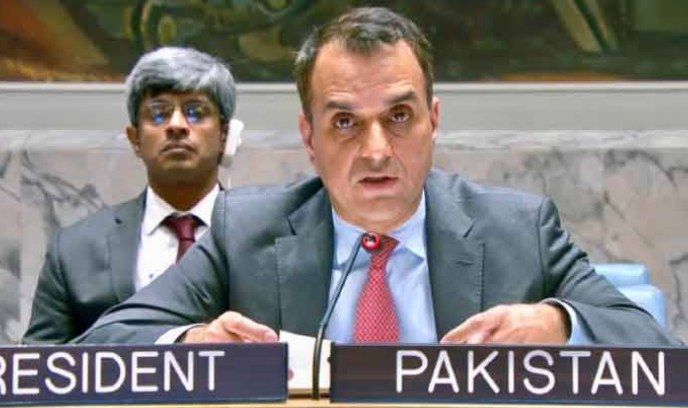
New York (Web Desk): Pakistan has urged the United Nations Security Council (UNSC) to lift economic sanctions on Syria, warning that continued restrictions are hampering the country’s recovery and political transition after more than a decade of devastating conflict.
Speaking at a Council session in New York, Pakistan’s Acting Permanent Representative to the UN, Ambassador Usman Jadoon, said that easing sanctions was vital for Syria’s reconstruction, economic revival, and reintegration into the global community.
He emphasized that while sanctions relief was critical, it must be accompanied by stronger governance reforms to produce meaningful progress on the ground.
Referring to Syria’s recent parliamentary elections for the People’s Assembly, the envoy described the process as a sign of renewed political participation and an effort to rebuild national institutions.
He expressed optimism that areas where polls were delayed due to security threats would soon hold elections to ensure full and inclusive representation.
Jadoon also welcomed the recent understanding between the Syrian Democratic Forces (SDF)—a Kurdish-led coalition of local militias—and the central government to merge SDF fighters into the Syrian army.
He called the move a positive and necessary step toward strengthening state unity and restoring institutional cohesion, urging both sides to ensure its complete and timely implementation.
The ambassador further underlined the need to confront the threat posed by foreign terrorist fighters through political dialogue and security measures, including reforms focused on disarmament, demobilization, and reintegration.
He stressed the importance of extending effective state authority to regions such as Suweidah, Aleppo, and Deir-az-Zour, where instability continues to pose challenges.
Reiterating Pakistan’s support for the people of Syria, Jadoon expressed confidence that with sustained domestic efforts and international cooperation, the country could overcome its hardships and emerge stable and united.
He reaffirmed Pakistan’s commitment to a Syrian-owned and Syrian-led political process that respects the will of its people.
During the same meeting, Najat Rochdi, the UN Secretary-General’s Deputy Special Envoy for Syria, highlighted the enduring sacrifices of Syrian women and their pivotal role in shaping the country’s post-war future. She noted that after years of struggle, women had hoped for relief and equality during the ongoing political transition, yet the early outcomes had not met their expectations.
Commenting on the peaceful indirect elections held on 5 October for the transitional People’s Assembly, Rochdi said that although the UN was not directly involved, it had consistently encouraged transparency and inclusiveness.
She pointed out that the 119 elected members included only one Christian, three Ismailis, three Alawites, four Kurds, and no Druze representatives, urging for more balanced participation across communities.
Rochdi called the impact of 14 years of civil war and decades of authoritarian rule “staggering,” stressing that Syria’s transition required unprecedented levels of international support.
She appealed for a faster and broader lifting of sanctions to help the country move toward sustainable peace and recovery.
Neo News | Copyright © 2026