Fri, September 18, 2026

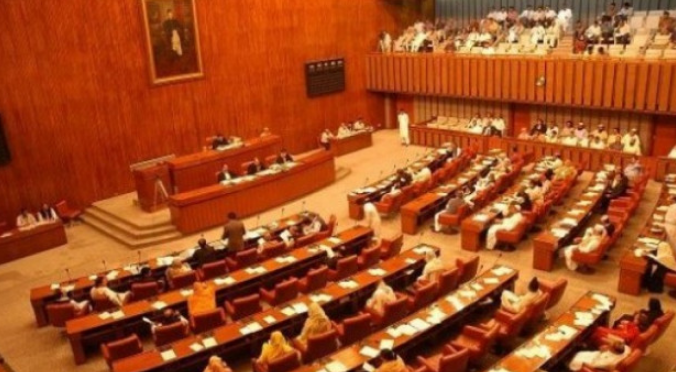
Islamabad (Web Desk): The Senate on Tuesday passed the Anti-terrorism (Amendment) Bill, 2025 amid uproar from the opposition benches.
The bill, aimed at enhancing the government’s capacity to tackle terrorism, was presented by Minister of State for Interior and Narcotics Control, Muhammad Tallal Badar.
It seeks to modify the existing Anti-terrorism Act of 1997 to reintroduce provisions that grant wider powers to law enforcement and security agencies, particularly with regard to the detention of individuals deemed a threat to national security.
Jamiat Ulema-e-Islam-Fazl (JUI-F) Senator Kamran Murtaza proposed several changes to the bill during the session; however, these were voted down by a majority of the House. The bill was then approved through a clause-by-clause reading process.
According to the bill’s rationale, the present security landscape demands stronger legal mechanisms than those currently in place. It emphasizes the necessity of restoring Section 11EEEE to empower both military and civil armed forces with the authority to detain suspects based on reasonable suspicion or credible intelligence.
The provision is designed to enable pre-emptive action to thwart potential terrorist activities. The bill also supports the formation and functioning of Joint Interrogation Teams (JTIs), comprising representatives from different intelligence and law enforcement bodies, to ensure a more coordinated and effective intelligence-gathering approach.
During the debate, Law Minister Azam Nazeer Tarar addressed the concerns raised by various lawmakers, stating that some of the recommendations made earlier by Syed Naveed Qamar had already been included in the final draft.
He assured the House that the legislation had undergone judicial scrutiny and included a sunset clause limiting its enforcement to three years, aligning it with the original intent of the 1973 Constitution.
The law minister further clarified that under Clause 2, any individual detained under the law must be brought before a magistrate within 24 hours.
PTI’s Barrister Syed Ali Zafar expressed his party’s support for counterterrorism efforts but raised objections over certain sections of the bill that he claimed were unconstitutional.
He recommended that the bill be sent to a parliamentary committee for further review. Kamran Murtaza echoed the sentiment, asking for the matter to be referred to a standing committee for at least two or three days to allow more detailed discussion.
Noorul Haq Qadri, also from PTI, suggested that the Council of Islamic Ideology be consulted to ensure the legislation aligns with Islamic principles.
Speaking on the occasion, Senator Irfan-ul-Haque Siddiqui took a firm stance against terrorism and highlighted the national tragedy of losing nearly 100,000 lives to extremist violence.
He stressed that the legislation should not be viewed through a political lens and should not be misused to target political opponents.
He warned against the dangers of allowing militants to act freely and urged lawmakers to support preventive laws that both deter terrorism and curb the misuse of authority that leads to forced disappearances.
In a personal reflection, Siddiqui shared his own experience of imprisonment and expressed empathy for political figures from rival parties who had suffered similar treatment.
Recalling past incidents involving leaders like Fawad Chaudhry and Shah Mehmood Qureshi, he condemned such actions regardless of political affiliations and called for the preservation of human dignity and justice in all circumstances.
Alongside the anti-terrorism legislation, the Senate also passed two other bills without opposition.
The Pakistan Land Port Authority Bill, 2025 was tabled by Muhammad Tallal Badar, while the Petroleum (Amendment) Bill, 2025 was presented by Petroleum Minister Ali Pervaiz Malik. Both bills were passed unanimously by the upper house of Parliament.
Neo News | Copyright © 2026