Thu, September 17, 2026

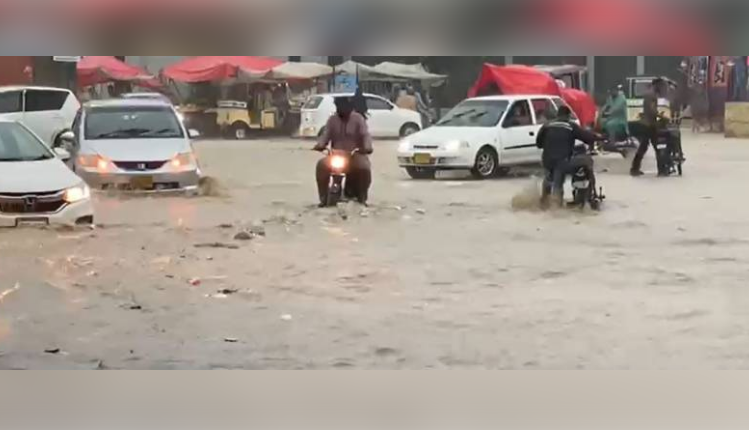
Karachi (Web Desk): At least eight people were killed after Torrential monsoon rains struck Karachi on Tuesday, leading to widespread urban flooding and significant disruption throughout the city.
Key roads such as Sharea Faisal, II Chundrigar Road, Shah Faisal Colony, Model Colony, and areas near the airport were heavily affected by continuous downpours. Several neighborhoods, including Malir Halt, Rafah-e-Aam, Surjani Town, and Korangi, also experienced consistent rainfall, causing traffic congestion and leaving many commuters stranded due to water accumulation, particularly on major arteries like Sharea Faisal and University Road.
According to data released by the Pakistan Meteorological Department (PMD), the most intense rainfall in the city was measured in Gulshan-e-Hadeed at 75 millimetres. University Road followed with 59 millimetres, while Keamari recorded 30 millimetres and Nazimabad 29 millimetres. Other areas saw comparatively less rain, including Saadi Town with 24 millimetres, Sharea Faisal with 17, Korangi with 14.6, the airport with 13, Orangi with 12.2, and Gulshan-e-Maymar with 11 millimetres.
The recent downpour is part of an ongoing monsoon system, with the PMD forecasting more isolated showers in Karachi through August 23. The weather department has highlighted the next two days as particularly crucial for the city and the wider province, warning that additional rainfall may exacerbate urban flooding. A monsoon depression currently over western Odisha is expected to travel towards Gujarat, India, within the next 36 hours, potentially influencing weather patterns in southern Pakistan.
The rain’s impact on infrastructure was stark, as a section of road near Landi Kotal Chowrangi in North Nazimabad collapsed, severely disrupting traffic. Residents expressed frustration over the lack of immediate repair efforts, though local officials stated that higher authorities had been notified and that traffic police were working to establish alternate routes to ease congestion.
In addition to transportation challenges, the rainfall led to power outages in multiple neighborhoods. However, K-Electric assured the public that more than 1,770 of its 2,100 feeders were still supplying electricity. The company clarified that electricity was temporarily suspended in low-lying and hazardous areas as a safety measure. Their field teams, they added, had been fully mobilized and were addressing on-ground issues to restore service promptly.
In anticipation of the ongoing rain, Sindh Chief Minister Syed Murad Ali Shah convened an emergency meeting to review the city’s preparedness. He instructed local authorities, including the city’s administration and traffic police, to remain on high alert.
Karachi Mayor Murtaza Wahab briefed the CM on efforts to tackle drainage issues at 44 identified chokepoints across the city. He reported that around 150 stormwater drains managed by town administrations were currently undergoing cleaning and de-silting to improve water flow and minimize waterlogging.
The Sindh CM stressed the importance of proactive measures to limit disruptions and ensure public safety during the current monsoon spell. He called for strong coordination between departments and emphasized the need to keep infrastructure functional amid the heavy rains.
It is pertinent to mention that Karachi is not alone in facing the monsoon’s wrath. Severe rainfall has affected multiple regions across Pakistan, causing widespread destruction and loss of life.
Nationwide, rain-related incidents have resulted in 660 fatalities so far. Khyber Pakhtunkhwa has suffered the highest number of deaths at 392, followed by Punjab with 164, Gilgit Baltistan with 32, Sindh with 29, Balochistan with 20, Azad Jammu and Kashmir with 15, and Islamabad with eight.
Among the deceased were 394 men, 95 women, and 171 children. The total number of injuries has climbed to 935, with the highest toll again in Punjab, where 582 people were injured. Khyber Pakhtunkhwa followed with 245, while other regions reported lower figures: Sindh (40), Gilgit Baltistan (37), Azad Kashmir (24), Balochistan (4), and Islamabad (3).
Neo News | Copyright © 2026