Thu, September 17, 2026

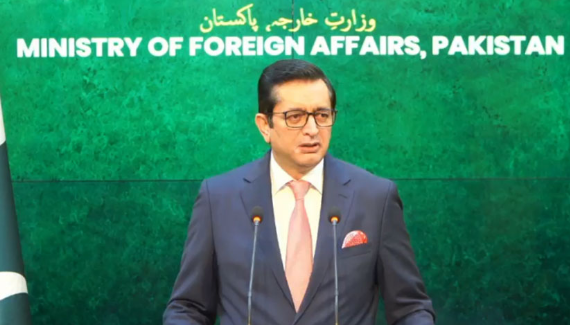
Islamabad (Web Desk): Pakistan on Thursday reiterated its commitment in ‘intent and spirit’ to implement Strategic Mutual Defence Agreement (SMDA) as well as the Makkah Joint Defence Agreement.
Foreign Office (FO) Spokesperson Sajjad Haider Khan made the remarks during his weekly media briefing.
His comments came as tensions in the Middle East intensified following a series of attacks by Yemen’s Houthi rebels in Saudi Arabia.
On Wednesday, a Saudi-led coalition engaged in fighting the Houthis accused the group of attempting to target the holy city of Makkah. The allegation triggered strong reactions across the Muslim world and added to the growing tensions in the region. The Houthis, however, rejected the Saudi claim, describing it as a “lie”, and denied that a drone launched by the group had been intercepted while heading towards Makkah.
When questioned about whether “any mechanism had been devised as to how Pakistan will ensure that recent Houthi attacks in Saudi Arabia are thwarted,” the spokesperson said Pakistan remained committed to “implementing” the SDMA and the Makkah pact.
“However, when, how, where and what force will be used against what objectives, in which modes and matters [..] — operational confidentiality requires us to be discreet at this stage,” he added.
Responding to a question about Pakistan’s diplomatic initiatives aimed at “de-escalate and defuse” the situation involving the Houthis, Khan said, “Pakistan has for a long time [..] shared the perspective that we would like to have peace and stability because this is not only in the interest of Pakistan and Iran, but also the entire region and beyond.”
Describing developments around Bab al-Mandeb as “exceptionally serious”, Khan urged the Houthis to “stop their activities”.
“In this regard, our discussions basically revolve around bringing peace and stability through dialogue and diplomacy and not through coercive measures,” he added.
During the briefing, the FO spokesperson also announced that Prime Minister Shehbaz Sharif would head Pakistan’s delegation to the 81st session of the United Nations General Assembly (UNGA) in New York next week.
According to Khan, Deputy Prime Minister and Foreign Minister Ishaq Dar, along with a number of federal ministers, will accompany the prime minister.
The Foreign Office said PM Shehbaz, during his UNGA speech, would “highlight Pakistan’s perspective on regional and global developments, reaffirming the importance of dialogue, diplomacy and restraint and peaceful resolution of issues”.
The prime minister is also expected to present Pakistan’s position on sustainable development, climate change, counter-terrorism, Islamophobia, international economic challenges, reforms at the United Nations and matters affecting the Global South.
Khan said PM Shehbaz would also raise the issues of India-occupied Kashmir and Palestine.
Alongside the UNGA proceedings, the premier is scheduled to attend several high-level meetings and hold bilateral discussions with foreign leaders and the UN secretary general.
During these engagements, he will stress “Pakistan’s commitment to multilateralism, the UN Charter, regional peace and international cooperation”.
The spokesperson was also questioned about reports concerning Pakistani Sikh pilgrims who were stopped at Faisalabad International Airport while attempting to travel to India for religious observances at Gurdwara Sri Hemkund Sahib.
Khan described the reports as a “malicious media campaign” by India and said, “It was reported that the pilgrims were not allowed to board the plane, which is not correct.
“We were not aware that the Indian High Commission had issued these visas, and the visas were not covered under the 1974 bilateral protocol that exists between Pakistan and India,” he explained, adding that the agreement was designed to facilitate religious visits to shrines in the two countries.
According to Khan, the visas had been granted “independently of any coordination”.
Referring to India’s “exceptionally restrictive visa regime,” he said Pakistan continued to remain committed to “extending a warm welcome to Sikh pilgrims in Pakistan, including from India”.
He also pointed to the number of visas granted to Sikh pilgrims for different religious occasions, saying the “numbers speak for themselves”.
Khan further said Indian Sikh pilgrims had been prevented by their own country from travelling to Pakistan in 2025. He added that Pakistan remained prepared to receive Sikh pilgrims through the Kartarpur corridor “as and when India allows them because it has been closed from the Indian side and not Pakistan”.
The FO spokesperson was subsequently asked about India’s presence at the 12th meeting of the Heads of Border Services of the Competent Authorities of the Shanghai Cooperation Organisation (SCO).
Khan confirmed that India’s chargé d’affaires had attended the meeting.
“Participation is there, and we hope that participation will continue because the broader objective is peace and security and fighting terrorism, and it is a common challenge for both countries.”
Asked about India’s reaction to Pakistan and China putting into operation a joint mechanism to manage their shared border, the spokesperson dismissed India’s “baseless and illegally untenable assertions” concerning the arrangement and the Joint Boundary Demarcation Commission.
The commission was created under the Sino-Pakistan Boundary Agreement signed on March 2, 1963.
“China is not only our neighbour but an all-weather strategic corporate partner. Our ironclad ties have withstood the test of time,” Khan said.
He maintained that the 1963 agreement remained “valid” and said it was a “mockery of international law that India spoke of legality in an attempt to challenge the validity of the border commission”.
Khan said India should first “carry out its own introspection” regarding its actions in India-occupied Kashmir “instead of advancing fictitious territorial claims”.
Neo News | Copyright © 2026