Wed, September 16, 2026

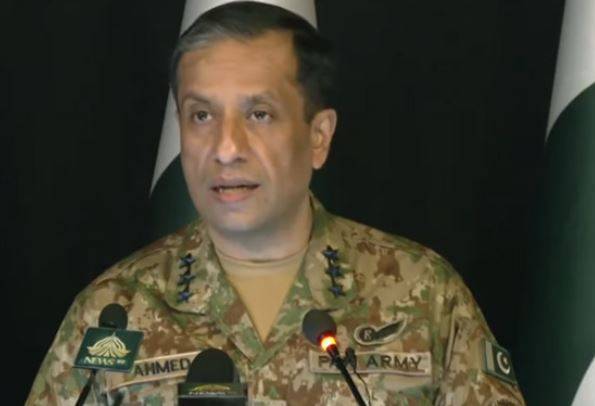
Rawalpindi (Web Desk): Director-General of Inter-Services Public Relations (ISPR), Lt Gen Ahmed Sharif Chaudhry, has characterised the Makkah Joint Defence Agreement among Pakistan, Saudi Arabia and Turkiye as a purely defensive arrangement, stressing that the agreement carries no “regional aspirations”.
“It is defensive, as the word also implies. There's nothing aggressive. There are no regional aspirations. It is a collective deterrence,” the military's spokesperson said in an interview with Al-Arabiya English on Wednesday.
The trilateral Makkah agreement, signed by Pakistan, Saudi Arabia and Turkiye on August 7, aims to enhance cooperation between the three countries in the areas of collective security and defence.
Questions regarding how the agreement could be activated emerged after Yemen’s Houthis launched attacks targeting Saudi cities and energy infrastructure, adding another potential front to the ongoing conflict in the Middle East.
The ISPR chief described the agreement as “complementary”, explaining that the three participating countries maintain their own separate ties with various alliances, nations and international blocs.
"So this mutual defence agreement is complementary in nature. It is not competing with any other relationship of all these countries with each other,” he explained.
Asked what Pakistan’s response would be if one of the agreement’s members faced an attack, Lt Gen Chaudhry said the specific operational arrangements remain classified and are not disclosed publicly.
“You see, you have multiple other agreements which are defensive in nature and committal in nature. But if you see, no country comes out and starts sharing its operational details in any military, because what you're asking is the ‘how part’ of how we are going to defend Pakistan against any aggression. I think that is always part of the operational classification and security.
“So no country does that. So even so, what you're asking is how it will be done. It is for the three countries to decide, and it is for them to know and for them to actualise it.”
Turning to the May 2025 confrontation with India, the ISPR director-general said Pakistan’s response demonstrated the dangers of military confrontation between two nuclear-armed neighbours and stressed that such a conflict should not occur.
“[…] what a strategic folly India made that was the lesson that we taught in each domain, whether it was in the air, ground, cyber, sea… whether it was in informational [or] it was in the diplomatic domain. So yes, a good lesson was taught to India.”
Lt Gen Chaudhry also accused India of attempting to treat external matters as internal issues, particularly in relation to Kashmir.
The ISPR DG India has a problem of internalisation of external issues. “For example, Kashmir is an external problem, an established agenda on this in the United Nations Security Council, and they want to internalise it again through repression,” he added.
According to Lt Gen Chaudhry, Pakistan has consistently conveyed that it seeks peaceful relations based on equality and described the country as a rational and objective actor in the region.
Pakistan believes in peace on equal terms; Pakistan is a very rational and objective player, a very rational and objective actor who believes in regional peace.”
At the same time, the senior military spokesperson cautioned India against taking any military action, saying Pakistan would take steps necessary to protect its security and territorial integrity.
“We had very emphatically shown to Indians and the world at large during Marka-e-Haq that we have the capability, resolve and the will of the people to dominate to control the escalation…”.
He further warned that any attempt by India to launch a “false flag operation, build up a narrative and try to force it” could result in severe consequences.
On the question of what safeguards could stop a Pakistan-India conflict from escalating into a nuclear confrontation, the ISPR chief said Pakistan’s military capability and determination serve as the “biggest guarantee”, arguing that any such move by India could lead to mutually assured destruction.
He also said Pakistan’s political leadership displayed a rational approach during the May conflict, contrasting it with what he described as India’s decision to pursue military action under “strategic folly and hubris”.
“So what we did, we went to notch up plus responses everywhere, and then it was them who could not even sustain Pakistan's conventional military response for a few hours.”
The confrontation began on May 6-7 last year when India launched military action against Pakistan, following an attack on tourists in Pahalgam, a town in Indian Illegally Occupied Jammu and Kashmir.
During the 87-hour hostilities, Pakistan said it shot down eight Indian fighter aircraft, including French-made Rafale jets, along with dozens of drones.
The conflict between the two nuclear-armed neighbours concluded on May 10 after a ceasefire was reached through US mediation.
Neo News | Copyright © 2026