Thu, September 17, 2026

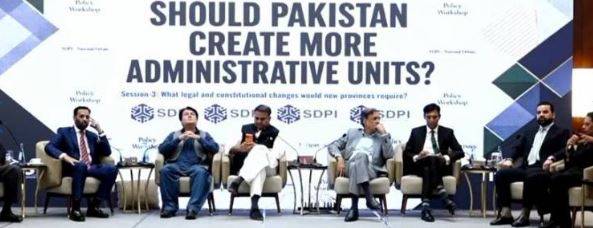
Islamabad (Web Desk): The Sustainable Development Policy Institute (SDPI) organised a national-level debate in Islamabad titled “Should New Administrative Units Be Created in Pakistan?”, bringing together political leaders from various parties, experts and former federal ministers to discuss the country’s administrative structure and governance challenges.
Participants at the debate stressed that administrative reforms and the devolution of authority to the grassroots level were essential for improving governance, ensuring a fair distribution of resources and addressing public grievances effectively.
Speakers largely supported the idea of creating new administrative units based on population and administrative needs. They also emphasised that lasting solutions to public problems would remain difficult without a strong, empowered and financially capable local government system.
MQM leader and Federal Minister Mustafa Kamal said the existing system was failing to deliver effectively, leaving citizens frustrated over unresolved issues.
He argued that Pakistan should consider creating new administrative units and ensure that resources transferred from the federal government to the provinces also reach the grassroots level.
PPP leader Qamar Zaman Kaira described the renewed debate on the creation of new provinces as a positive development.
He said Pakistan faced several challenges related to the distribution of powers and stressed that weaknesses in the local government system needed to be addressed. He called for constitutional protection and greater authority for local governments.
Kaira maintained that any discussion on establishing new provinces should remain within the constitutional and legal framework. He said if the existing provincial structure was unable to function effectively, proposals ranging from 10 to 20 provinces could be considered.
However, he cautioned that any restructuring should be carefully planned to prevent the emergence of new administrative and political problems.
Former federal minister Fawad Chaudhry said meaningful solutions to public issues could only be achieved by transferring powers to the lower levels of government. He argued that political and administrative transformation required the creation of new provinces.
Barrister Saif also supported the need for new provinces and broader administrative reforms. He proposed the formation of a national commission to examine the required reforms and stressed that local governments must be empowered to ensure effective devolution of authority.
He noted that establishing new provinces would require amendments to several provisions of the Constitution.
Mian Amer Mahmood described local government as an effective system but said Pakistan had rarely witnessed a genuinely empowered and functional local government structure during democratic periods.
He said access to good governance was a fundamental right of citizens and argued that creating new provinces could potentially improve governance and generate savings rather than necessarily increasing administrative expenditure.
Former federal minister Asad Umar said excessive centralisation would weaken the country, while empowering citizens and strengthening institutions at the grassroots level would make Pakistan stronger.
Other speakers, including Nadeem Afzal Chan, Liaquat Baloch, Noor-ul-Haq Qadri, Salman Akram Raja, Dr Farukh, Muhammad Ali Durrani and several others, also shared their views during the discussion.
The participants broadly agreed that improving Pakistan’s administrative framework, ensuring equitable distribution of resources and transferring greater authority to local communities were crucial for strengthening governance, resolving public grievances and supporting the country’s long-term development.
Neo News | Copyright © 2026