Thu, September 17, 2026

Islamabad (Web Desk): Pakistan has renewed its appeal for all sides to show maximum restraint and avoid any actions that could further threaten regional peace and stability as tensions between the United States (US) and Iran escalate once again.
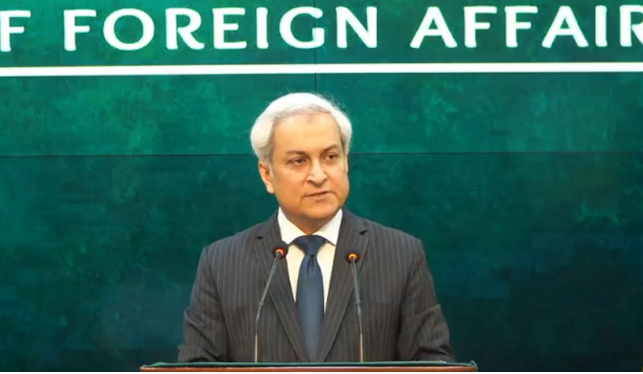
Speaking at weekly media briefing in Islamabad on Thursday, Foreign Office (FO) Spokesperson Tahir Andrabi rejected the impression that it had scaled back its role in promoting regional peace, insisting that the Islamabad Memorandum of Understanding (MoU) continues to be a credible and lasting framework for encouraging dialogue, mutual respect, and shared prosperity despite the renewed confrontation between Iran and the United States.
“Admittedly, the mediation process is currently facing severe challenges because the logic of escalation is prevailing. However, we hope that this logic of escalation will eventually be overcome by the rationality for peace and dialogue. A peace process never dies; it may be placed on the back burner temporarily, but it remains viable,” the FO spokesperson said.
He added that when all sides eventually recognize that continued escalation has reached its limits, the Islamabad MoU, together with the roadmap contained in the Pakistan-Qatar Joint Statement issued on June 22, 2026, would remain available as a foundation for restoring peace.
Reaffirming Pakistan’s serious concern over the worsening regional situation, Andrabi said Islamabad continued to remain engaged with international partners at the highest diplomatic level to encourage dialogue, reduce tensions, and promote peaceful solutions to conflicts.
He also pointed to the negative impact of instability in the Strait of Hormuz on global energy supplies and economic stability, especially for developing countries, and called for the early restoration of normal conditions and uninterrupted maritime navigation.
The spokesperson informed reporters that Pakistan’s diplomatic outreach had included Prime Minister Shehbaz Sharif’s telephone conversations with the Amir of Qatar, Sheikh Tamim bin Hamad Al Thani, to express solidarity after the recent attacks on Qatar. The prime minister also spoke with Iranian President Dr. Masoud Pezeshkian, urging restraint to preserve the progress achieved through recent peace efforts while discussing follow-up measures related to the Iranian president’s recent visit to Pakistan.
Answering a question about the release and possible deportation of Rochdale grooming gang leader Shabbir Ahmed from the United Kingdom, Andrabi strongly denounced child sexual abuse but maintained that the matter was entirely an internal issue for Britain. He noted that the individual was a British citizen who had spent his life in the UK and had been convicted by a British court.
“The onus lies on the society where he grew up, was raised, groomed, and unfortunately, spoiled,” the spokesperson said.
“Government of Pakistan has no connection whatsoever with this matter. We cannot be associated with any decisions relating to the individual’s release or subsequent treatment under British law.”
Responding to another query, Andrabi dismissed the Indian National Investigation Agency’s recently submitted charge sheet against senior Hurriyat leaders in connection with a 1996 case, describing it as a politically driven move intended to undermine the Kashmiri people's struggle for self-determination.
Replying to a question regarding a Financial Times report on the security of Chinese companies operating in Balochistan, the spokesperson said Pakistan and China remained in constant communication and emphasized that Islamabad was fully committed to providing comprehensive security to Chinese engineers, technicians, workers, and other personnel working in the country.
He also reiterated Pakistan’s unwavering support for the sovereignty and territorial integrity of Saudi Arabia, saying the country was fully prepared to honour every bilateral commitment, including the Mutual Strategic Defense Agreement signed in September 2025.
Speaking about ongoing trade negotiations with the US, Andrabi, who was also part of Pakistan’s delegation, said both sides had achieved meaningful progress during reciprocal trade discussions held in Washington with the US Trade Representative and the US Commerce Department, with the objective of expanding and diversifying Pakistan’s exports.
On Afghanistan, the spokesperson said Pakistan had facilitated the movement of around 45 to 50 United Nations aid trucks through the Torkham border crossing and had also assisted stranded Pakistani students in returning home.
He added, however, that relations would not significantly improve unless the Afghan interim authorities provided verifiable written assurances that Afghan territory would not be used to launch or support terrorist attacks against Pakistan.
The spokesperson also rejected reports suggesting Pakistan had blocked Afghanistan’s inclusion in the Shanghai Cooperation Organisation, explaining that full membership naturally required formal diplomatic relations with existing SCO member states.
Commenting on Indian media coverage of attacks in Balochistan, Andrabi accused sections of the Indian media of openly celebrating terrorism inside Pakistan while also making baseless allegations regarding secret US support in Afghanistan.
Replying to a question about the Japan-India joint statement that referred to cross-border terrorism allegedly originating from Pakistan, the spokesperson said Islamabad had lodged a strong diplomatic protest with Tokyo.
“Pakistan and Japan share long-standing, cordial, and multi-faceted relations built on a mutual commitment to international peace and development. During bilateral engagements with India, the Indian side routinely exerts pressure to force the inclusion of such malicious, one-sided formulations in joint statements—a tactic they employ with several other countries as well.”
He added that Japan had been informed that such wording failed to reflect realities on the ground and overlooked Pakistan’s unparalleled sacrifices and contributions in the global fight against terrorism.
Turning to international media reports regarding an alleged safety leak at India’s largest nuclear reactor, Andrabi said such reports were unsurprising because Pakistan had repeatedly raised concerns over India’s nuclear safety standards and non-proliferation record, particularly in light of repeated incidents involving illicit nuclear material appearing on the Indian black market.
Responding to another question, he said the government was actively working through bilateral, multilateral, and inter-agency channels to secure the release of Pakistani citizens being held hostage by Somali pirates in Puntland, although the operation remained challenging because of logistical and operational constraints.
He further informed the media that Pakistan had submitted its seventh National Report on the implementation of United Nations Security Council Resolution 1540 to the United Nations on June 30, showcasing the country's strong legal framework, physical protection measures, and export control system as a responsible nuclear-weapon state.
Highlighting other diplomatic activities, Andrabi said Prime Minister Shehbaz Sharif, accompanied by former Prime Minister Nawaz Sharif and Deputy Prime Minister Ishaq Dar, travelled to Doha on July 13 to offer condolences following the passing of the former Amir of Qatar, Sheikh Hamad bin Khalifa Al Thani.
He also noted that President Asif Ali Zardari had paid an official visit to the Kyrgyz Republic, marking the first trip by a Pakistani head of state to the country in 21 years.
The spokesperson added that Deputy Prime Minister Ishaq Dar was on a two-day visit to China, where he would sign, on Pakistan’s behalf, the instrument establishing the Chinese-led World Artificial Intelligence Cooperation Organization (WAICO).
Neo News | Copyright © 2026