Fri, September 18, 2026

Washington / Tehran (Web Desk/Agencies): The United States (US) and Iran have reached a preliminary understanding aimed at ending the conflict between them, removing the US blockade on Iran and restoring shipping through the Strait of Hormuz.
The announcement immediately eased concerns in energy markets, causing oil prices to fall, although negotiations over Iran’s nuclear program are still to come.
US President Donald Trump announced the breakthrough on Truth Social on Sunday evening, writing, "The Deal with the Islamic Republic of Iran is now complete." His statement came shortly after Pakistan Prime Minister Shehbaz Sharif, whose country helped mediate the talks, confirmed that an agreement had been achieved.
The memorandum of understanding is expected to be formally signed in Switzerland on Friday.
Although full details were not immediately released, Sharif said the agreement provides for "the immediate and permanent termination of military operations on all fronts, including in Lebanon."
Following intensive talks, we are pleased to announce that the Peace Deal between the United States of America and Islamic Republic of Iran has been REACHED. Both sides have declared the immediate and permanent termination of military operations on all fronts, including in…
— Shehbaz Sharif (@CMShehbaz) June 14, 2026
Lebanon remained one of the most difficult issues throughout the negotiations as Israel and Hezbollah continued exchanging attacks despite repeated calls for restraint. Iran’s Supreme National Security Council later announced that military operations across all fronts, including Lebanon, would permanently cease from Monday night.
Iranian Deputy Foreign Minister Kazem Gharibabadi said broader discussions on sanctions relief and other issues would continue during a 60-day ceasefire period. Sources previously told Reuters that Iran’s nuclear program would also be addressed during those talks.
Israel, which has repeatedly stated it was not involved in the negotiations, did not immediately respond to the announcement.
Iranian media later published details of a reported 14-point draft agreement. According to Mehr News Agency, the proposal includes an immediate end to hostilities, the lifting of the US naval blockade, reopening of the Strait of Hormuz and a 60-day negotiation period focused on sanctions and nuclear-related matters.
The draft reportedly includes US commitments to respect Iran’s sovereignty, avoid interference in its internal affairs, withdraw forces from around Iran and refrain from imposing new sanctions during negotiations.
It also outlines the lifting of the naval blockade and reopening of the Strait of Hormuz within 30 days, along with a monitoring mechanism to oversee implementation.
Under the proposal, sanctions on Iranian oil and petrochemical exports would be suspended, while Tehran would gain access to the resulting revenues. Around $24 billion in frozen Iranian assets would also be released during the negotiation period, with half becoming available before final talks begin.
According to the draft, the final agreement would remove US primary and secondary sanctions and end related resolutions adopted by the UN Security Council and the International Atomic Energy Agency.
The negotiations would focus on Iran’s nuclear activities and sanctions relief. Tehran would reaffirm its commitment under the Nuclear Non-Proliferation Treaty not to develop nuclear weapons. Iranian media reported that discussions would only cover enrichment activities, enriched material, sanctions relief and economic reconstruction, while Iran’s missile program and support for resistance groups would remain excluded.
The proposal also calls for reconstruction plans worth at least $300 billion from the US and its allies and would eventually be endorsed through a UN Security Council resolution.
Tasnim News Agency reported that final revisions were made to the draft, including provisions concerning management of the Strait of Hormuz and guarantees related to Lebanon’s sovereignty and territorial integrity.
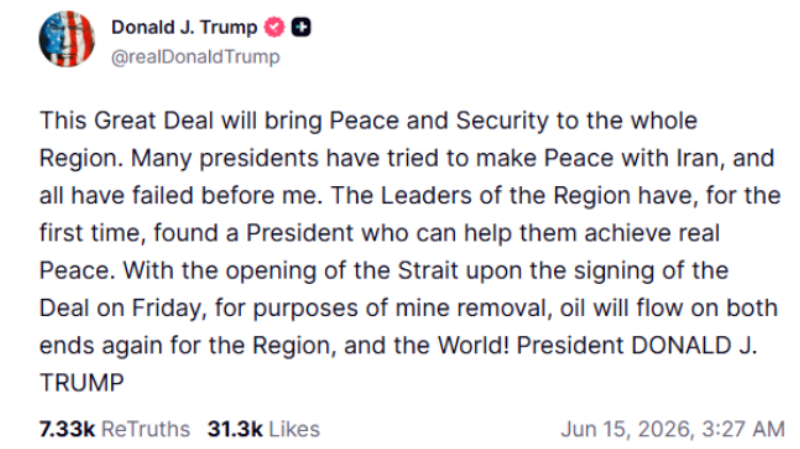
Trump later said the Strait of Hormuz would reopen on Friday and that he had ordered an end to the blockade of Iranian ports. Celebrating the agreement, he wrote, "Ships of the World, start your engines. Let the oil flow!" and added that "oil will flow on both ends again for the Region, and the World!"
Following the announcement, Brent crude and US West Texas Intermediate prices both dropped sharply, while Asian stock markets moved higher.
Former State Department spokesman Matthew Miller criticized the deal, arguing that Trump had made major concessions to restore conditions that existed before the war. "We have no assurances the nuclear program will ever be addressed, but Iran has shown the world it can take the global economy hostage and get something from the US in return," he said.
Thousands of people, mostly in Iran and Lebanon, have been killed since fighting began on February 28. Iran targeted Israel and Gulf states hosting US forces while disrupting shipping through the Strait of Hormuz, prompting Washington to impose restrictions on Iranian ports.
The conflict has become a growing political challenge for Trump and Republicans ahead of the midterm elections, particularly due to rising fuel costs. At the same time, some members of his party continue demanding the complete dismantling of Iran’s nuclear program.
Republican Senator Lindsey Graham welcomed the agreement but stressed that future negotiations would require close scrutiny. "Under our law, any nuclear deal with Iran will be sent to Congress for review and a vote," he said. "Congratulations to all in getting us to this point."
Trump withdrew the US from the 2015 nuclear deal during his first term, leading Iran to expand its uranium enrichment activities. The future of that stockpile is expected to be a central issue in upcoming negotiations.
The agreement was finalized despite an Israeli strike in Lebanon on Sunday. Prime Minister Benjamin Netanyahu has differed with Trump over efforts to limit Israeli military operations in Lebanon as part of a broader settlement with Iran.
According to Israeli media, Trump briefed Netanyahu on the progress of negotiations during a phone call. In an interview with The New York Times, Trump described Netanyahu as "a very difficult guy" and suggested the Israeli leader should appreciate Washington’s efforts to prevent Iran from obtaining nuclear weapons.
The United Kingdom, Germany, France and Italy welcomed the development, saying they were prepared to ease sanctions if Iran takes "clear, verifiable steps" to limit its nuclear activities.
British Prime Minister Keir Starmer said, "We are clear that toll-free freedom of navigation must now be restored in the Strait of Hormuz." He added, "Iran must never have a nuclear weapon."
Before the announcement, an Iranian official told Reuters that the US had agreed to release $25 billion in frozen Iranian assets. A US official, however, said the ultimate objective remained the dismantling of Iran’s nuclear program and removal of its highly enriched uranium stockpile. The Iranian source maintained that Tehran would instead be allowed to dilute the material inside the country.
Neo News | Copyright © 2026