Thu, September 17, 2026

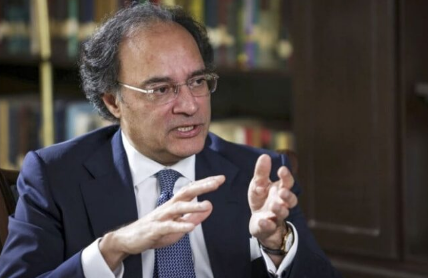
Washington (Web Desk): Federal Minister for Finance and Revenue Senator Muhammad Aurangzeb began his official visit to the United States with an intensive round of high-level engagements on the sidelines of the Annual Meetings of the International Monetary Fund (IMF) and the World Bank Group (WBG) in Washington.
According to an official statement, the finance minister and his delegation held a detailed discussion with Jihad Azour, Director of the IMF’s Middle East and Central Asia Department, and his team.
Both sides exchanged views on Pakistan’s ongoing economic reform program and reaffirmed their shared resolve to sustain the pace of reforms. The meeting reviewed progress under the Second Review of the Extended Fund Facility (EFF) and underlined the need to maintain strong macroeconomic discipline.
Senator Aurangzeb also took part in the Commonwealth Finance Ministers’ Meeting, where he stressed the need for practical measures to build a stronger and more resilient Commonwealth. He extended Pakistan’s support for launching the Commonwealth Infrastructure and Financial Resilience Hub and the Technical Assistance Fund to enhance capacity building and peer learning.
Highlighting the growing challenges of climate change, he emphasized the necessity of ensuring adequate climate financing for developing countries and called for the prompt activation of the Loss and Damage Fund.
During a separate engagement, the minister met with Axel van Trotsenburg, Senior Managing Director of the World Bank Group, to discuss ongoing development cooperation. Senator Aurangzeb acknowledged the Bank’s continuous support for Pakistan’s economic agenda and drew attention to the devastation caused by recent floods that severely hit agriculture and slowed GDP growth. He underscored the need for increased investment in climate adaptation and mitigation and agreed on the importance of mobilizing additional resources to strengthen resilience against future disasters.
The finance minister was later hosted by the U.S.-Pakistan Business Council (USPBC), where he outlined Pakistan’s improving macroeconomic outlook and stressed that private sector-led growth remains key to sustaining economic stability.
He briefed participants on the recent trade agreement concluded with the United States and expressed optimism about expanding both government-to-government and business-to-business partnerships in sectors including mining, agriculture, information technology, and pharmaceuticals. The session concluded with an interactive question-and-answer segment during which the minister assured business leaders that their concerns would be addressed effectively.
Earlier, Senator Aurangzeb held talks with Robert Kaproth, Assistant U.S. Treasury Secretary for International Finance, and Counselor Jonathan Greenstein. The discussion focused on Pakistan’s strong economic fundamentals supported by the IMF program, the successful conclusion of a tariff deal with the U.S. administration, and new legislation regulating virtual assets. The finance minister invited American investors to explore opportunities in Pakistan’s energy, minerals, agriculture, and IT sectors.
Continuing his meetings, he conferred with Riccardo Puliti, Regional Vice President of the International Finance Corporation (IFC) for the Middle East, Central Asia, Türkiye, Afghanistan, and Pakistan. The minister appreciated IFC’s continued collaboration and its role in mobilizing private investment through the 10-year Country Partnership Framework. Both sides agreed to accelerate the financial closure of IFC’s flagship Reko Diq project, while the minister welcomed the opening of IFC’s new regional office in Islamabad to further deepen cooperation.
Senator Aurangzeb also met Dr. Muhammad Sulaiman Al-Jasser, President of the Islamic Development Bank (IsDB), to review the Bank’s development portfolio in Pakistan. He expressed gratitude for IsDB’s sustained partnership and acknowledged its approval of financing for two sections of the M-6 motorway. The minister called for swift implementation of ongoing projects and reaffirmed cooperation in areas including polio eradication, oil financing, and the formulation of a new Country Engagement Framework for Pakistan.
Later in the day, the finance minister met with senior executives of Citi Bank, commending the institution’s longstanding relationship with Pakistan. He briefed them on the country’s stabilizing macroeconomic indicators, backed by structural reforms and positive evaluations from international rating agencies.
Senator Aurangzeb also discussed Pakistan’s growing position as a hub for digital and financial innovation, assuring Citi that its proposals would receive due consideration.
In addition to these official interactions, the finance minister engaged with international media outlets, including the Associated Press and Reuters.
The day concluded with a dinner hosted by Pakistan’s Ambassador to the United States, Rizwan Saeed Sheikh, in honor of the visiting delegation.
The event brought together members of the Pakistani diaspora, community representatives, and American dignitaries for discussions on Pakistan’s reform agenda, economic growth, and investment opportunities. Senator Aurangzeb lauded the contributions of overseas Pakistanis and reiterated the government’s determination to involve them more closely in the country’s development efforts.
Neo News | Copyright © 2026