Fri, September 18, 2026

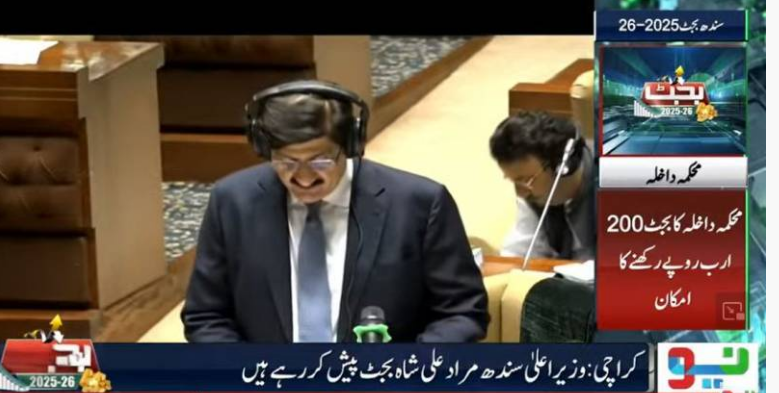
Karachi (Web Desk): Sindh Chief Minister Syed Murad Ali Shah unveiled the provincial budget for the fiscal year 2025-26 with a total outlay of Rs 3,451.87 billion.
While addressing the budget session in the assembly, Shah highlighted significant increases in funding for key sectors such as education, healthcare, infrastructure, and social welfare.
Reflecting on his long-standing involvement in the province's financial affairs, he expressed pride in presenting Sindh’s budget for the tenth time and noted that it was the twelfth overall budget he had introduced in the assembly.
Among the key announcements was the introduction of an ad hoc relief allowance for government employees, with those in grades 1 to 16 receiving a 12% increase, and employees in grades 17 to 22 receiving a 10% hike.
Pensions are set to rise by 8%, and additional allowances will be provided for employees with disabilities.
In a move aimed at easing the financial burden on the public, the Sindh CM declared the abolition of five taxes, including the professional tax and the entertainment duty.
He described the budget as comprehensive, with a vision to unlock Sindh’s untapped potential through an emphasis on social welfare, infrastructure development, and economic self-reliance.
Murad Ali Shah stressed his government’s commitment to these priorities, noting substantial investments in health and education sectors. Rs34.4 billion were allocated to health, with the Sindh Institute of Cardiovascular Diseases cited as having treated more patients than any other facility of its kind in Pakistan. The Gambat Institute performed 308 liver transplants over the past year, and the Sindh Institute of Child Health continued to deliver quality pediatric care.
To improve governance and transparency, the budget introduced a number of digital initiatives, including a KPI dashboard for project monitoring and the use of blockchain technology for managing land records.
A digital birth registration system is also being developed, intended to link health and education data to improve service delivery.
In the agriculture sector, the government plans to provide targeted subsidies for drip irrigation and supply new machinery to farmers through the Benazir Hari Card program.
Despite these announcements, the budget session was marked by loud protests from opposition members.
They accused the government of favouring landlords and neglecting the needs of ordinary citizens.
Opposition Leader Ali Khurshidi criticized the budget for overlooking urban areas in Sindh and argued that it was designed to protect the interests of powerful landowners.
However, the government maintained that the focus remained firmly on social welfare and enhancing education by directing funding straight to schools.
Neo News | Copyright © 2026