Fri, September 18, 2026

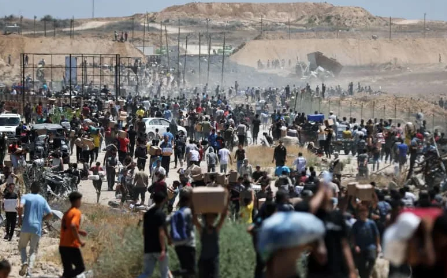
New York (Web Desk): Catherine Russell, Executive Director of UNICEF, has expressed profound concern following what she described as the "unconscionable" deaths of children during an aid distribution event in the central Gaza Strip on Thursday.
According to Russell, the killing of 15 Palestinians—among them nine children and four women—was horrifying. These individuals had reportedly been queuing for food supplements distributed by Project Hope, a partner of UNICEF.
The incident occurred in Deir Al-Balah, where another 30 people were injured, including 19 children. Media sources suggest the deaths and injuries were caused by an Israeli airstrike.
"The killing of families trying to access life-saving aid is unconscionable," Russell declared. “These were mothers seeking a lifeline for their children after months of hunger and desperation.”
Among the victims was a young mother, Donia, whose one-year-old son, Mohammed, had spoken his first words just hours before being killed. Russell shared that Donia is now hospitalized in critical condition, “clutching Mohammed’s tiny shoe.” She added, “No parent should have to face such tragedy.”
Russell pointed out that this tragic event is a stark example of the harsh circumstances many in Gaza face today, due in part to the limited humanitarian aid entering the region and the failure of warring parties to uphold their obligations to protect civilians.
She warned that the continued scarcity of supplies is putting children at risk of severe malnutrition and worsening famine.
“The number of malnourished children will continue to rise until life-saving aid and services are resumed at full scale,” she cautioned.
Russell emphasized that under international law, all parties in conflict are required to safeguard civilians and permit the safe and unhindered delivery of humanitarian relief.
“We call on Israel to urgently review its rules of engagement to ensure full compliance with international humanitarian law, notably the protection of civilians including children, and to conduct a thorough and independent investigation of this incident and all allegations of violations,” she stated.
The United Nations also reiterated its condemnation of civilian deaths in Gaza. Speaking to reporters in New York, UN spokesperson Stephane Dujarric stressed that parties involved in the conflict are legally obligated to minimize civilian harm during hostilities.
He also noted that on the same day, another attack reportedly struck the office of a humanitarian organization in Gaza City, resulting in the deaths of three staff members.
Dujarric addressed the worsening fuel crisis in Gaza, which is severely affecting both residents and aid operations. A UN convoy managed to deliver approximately 75,000 litres of fuel from Israel on Wednesday—the first such delivery in over four months.
However, Dujarric warned that this amount was not sufficient to meet even one day’s energy demands. “We and our humanitarian partners need hundreds of thousands of litres of fuel each day to keep essential lifesaving and life-sustaining operations going,” he explained.
A humanitarian organization has raised concerns that the fuel shortage might soon cut off clean water supplies for around 44,000 children, heightening the risk of outbreaks of waterborne diseases like cholera, diarrhoea, and dysentery.
UN-affiliated education providers have reported establishing 626 temporary classrooms in Gaza between October 2023 and June 2025, serving around 240,000 students—half of whom are girls.
Despite these efforts, only 299 facilities remain functional, hindered by displacement orders, insufficient funding, and various operational obstacles.
Humanitarian staff on the ground—including emergency responders, health personnel, and aid workers—continue to distribute food and other necessities under extremely dangerous and harsh conditions.
Many of them are also struggling with hunger, water shortages, and threats to their personal safety, Dujarric noted. “A number of our own colleagues are also facing hunger.
They also face water scarcity and threats to their personal safety, just like everyone else in Gaza,” he said.
Dujarric reaffirmed the UN’s message that this dire humanitarian situation must be brought to an end. He underscored the urgency of a ceasefire, describing it as “not only urgent, it is long overdue,” and repeated calls for the unconditional release of all hostages.
Turning to the West Bank, Dujarric highlighted growing concerns about intensified Israeli military activities in the northern areas, which humanitarian groups say are causing widespread destruction and generating more humanitarian needs.
These actions are also diminishing hopes for displaced families to return to their homes. “Meanwhile, attacks, harassment and intimidation by Israeli settlers against Palestinians have become a daily reality,” he added.
He referenced a settler attack on July 3 that forced the displacement of the Mu’arrajat East Bedouin community in the central West Bank.
“This is the ninth community to be fully displaced in the Ramallah and Jericho areas since January 2023, following the recurrent attacks by Israeli settlers,” he noted.
Neo News | Copyright © 2026