Thu, September 17, 2026

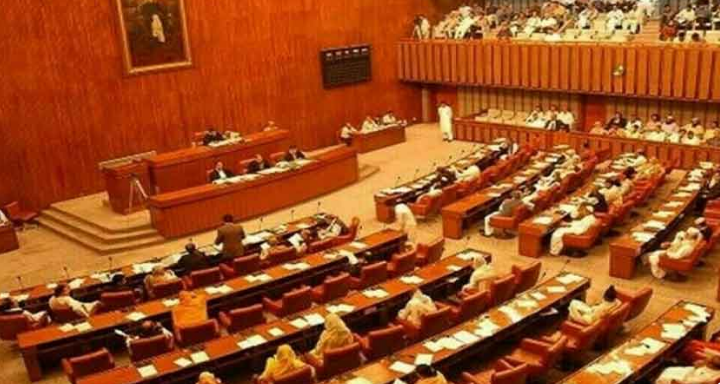
Islamabad (Web Desk): The Senate on Monday passed the 27th Constitutional Amendment Bill, introducing major reforms in Pakistan’s judicial and military systems, amid loud opposition protests and uproar in the House. Members of the opposition tore up copies of the bill before walking out, refusing to participate in the voting process.
Law Minister Azam Nazeer Tarar presented the 59-clause bill, which received the required two-thirds majority, securing 64 votes in the 96-member chamber.
No senator voted against the legislation as opposition members boycotted the session. In addition to government lawmakers, senators from the Awami National Party (ANP), PTI-backed Saifullah Abro, and JUI-F’s Ahmed Khan also supported the amendment.
Presenting the bill, Tarar explained that the legislation stemmed from proposals by political parties and bar councils advocating the formation of a Federal Constitutional Court (FCC). He noted that the
Supreme Court has been inundated with constitutional petitions, affecting the timely handling of civil and criminal cases. Establishing the FCC, he said, would allow constitutional matters to be handled by a specialised body, enabling the Supreme Court to concentrate on appellate cases and reduce case backlogs.
According to Tarar, the FCC would be composed of judges with expertise in constitutional law. He added that changes to Article 243 were introduced to strengthen procedural clarity and the administrative structure of the armed forces, alongside other necessary consequential amendments.
Earlier in the session, PPP Senator Farooq H. Naek presented the joint parliamentary committee’s report on the amendment, mentioning that the panel had introduced a few textual adjustments before final approval. He confirmed that both the report and the bill were submitted together for Senate consideration.
The federal government had tabled the bill in the Senate last week, triggering intense protests from opposition parties, who accused the government of undermining the spirit of the Constitution. The legislation was then referred to a joint committee comprising members from both Houses, though opposition lawmakers refused to participate in the discussions.
During his speech, Naek explained that the proposed constitutional amendment was designed to establish a Constitutional Court. He said the committee unanimously endorsed its creation but suggested several revisions. Representation from all provincial High Courts would be ensured, and the eligibility condition for judges’ inclusion had been reduced from seven years to five.
Naek further stated that under the new framework, the Constitutional Court would only be able to take suo motu action upon a formal application, replacing the unilateral authority currently held by the Supreme Court.
He also detailed that the transfer of High Court judges between provinces would fall under the jurisdiction of the Judicial Commission of Pakistan, and if a judge refuses such a transfer, the matter would be referred to the Supreme Judicial Council for review after the judge is given a chance to justify the refusal. The senator added that the president would no longer enjoy immunity in cases where he holds a public office.
ANP Senator Aimal Wali Khan, during the debate, stressed that majority power should be exercised responsibly, warning that undermining the Constitution’s essence could ultimately weaken democracy itself.
Speaking to the media outside Parliament, Law Minister Azam Nazeer Tarar said that the bill’s passage required the full presence of members in the House and expressed confidence that the amendment would be approved by the Senate.
MQM-P Senator Faisal Subzwari commented that the reforms should produce concrete outcomes, saying that if the Supreme Court’s name and structure were being altered, the changes must bring tangible improvements.
Meanwhile, opposition senators vowed to resist the government’s efforts to enact the amendment. PTI Senator Ali Zafar, addressing reporters earlier, said that the opposition had opposed the bill from the very start, referring to a tweet by PPP Chairman Bilawal Bhutto-Zardari that initially revealed the proposal.
Separately, the Tehreek Tahafuz Ayeen-e-Pakistan (TTAP) held a meeting chaired by Mahmood Khan Achakzai to discuss the implications of the amendment.
The meeting, attended by Raja Nasir Abbas, Hamid Khan, Noorul Haq Qadri, Humayun Mohmand, and other political figures, concluded that the 27th Amendment was contrary to the spirit of the Constitution.
The opposition declared it unconstitutional, undemocratic, and ineffective, vowing to continue their opposition through legal, constitutional, and democratic means.
Neo News | Copyright © 2026