Thu, September 17, 2026

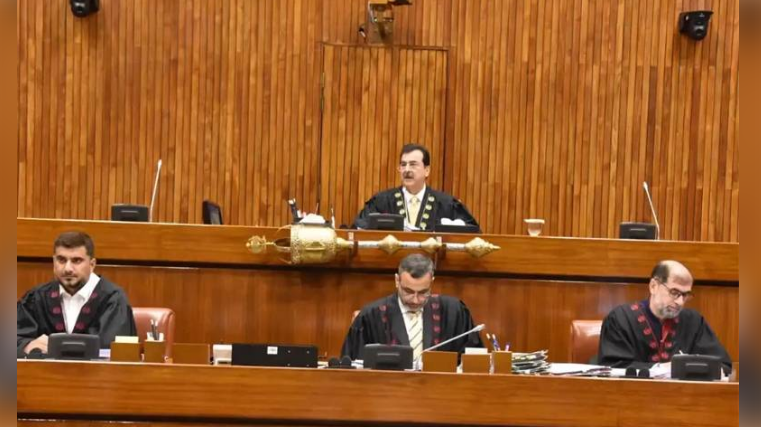
Islamabad (Web Desk): The draft of the 27th Constitutional Amendment, which had earlier received the federal cabinet’s approval, was formally laid before the Senate on Saturday and subsequently forwarded to a joint parliamentary committee for detailed examination.
Presiding over the session, Senate Chairman Yusuf Raza Gilani oversaw the proceedings focused primarily on the amendment.
Federal Minister for Law and Justice Azam Nazeer Tarar presented the bill in the upper house, while the motion to suspend the question hour—moved by the Minister for Parliamentary Affairs—was accepted by the chamber.
The proposed amendment was handed over to a joint committee comprising members of both the Senate and National Assembly’s Standing Committees on Law and Justice.
This body, to be co-chaired by Senator Farooq H. Naek and MNA Mahmood Bashir Virk, will undertake a comprehensive clause-by-clause review of the draft.
During the session, Minister Tarar informed lawmakers that all political parties would be invited to contribute to the discussions, assuring that the bill would be debated extensively before moving forward.
The amendment draft suggests that the Judicial Commission be empowered to transfer High Court judges and that the size of provincial cabinets be expanded.
It also outlines sweeping reforms within the military command structure. According to the proposed changes, the position of Chairman Joint Chiefs of Staff Committee will cease to exist from November 27, with the Chief of Army Staff assuming the newly designated role of Chief of Defence Forces.
Moreover, the ranks of Field Marshal, Marshal of the Air Force, and Fleet Marshal would become permanent titles, though Parliament would retain authority to revoke them through a process akin to presidential impeachment.
The prime minister would appoint the Chief of National Command in consultation with the Army Chief.
Opposition senators, including Ali Zafar and Allama Raja Nasir Abbas, voiced reservations over the procedure, claiming that the amendment was being advanced without sufficient consultation.
Allama Abbas criticized the government for allowing only two days to review such a significant proposal, cautioning that concentrating additional authority in the office of the Army Chief could render the Constitution controversial. He urged the government to seek consensus and enact safeguards against the unchecked use of power.
Deputy Prime Minister Ishaq Dar explained that the draft would undergo rigorous discussion in the standing committee and clarified that the appointment of the Leader of the Opposition in the Senate fell under the jurisdiction of the Chairman.
The session also touched upon preparations for the forthcoming Inter-Parliamentary Speakers’ Conference in Islamabad, with Chairman Gilani briefing lawmakers on the arrangements.
A joint meeting of the Senate and National Assembly Standing Committees on Law and Justice was convened at 2pm to continue deliberations on the 27th Amendment.
Senator Kamran Murtaza left the Senate floor to attend the committee meeting, stating that he had not been notified earlier. However, Senator Sherry Rehman, who chaired the committee session, maintained that the notice had been duly circulated and urged his attendance.
Addressing the house, she emphasized the essential role of opposition parties in a democratic setup, recalling the PPP’s boycott of the 1985 elections as an example underscoring the importance of political inclusivity.
She also reaffirmed that the Constitution guarantees the independence and supremacy of the judiciary under the Charter of Democracy.
Senator Faisal Javed, while speaking in the Senate, questioned the legitimacy of the incumbent government to amend the Constitution, alleging that the 2024 general elections had disregarded the public’s mandate.
He argued that genuine leadership supported by the people was currently behind bars and maintained that Pakistan could not prosper until power was restored to its rightful owners—the citizens.
Opposition members later refused to attend the parliamentary committee’s meeting on the amendment, citing inadequate notice and concerns about procedural haste.
Talking to the media, Barrister Ali Zafar said the draft had been circulated only minutes before the scheduled meeting at 2:30pm, arguing that proposed reforms such as altering military hierarchy, authorizing judicial transfers, and scrapping Article 184 were critical issues that warranted in-depth debate.
He warned that the opposition would not act as “rubber stamps” and insisted that predetermined decisions on major constitutional matters compromised democratic values.
From Committee Room No. 5, Senator Farooq H. Naek told reporters that in-camera sessions were held in the national interest and that all political parties, including those without parliamentary representation, were invited to nominate members for participation.
He highlighted that recording the opposition’s perspective was vital for maintaining public transparency and institutional accountability.
The amendment had earlier been approved by the federal cabinet during a meeting chaired by Prime Minister Shehbaz Sharif via video link from Baku.
Following the cabinet’s endorsement, Minister Tarar briefed the press, confirming that the bill would first be presented in the Senate and then referred to a joint parliamentary committee.
He stated that consultations had already taken place with coalition partners, including the Pakistan Peoples Party (PPP) and the Muttahida Qaumi Movement (MQM).
Tarar elaborated that the amendment seeks to reduce executive authority over judicial transfers by vesting that power in the Judicial Commission.
It also aims to resolve delays in Senate elections in Khyber Pakhtunkhwa to ensure uniform polling across the country.
Other proposed changes include increasing the number of advisers from five to seven, modifying Article 243 regarding appointments to key state positions, and revising Article 140-A to strengthen local governments—a proposal initially advanced by the MQM.
Neo News | Copyright © 2026