Fri, September 18, 2026

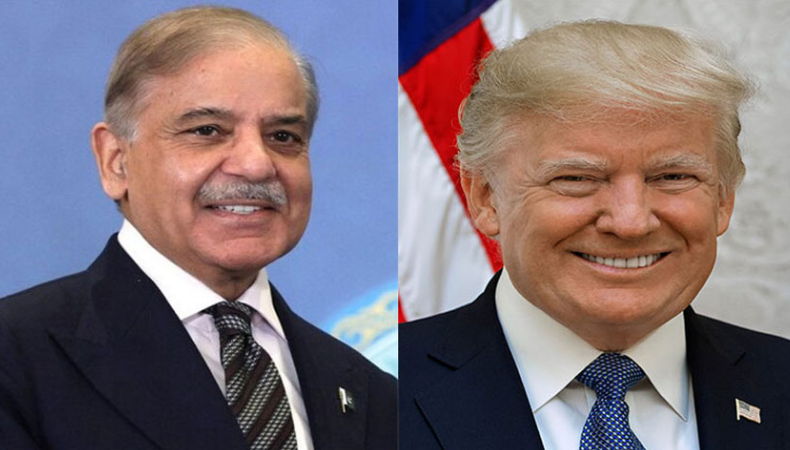
Islamabad (Web Desk): Prime Minister Muhammad Shehbaz Sharif Saturday thanked US President Trump for his leadership and proactive role for peace in the region.
“Pakistan appreciates the United States for facilitating this outcome, which we have accepted in the interest of regional peace and stability. We also thank Vice President JD Vance and Secretary of State Marco Rubio for their valuable contributions for peace in South Asia,” the prime minister posted on X handle.
He further said that Pakistan believed this marked a new beginning in the resolution of issues that had plagued the region and prevented its journey toward peace, prosperity and stability.
Earlier, on his X handle, the US president announced that India and Pakistan had agreed to a full and immediate ceasefire.
“After a long night of talks mediated by the United States, I am pleased to announce that India and Pakistan have agreed to a full and immediate ceasefire, he said.
“Congratulations to both countries on using common sense and great intelligence,” President Trump wrote.
Meanwhile, Deputy Prime Minister and Foreign Minister Ishaq Dar also confirmed on Saturday that Pakistan and India agreed to an immediate ceasefire.
Taking to his social media handle X, he wrote, “Pakistan and India have agreed to a ceasefire with immediate effect.”
The deputy prime minister said that Pakistan had always strived for peace and security in the region, without compromising on its sovereignty and territorial integrity.
The development came hours after Pakistan launched an operation to exercise its right of self-defence following the Indian missile attacks.
Pakistan’s Armed Forces launched a strong response under "Operation Bunyan-al-Marsoos' (Iron Wall), targeting India through both traditional military means and cyber operations.
According to security sources, Pakistani cyber teams disrupted major parts of India’s digital network. Several important Indian websites were hacked, including those of the Bharatiya Janata Party (BJP), Hindustan Aeronautics Limited, Border Security Force, and the Unique Identification Authority of India.
In a major cyberattack, Pakistani hackers breached the Maharashtra State Electricity Transmission Company. The attack caused power outages and wiped out meter data across the region.
Sensitive data from Indian institutions such as Assam Rifles, the Department of Atomic Energy, and the Defence Production division was also leaked online. The data reportedly contains proof of India’s links to terrorism and is now available on the dark web.
More than 2,500 Indian surveillance cameras were also hacked, exposing serious flaws in India’s internal security system.
Throughout the operation, Pakistan’s Armed Forces showed bravery, advanced technical skills, and a strong will to respond to threats.
Neo News | Copyright © 2026