Thu, September 17, 2026

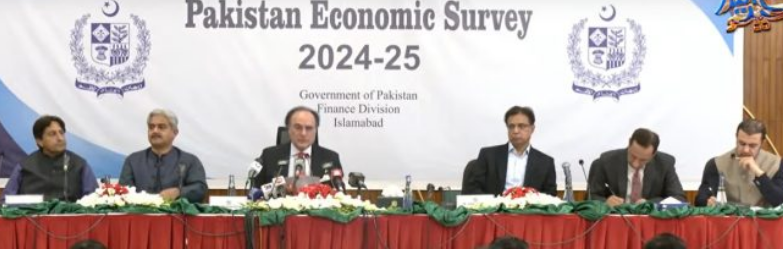
Islamabad (Web Desk): The Economic Survey for the fiscal year 2024–25 was launched in Islamabad on Monday, highlighting a positive shift in Pakistan's economic trajectory with a recorded GDP growth rate of 2.68 percent.
While presenting the survey, Minister for Finance Muhammad Aurangzeb described this growth as part of a gradual recovery, emphasizing that it sets the country on the right path toward achieving sustainable economic development.
The Finance Minister credited the upward trajectory to effective macroeconomic management, improved fiscal and external account balances, and a notable drop in inflation.
He also provided a global perspective, noting that while the world GDP grew by 3.3 percent last year, it is expected to slow to 2.8 percent this year. Against this backdrop, he expressed satisfaction with Pakistan’s progress, particularly the sharp decline in inflation from 23 percent last year to just 4.6 percent this year.
He stated that this was a sign of successful government consolidation efforts during the current fiscal year.
Aurangzeb detailed sector-wise performance, noting that the industrial sector grew by 4.8 percent. Within this, small-scale manufacturing increased by 1.3 percent, while large-scale manufacturing experienced a contraction, though less severe than the previous year. Some segments of industry posted remarkable growth, with the auto sector expanding by 40 percent, wearing apparel by 8 percent, textiles by 2 percent, and petroleum products by 4.5 percent.
The services sector recorded a 2.9 percent increase, supported by a 6.5 percent growth in Information and Communication, a 3.8 percent rise in Construction and Real Estate, and a 4.1 percent boost in Food Services. In the agriculture sector, overall growth was limited to 0.6 percent.
However, livestock expanded by 4.7 percent, poultry by 8 percent, and combined fruits and vegetables by 4.8 percent. Fisheries and forestry also showed positive trends. The Finance Minister mentioned that agriculture credit grew by 16 percent, surpassing two trillion rupees, and reiterated the government’s commitment to improving credit accessibility across the full agricultural supply and value chain, which he said would benefit major crops.
On the external economic front, Pakistan posted a current account surplus of 1.9 billion dollars during the first ten months of the fiscal year, with expectations that the year would end in surplus. Exports increased by 7 percent, including 3.1 billion dollars in IT exports. Imports rose by 11.7 percent, with notable increases in machinery and transport imports by 16.5 percent and 26 percent respectively—trends which the minister noted as favorable for both agriculture and industry.
The Finance Minister highlighted growing international confidence in Pakistan's economy, evidenced by improved ratings from Fitch and Moody’s, and support from global financial institutions. He confirmed that Pakistan successfully secured the latest IMF tranche despite challenges, including what he described as obstacles from India. He emphasized that international and bilateral partners continue to stand by Pakistan economically.
Looking ahead, he stressed the importance of increased resource allocation to address climate change challenges. The government, he said, will focus in the next fiscal year on projects aimed at enhancing climate resilience and adaptation.
Revenue collection rose by 26 percent during the first eleven months of the current fiscal year, further strengthening the fiscal position. Aurangzeb stated that the recovery was solidified in the current year and reaffirmed the government’s commitment to staying the course to secure long-term, sustainable growth.
He pointed out that the policy rate had been reduced to 11 percent from 22 percent, a move that saved between 800 billion and one trillion rupees in debt servicing costs. As a result, the debt-to-GDP ratio dropped to 65 percent from 68 percent. He acknowledged, however, that debt servicing remains the government’s largest expenditure item.
In response to media questions, the Secretary Finance said that government expenditures had been curtailed to the maximum extent possible. Addressing another query, the Finance Minister assured that the government is actively working to resolve the issue of circular debt.
The Economic Survey reported that over 598 billion rupees were allocated to the Benazir Income Support Programme (BISP) during the outgoing fiscal year to protect vulnerable segments of society.
Financial assistance was extended to about 9.87 million beneficiaries under BISP.
According to the report, workers' remittances stood at 31.2 billion dollars in the first ten months of the fiscal year, marking a significant increase from the previous year. Foreign exchange reserves also rose, reaching 16.6 billion dollars.
The survey further noted that national savings outpaced total investment during this fiscal year, resulting in a surplus on the external account. National savings were recorded at 14.1 percent of GDP, compared to an investment level of 13.8 percent. Per capita income increased to 1,824 dollars.
Finally, the Pakistan Stock Exchange demonstrated robust investor confidence with a bullish 50.2 percent gain during the fiscal year, reflecting the overall improvement in economic sentiment.
Neo News | Copyright © 2026