Thu, September 17, 2026

Islamabad (Web Desk): Pakistan’s economy delivered a strong recovery in fiscal year 2025–26, posting 3.7 per cent GDP growth despite global uncertainty, severe flooding, and escalating regional tensions.
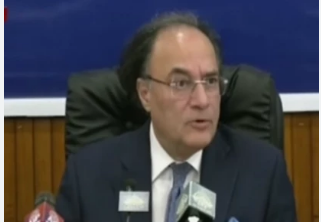
Federal Minister for Finance and Revenue Muhammad Aurangzeb said the performance reflects economic resilience and disciplined policy management.
Speaking while presenting the Economic Survey of Pakistan 2025–26, he stated that the country remained on course from stabilization toward growth, even as multiple external shocks continued to pressure the economy, which he said also demonstrated renewed market confidence.
He was accompanied by Federal Minister for Planning, Development and Special Initiatives Ahsan Iqbal, Federal Minister for Information and Broadcasting Attaullah Tarar, Minister of State for Finance and Revenue Bilal Azhar Kayani, along with senior officials from the Ministry of Finance, as they jointly highlighted the country’s key economic results and indicators.
Aurangzeb described the survey as more than a statistical report, calling it a reflection of resilience over the past year. He reiterated that Pakistan continues to move steadily from stabilization into a phase of growth.
The minister further explained that the fiscal year began under challenging global trade conditions triggered by tariff-related uncertainty, which was later compounded by devastating floods during August and September, followed by a regional conflict.
Aurangzeb said that these external shocks tested the economy significantly, yet the government managed to maintain momentum and safeguard growth.
Despite these difficulties, Pakistan achieved its highest economic expansion in four years. He noted that the economy had earlier contracted by 0.2 per cent in 2023, then recovered with growth of 2.6 per cent in 2024 and 3.2 per cent in 2025 before reaching the latest 3.7 per cent increase.
He also shared that the size of the national economy reached a record Rs126.9 trillion, equivalent to $452.1 billion, while per capita income increased to $1,901 compared to $1,751 in the previous year.
The finance minister said that growth was evenly spread across sectors. Agriculture expanded by 2.89 per cent despite flood-related losses, with the crop sector returning to positive territory and livestock continuing its strong contribution, accounting for nearly 60 per cent of agricultural GDP.
The industrial sector also posted notable gains, with large-scale manufacturing rising by 6.1 per cent, marking its strongest performance in four years. Out of 22 industrial subsectors, 16 recorded growth, including food processing, textiles, automobiles, petroleum products, and electrical equipment.
On the demand side, he highlighted rising consumption trends, including a 10 per cent increase in cement consumption, a 17 per cent rise in fertilizer demand, a 31 per cent surge in automobile sales, along with significant growth in petroleum products and mobile phone usage.
The services sector remained the dominant engine of expansion, growing by 4.9 per cent and contributing about 58 per cent to overall GDP.
Within this sector, information and communication services expanded by 7.52 per cent, reflecting the continued rise of the digital economy.
Discussing fiscal performance, he said government efforts toward consolidation helped reduce the fiscal deficit to 0.7 per cent of GDP from 2.6 per cent a year earlier, while the primary surplus improved.
Federal Board of Revenue revenues rose by 10.1 per cent, and interest or markup payments declined by 23 per cent, creating additional fiscal space.
“Although global growth had slowed to 3.1 per cent, Pakistan had still managed to outperform expectations,” the finance minister said, reaffirming the government’s focus on maintaining broad-based and inclusive economic growth.
Neo News | Copyright © 2026