Fri, September 18, 2026

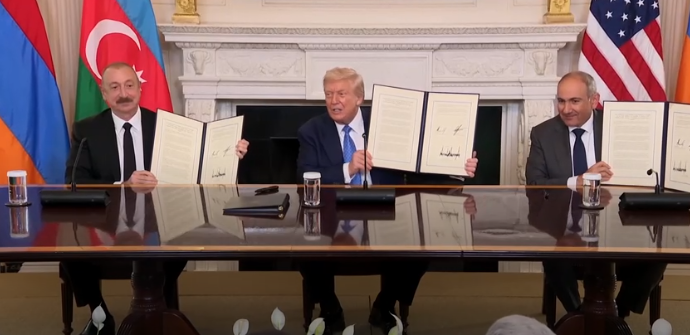
Washington (Web Desk): After decades of hostility and repeated cycles of conflict, Armenia and Azerbaijan have signed a groundbreaking peace agreement brokered by the United States, signaling a major diplomatic shift in the South Caucasus.
The accord, finalized during a ceremony at the White House, was presided over by President Donald Trump, who welcomed Azerbaijani President Ilham Aliyev and Armenian Prime Minister Nikol Pashinyan as they pledged to end their long-standing enmity.
Trump, speaking alongside the two leaders, described the moment as a historic reconciliation between nations that had been locked in conflict for 35 years. He announced that both countries had agreed to cease hostilities, normalize diplomatic relations, and honor each other's territorial boundaries—an outcome he hailed as a testament to diplomacy and perseverance.
One of the key features of the agreement is the establishment of a U.S.-backed transit corridor across the South Caucasus, with exclusive American development rights.
The corridor is expected to boost trade, energy exports, and infrastructure connectivity in a region long disrupted by closed borders and unresolved disputes.
Although specifics about the corridor's development were not made public, U.S. officials confirmed that multiple companies, including three from the United States, have already expressed interest in the project, informally dubbed the “Trump Route for International Peace and Prosperity.”
In tandem with the peace accord, the US. has signed individual deals with both Yerevan and Baku to deepen cooperation in sectors such as energy, commerce, and emerging technologies, particularly artificial intelligence.
Though details remain undisclosed, the agreements are expected to position the U.S. as a significant economic and strategic partner to both nations. Additionally, longstanding U.S. restrictions on defense ties with Azerbaijan have been lifted, a move likely to provoke concern in Moscow.
American officials involved in the negotiations say that sustained visits to the region and quiet diplomacy were instrumental in reaching the breakthrough.
The White House sees this as a model for resolving other entrenched regional conflicts, especially along Russia’s periphery. Observers note that Armenia is preparing to formally grant the US long-term rights to oversee and develop the new transit route, giving Washington a foothold in a region Russia has historically considered part of its sphere of influence.
The peace deal also raises the possibility of Azerbaijan joining the Abraham Accords—a series of normalization agreements with Israel forged during Trump’s first term—adding another layer to the broader realignment of alliances. Both Aliyev and Pashinyan publicly thanked Trump for his role in brokering the peace and stated their intention to nominate him for the Nobel Peace Prize.
Despite the celebratory tone, international analysts caution that the agreement’s success will depend heavily on continued American engagement. Regional experts point out that past peace efforts have often collapsed into renewed violence. Without consistent U.S. attention and support, the risk of regression remains high.
Some human rights advocates have urged the administration to press for reforms alongside reconciliation. The Washington-based organization Freedom Now called on Trump to use his leverage to secure the release of more than 370 political prisoners in Azerbaijan. The Azerbaijani government, however, has pushed back against such calls, accusing Western groups of meddling in its domestic affairs.
The backdrop to this accord includes a dramatic shift in the region’s territorial landscape. In 2023, Azerbaijan retook full control of Nagorno-Karabakh, a region within its borders but historically dominated by ethnic Armenians. This led to a mass exodus of roughly 100,000 Armenians, effectively ending the area’s long-standing autonomous status.
Trump, in his remarks, framed the agreement as part of a broader peace-building effort early in his second term. The White House has also credited his administration with resolving tensions in other flashpoints, including disputes between Cambodia and Thailand, Rwanda and the Democratic Republic of Congo, and Pakistan and India. Still, Trump has yet to broker an end to Russia’s war in Ukraine or the ongoing conflict between Israel and Hamas.
Looking ahead, Trump announced plans to meet Russian President Vladimir Putin in Alaska on August 15, aiming to explore potential paths to peace in Ukraine.
Meanwhile, foreign policy experts say the Armenia-Azerbaijan deal could serve as a precedent for addressing other frozen conflicts and closing routes used by Moscow to circumvent international sanctions.
Though many questions remain, particularly about the implementation of the corridor and the level of control local governments will retain, the agreement has nonetheless redefined the political landscape of the South Caucasus.
The United States has now emerged not just as a mediator, but as a central player in shaping the region’s future.
Neo News | Copyright © 2026