Fri, September 18, 2026

Washington (Web Desk): United States (US) President Donald Trump announced on Monday that he plans to substantially raise tariffs on Indian imports in retaliation for India’s ongoing oil trade with Russia.
His decision marks a sharp escalation in trade tensions between Washington and New Delhi, driven by what the Trump administration views as India’s disregard for sanctions aimed at isolating Moscow.
Last week, Trump had already declared a 25 percent tariff on Indian goods and warned of further, unspecified penalties. Though he did not provide concrete details at the time, he later followed up with a scathing statement: “I don’t care what India does with Russia. They can take their dead economies down together, for all I care.”
Over the weekend, two Indian officials told Reuters that New Delhi intends to continue buying oil from Russia despite the potential consequences. Meanwhile, White House Deputy Chief of Staff Stephen Miller accused India of indirectly supporting Russia’s war in Ukraine by continuing to purchase oil from Moscow.
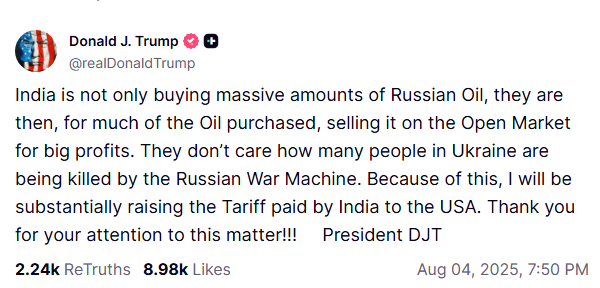
On Truth Social, Trump renewed his criticism of India’s actions, highlighting what he described as profiteering from war. “India is not only buying massive amounts of Russian oil, they are then, for much of the oil purchased, selling it on the open market for big profits,” Trump wrote. “They don’t care how many people in Ukraine are being killed by the Russian war machine. Because of this, I will be substantially raising the tariff paid by India to the USA.”
India ranks as the third-largest importer of crude oil globally and is currently the leading buyer of seaborne Russian oil—a critical income source for Moscow as it sustains its prolonged military campaign in Ukraine.
Trump’s move places India under greater pressure than several other countries that have reached bilateral tariff agreements with his administration. For example, Vietnamese exports face a 20 percent tariff, Indonesia’s stand at 19 percent, while goods from Japan and the European Union are taxed at 15 percent.
Trump also claimed that the US recently struck a favorable trade arrangement with Pakistan—India’s longstanding rival—which Islamabad says will lower duties on its exports.
This development has added strain to already tense relations between India and the US, particularly in the aftermath of a deadly border clash between India and Pakistan in May. New Delhi has expressed displeasure over Trump’s diplomatic overtures to Islamabad and the resulting implications for bilateral trade.
Though Trump and Indian Prime Minister Narendra Modi once shared a public rapport, the relationship appears to have soured in recent weeks. Modi’s government has begun adopting a firmer tone, distancing itself from its earlier enthusiasm for closer ties with Trump.
Despite Trump’s claim that he brokered a ceasefire between India and Pakistan through social media pressure and trade threats, India denies that his intervention had any effect.
Trump’s remark about the Indian economy being “dead in the water” has put Modi’s ruling Bharatiya Janata Party (BJP) in a difficult political position.
Until recently, BJP supporters were actively campaigning in favor of Trump’s re-election, conducting religious rituals and even establishing a temple with a statue of the American president.
Nevertheless, Trump has dismissed such symbolic gestures and focused his attention on India’s oil trade and protective tariffs.
In response, the Indian government stated it is consulting with all “stakeholders” to determine its course of action—a term generally used to describe major businesses that had pinned their hopes on Modi’s ability to maintain strong relations with both Washington and Moscow.
However, with Trump doubling down, those hopes may now be fading fast.
Neo News | Copyright © 2026