Fri, September 18, 2026

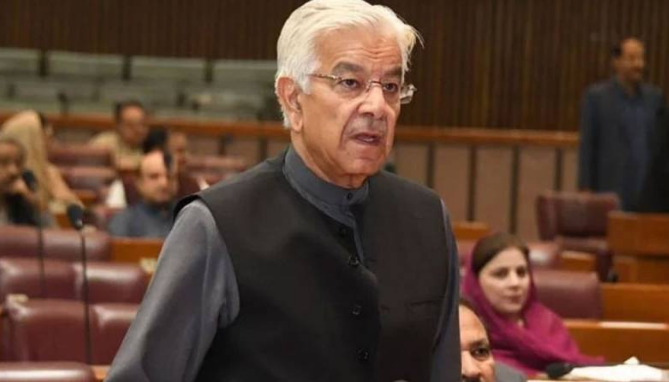
Islamabad (Web Desk): Defence Minister Khawaja Asif on Tuesday asserted that the conflict currently engulfing Iran, despite Tehran’s willingness to reach an accord, was driven by a larger “Zionist agenda” aimed at extending Israel’s influence up to Pakistan’s borders and surrounding the nation with adversarial forces.
He urged all 250 million Pakistanis, regardless of political or religious background, to recognise what he described as a conspiracy orchestrated by long-standing enemies.
"Zionism is a threat to humanity. From the establishment of Israel on the land of Palestine until today, every catastrophe that has befallen the Islamic world, every war imposed upon it, will show the direct or indirect hand of Zionist ideology and the state. Zionism has…
— Khawaja M. Asif (@KhawajaMAsif) March 3, 2026
The situation in the Middle East escalated rapidly as Israel carried out airstrikes against Iran, prompting Tehran to retaliate with missiles and drones targeting American interests and bases across the Gulf region.
Over a span of four days, several senior Iranian officials, including Supreme Leader Ayatollah Ali Khamenei, lost their lives in what Iranian authorities described as unprovoked strikes.
Officials warned that Khamenei’s death would be a turning point, with the Islamic Revolutionary Guard Corps pledging retribution and declaring that the crime would not remain unanswered.
In his statement, Asif condemned Zionism as a global threat, saying that from the establishment of Israel on Palestinian land to the present day, the ideology and state of Israel had played a direct or indirect role in every conflict and disaster that struck the Islamic world.
He also claimed that Zionist influence had dominated the world’s economic system for a century, effectively holding major global powers hostage.
Highlighting Pakistan’s strategic position, the defence minister reminded the public that the country is a nuclear power and that its armed forces are recognised worldwide for their strength.
He paid homage to the nation’s martyrs and warriors for defending its sovereignty and prayed for those who contributed to Pakistan’s nuclear capabilities.
The minister also praised former premier Nawaz Sharif, saying that authorising nuclear tests showcased Pakistan as a nuclear-armed state to the international community.
Asif reiterated that Iran had been open to a diplomatic settlement, but the war was forced upon it.
He claimed that the conflict was part of a larger strategy to project Israel’s influence to Pakistan’s borders.
Khawaja Asif warned that a coordinated approach involving Afghanistan, Iran, and India could ultimately target Pakistan, leaving it encircled by hostile forces, with insecure borders and the potential to be reduced to a subordinate state.
The defence minister concluded by praying for unity within the Islamic world, urging recognition of its adversaries, and calling for the liberation of Palestine.
He expressed hope that Pakistan would remain strong and secure until the Day of Judgment and offered prayers for the protection of the country’s defenders, asking Allah to be their guide and protector.
Neo News | Copyright © 2026