Fri, September 18, 2026

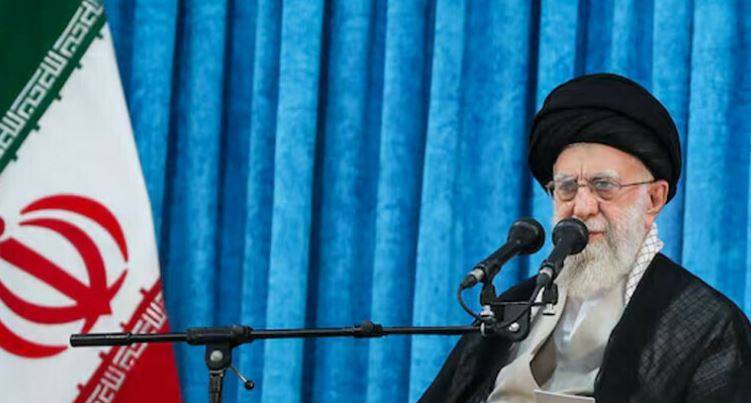
Tehran (Web Desk): Iran's Supreme Leader Ayatollah Ali Khamenei has been martyred during US-Israel strikes in Iran.
Iran’s state media has formally announced that Ayatollah Ali Khamenei was martyred in a coordinated US and Israeli airstrikes carried out on Saturday, marking what observers are calling one of the gravest crises in the modern history of Iran.
According to official Iranian reports, the attack directly targeted the Supreme Leader’s office and residential compound.
Israeli media outlets have claimed that Khamenei was inside an underground bunker at the time, accompanied by dozens of senior associates.
As per the media reports, approximately 30 powerful bombs were dropped on the specific compound during the operation, reducing the complex to rubble.
Iran’s State media confirmed that several members of Khamenei’s family were also killed in the strike, including his daughter and grandson, as well as his son-in-law and daughter-in-law.
Dozens of senior officials and close aides who were reportedly present at the location were also said to have died.
Following the martyrdom of the Supreme Leader, the Iranian government declared 40 days of national mourning. Flags across the country have been ordered flown at half-mast, and official and religious events have been converted into mourning ceremonies.
Authorities have called on the public to observe the period of grief nationwide.
Ayatollah Ali Khamenei had served as Iran’s Supreme Leader since 1989, assuming the position following the death of Ruhollah Khomeini.
Over more than three decades in power, he remained the country’s highest political and religious authority, shaping domestic policy and directing Iran’s foreign and security strategies during periods of intense regional tension.
Israel and the US launched joint military strikes against Iran on Saturday, triggering a sharp escalation in the Middle East and pushing the region into a volatile new phase of conflict.
President Donald Trump described the attacks as a preventive measure aimed at dismantling Iran’s missile capabilities and stopping its progress toward developing nuclear weapons, emphasizing the threat Washington believes Tehran poses to global security.
Iran retaliated almost immediately, firing a wide-ranging missile assault targeting locations in Gulf countries as well as Israel.
The Islamic Revolutionary Guard Corps stated that its strikes were directed at the US Navy’s Fifth Fleet headquarters in Bahrain, other American military bases in the Gulf, and selected sites within Israel.
Explosions were reported and air defense systems activated in Saudi Arabia, Bahrain, Qatar, the United Arab Emirates, Israel, and parts of Iraq, illustrating the broad scale of the unfolding crisis.
The missile barrage followed repeated Iranian warnings that any attack on its territory would provoke a strong counterstrike. Governments across the Gulf confirmed that their airspace had been targeted.
Authorities in Kuwait, Qatar, the UAE, and Jordan said their defense systems intercepted incoming missiles, while in Abu Dhabi, UAE state media reported one person killed amid the escalation that reverberated across the region.
Neo News | Copyright © 2026