Fri, September 18, 2026

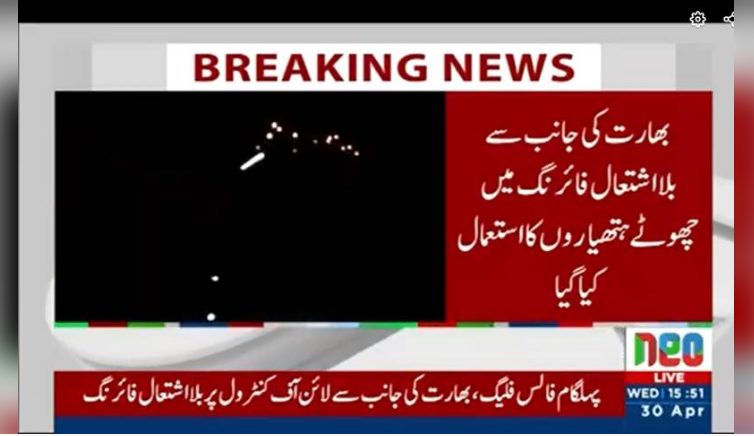
Rawalpindi (Web Desk): Pakistani security forces delivered a robust response to India’s unprovoked ceasefire violation along the Line of Control (LoC), destroying an Indian checkpost after late-night aggression on April 29-30, military sources confirmed.
According to security officials, Indian troops breached the ceasefire agreement by resorting to unprovoked small arms fire in the Kiani and Mandal sectors. The Pakistan Army retaliated with precision, neutralizing the threat and silencing Indian forces.
Security sources reported that Pakistan’s retaliatory strikes effectively destroyed several enemy bunkers, including the Chakputra post in occupied Kashmir. The swift and measured action demonstrated Pakistan’s operational readiness in the face of aggression.
Pakistan Army remains fully prepared to defend the country’s sovereignty and integrity at all times, according to security sources.
Earlier today, timely and swift response by Pakistan Air Force (PAF) forced four Indian Rafale jets patrolling near Line of Control (LoC) to retreat.
The security sources said that on the night of April 29/30, four Indian Rafale jets conducted patrolling within Indian geographical boundaries over Indian Illegally Occupied Jammu and Kashmir (IIOJK). However, PAF immediately detected the Indian fighter jets, they said.
They added that Indian jets became flustered and retreated owing to the timely and prompt action by the PAF.
“The Pakistani armed forces remain fully prepared and alert to give a befitting response to any aggression from India,” the security sources said.
Today’s incident also comes after the Pakistan Army yesterday shot down two Indian quadcopters after they violated the country’s airspace along the Line of Control (LoC) in two separate areas of Azad Jammu and Kashmir (AJK), official sources said.
The first drone was brought down in the Manawar sector of Bhimber district, where it was reportedly engaged in aerial surveillance when intercepted and destroyed by Pakistani troops. The second unmanned aerial vehicle was shot down in Poonch division’s Satwal sector.
The downing of the drones occurred amid continued exchange of fire along the LoC in Leepa Valley since the night of April 25, breaking a period of relative calm in the region. No casualties were immediately reported.
India—-gripped by war hysteria, has reportedly begun evacuating villages near the Line of Control (LoC).
According to sources, Indian forces have evacuated more villages in the Samba, Kathua, and Akhnoor sectors.
India evacuated border areas in occupied Kashmir amid escalating tensions while maintaining its oppressive crackdown on Kashmiri Muslims. Security sources warned that such provocative actions reveal New Delhi’s destabilizing war-mongering posture.
Earlier, in the Attari sector, India made announcements from a ‘Gurdwara’ instructing locals to harvest their crops, they said.
A deadly attack in Pahalgam, located in IIOJK, has sharply escalated tensions between South Asia’s two nuclear-armed neighbours.
The attack, which took place on April 22, resulted in the deaths of 26 individuals, most of whom were tourists. It stands as one of the most lethal incidents in the region in over two decades.
On April 23, India announced on April 23 the unilateral suspension of the Indus Waters Treaty (IWT)—a landmark water-sharing accord mediated by the World Bank in 1960.
Despite enduring multiple wars and diplomatic crises, the treaty has remained a rare symbol of cooperation between the two nations.
In retaliation, Pakistan declared on April 24 its intention to consider suspending the Simla Agreement of 1972, a foundational framework for bilateral relations, and warned of the potential closure of its airspace to Indian aircraft.
While Indian authorities hinted at possible cross-border involvement in orchestrating the Pahalgam attack, no definitive evidence has been released to support such claims.
Pakistan, for its part, categorically denied any involvement and has called for an independent international inquiry to ascertain the facts surrounding the incident.
On April 26, Prime Minister Shehbaz Sharif, while reiterating Pakistan’s strong condemnation of terrorism in all its forms and manifestations, said that Pakistan as a responsible country is open to participate ‘in any neutral, transparent and credible investigation’ into Pahalgam incident.
However, he expressed regret over the conduct of Pakistan’s eastern neighbour, accusing it of a continued pattern of exploitation and baseless accusations without credible evidence or transparent investigations.
Stressing that while Pakistan prefers peace, this inclination should never be mistaken for weakness, the prime minister made it clear that the nation will never compromise on its dignity or national security.
Neo News | Copyright © 2026