Thu, September 17, 2026

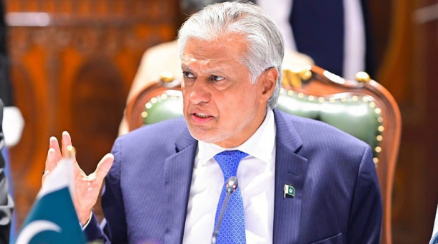
New York (Web Desk): Deputy Prime Minister and Foreign Minister Ishaq Dar expressed Islamabad’s willingness to engage in a comprehensive dialogue with India.
Addressing a press conference in New York, he made it clear that such dialogue should not be restricted to the issue of terrorism alone.
Stressing that Pakistan has endured significant losses as a result of terrorism, Dar noted that this fact was acknowledged by the US Secretary of State in a recent bilateral meeting. He highlighted that Pakistan’s sacrifices in the fight against terrorism were recognized during the talks.
The deputy premier also brought up the long-standing Jammu and Kashmir dispute during his meeting with US officials, asserting that lasting peace in South Asia is impossible without a resolution to this core issue.
He recalled that former US President Donald Trump had also addressed the matter on several occasions, underscoring its international relevance.
Turning to water-related concerns, DPM Dar reaffirmed Pakistan’s clear and consistent stance on the Indus Water Treaty.
He stated that the treaty is a binding agreement that cannot be altered or terminated unilaterally by any single party.
The DMP warned that any effort to divert or obstruct the flow of water due to Pakistan under the treaty would not be acceptable under any circumstances.
When asked about Pakistan’s position on Israel, Dar reiterated that the country has no intention of recognizing Israel.
He demanded an immediate halt to hostilities in Gaza and called for urgent humanitarian aid for the Palestinian population.
The deputy premier reiterated Pakistan’s unwavering support for the establishment of an independent and sovereign Palestinian state, with Al-Quds Al Sharif as its capital.
Reflecting on his visit to the US, DPM Dar described the trip as productive. He mentioned that Pakistan had also advocated for reforms in the United Nations Security Council (UNSC), emphasizing that the Organization of Islamic Cooperation (OIC) deserves appropriate representation in global decision-making forums.
Neo News | Copyright © 2026