Thu, September 17, 2026

Islamabad (Web Desk): Pakistan has dismissed reports suggesting that Chief of Defence Forces (CDF) and Chief of Army Staff (COAS) Field Marshal Asim Munir travelled to Iran recently as a representative of US President Donald Trump.
Field Marshal Munir arrived in Tehran on August 24 as part of Islamabad’s ongoing diplomatic initiative aimed at helping ease the confrontation between Washington and Tehran.
According to the Inter-Services Public Relations (ISPR), Pakistan and Iran discussed the possibility of reopening the Strait of Hormuz and efforts to achieve an "expedited termination" of the US-Iran conflict in the Middle East.
During his stay in Tehran, Field Marshal Munir met Iranian President Masoud Pezeshkian, Mohsen Rezaei, the Iranian supreme leader's representative on the Supreme National Security Council, Parliament Speaker Bagher Ghalibaf, Foreign Minister Abbas Araghchi and Interior Minister Eskandar Momeni.
The talks also covered regional stability, peace efforts and possible avenues for resolving outstanding differences through negotiations, the ISPR said.
Pakistan has increasingly taken on a central mediating role between Iran and the United States as diplomatic efforts continue to end the conflict that erupted following US and Israeli attacks on Iran on February 28.
Islamabad previously helped secure a two-week ceasefire between the two countries on April 8, temporarily stopping six weeks of hostilities. Since then, Pakistan has continued facilitating communication between Washington and Tehran.
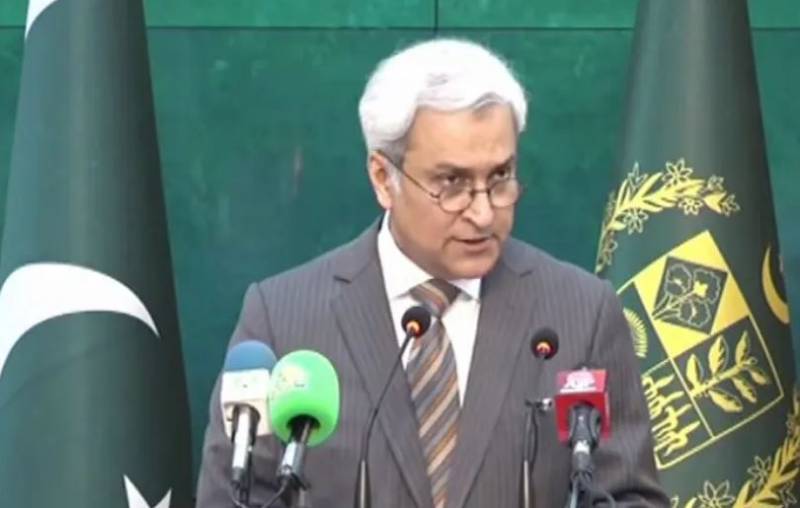
At his weekly media briefing on Thursday, Foreign Office (FO) Spokesperson Tahir Andrabi rejected the reports as “misleading and factually incorrect”.
He clarified that the CDF’s visit to Iran was undertaken “purely in the context and backdrop of Pakistan’s ongoing role as mediator”.
Andrabi said Field Marshal Munir’s August 24 visit to Tehran was part of Pakistan’s sustained diplomatic engagement to support efforts aimed at ending the conflict between the US and Iran, while also pursuing the reopening of the Strait of Hormuz.
“The discussion during the visit focused on regional de-escalation, breaking the military stalemate and exploring a negotiated settlement to restore regional peace and stability,” he added.
The FO spokesperson said Pakistan continued to work closely with friendly countries in a collective and sincere effort to help settle the wider crisis affecting the Middle East and Gulf region, particularly the ongoing confrontation between Washington and Tehran.
Andrabi said, “The visit underscored Islamabad’s sincere and constructive role in bridging differences between Washington and Tehran,” adding that Iran’s leadership had also recognised Pakistan’s contribution to reducing tensions and promoting peace across the region.
Responding to a question regarding a proposal from Afghanistan’s interim interior minister for creating a bilateral mechanism to deal with outstanding matters, the FO spokesperson said that Islamabad was willing to enter into state-level talks with Kabul to resolve bilateral concerns.
However, he made it clear that meaningful engagement would require the Afghan authorities to take practical and verifiable steps to ensure that their territory is not used for carrying out terrorist activities against Pakistan.
“Pakistan notes the proposal by the interim Afghan government’s interior minister for a bilateral mechanism to address issues. For any dialogue to take place, the Afghan side must ensure that its soil is not used against Pakistan,” the spokesperson said.
Andrabi added that Islamabad expected Afghanistan to improve border control arrangements and adopt measures against terrorism that could be independently verified.
“Pakistan is ready for institutional engagement with Afghanistan, provided that it results in verifiable counterterrorism measures,” the spokesperson said.
The FO also urged Afghanistan’s interim administration to honour its international commitments, including obligations linked to the Doha framework.
He further stressed that Kabul needed to stop India-backed banned groups, including the Tehreek-e-Taliban Pakistan (TTP) and Balochistan Liberation Army (BLA), from operating from Afghan territory.
“Afghan soil must be prevented from being used by anti-Pakistan elements, including the TTP and BLA,” Andrabi said.
To a question about other countries, including Bangladesh showing interest in joining the Makkah Joint Defence Agreement, the spokesperson described it as an evolving defensive architecture open to countries sharing common security obligations, with formal requests to be reviewed alongside partners in Riyadh and Ankara.
“As an evolving security architecture, the MJDA remains open to countries who share their commitments, collective obligations, and common security interests. Any formal request will be considered in consultation with our partners in Riyadh and Ankara. The operationalisation of MJDA, however, remains at an early stage,” he said.
The spokesperson also announced that Pakistan would take over the chairmanship of the Shanghai Cooperation Organisation (SCO) for a year after the Council of Heads of State meeting scheduled in Bishkek from August 31 to September 1, 2026.
He added that Prime Minister Shehbaz Sharif is expected to participate in the summit, while Pakistan will prepare to host the SCO summit in Islamabad in 2027.
Respondin to another question, he firmly rejected claims made retrospectively by a former Indian Chief of Defence Staff regarding the Kirana Hills incident, saying Pakistan’s air defence had successfully prevented India from achieving its military objectives during Marka-e-Haq.
“Pakistan’s layered air defence network effectively thwarted India’s military objectives… No strategic asset or sensitive infrastructure was compromised in Pakistan. Attempts to retrospectively recast these events through selective narrative or dramatised production cannot alter the verifiable operational record. History is established by facts and evidence, not by Bollywood-style retrospective claims. These post-facto punches, 16 or 17 months after the conflict, would be better directed at their own faces, the FO spokesperson said.
He further disclosed that Pakistan had strongly protested to Indian authorities over the unilateral demolition of consular structures located outside the Pakistan High Commission compound in New Delhi.
He distinguished the incident from Islamabad’s anti-encroachment campaign, which he said had been carried out after prior notification and involved diplomatic missions.
Speaking about Deputy Prime Minister and Foreign Minister Ishaq Dar’s ongoing official visit to UK, the FO spokesperson said that the he met International Maritime Organization Secretary-General Arsenio Dominguez to seek the organisation’s assistance in securing the release of 10 Pakistani sailors being held by Somali pirates.
He explained that authorities were actively pursuing the matter but cautioned that the case was particularly complicated because it involved tribal dynamics and energy-related cargo, factors that limited the scope for direct intervention.
Andrabi informed that Dar also held talks with Commonwealth Secretary-General Shirley Botchwey as well as a group of British-Pakistani lawmakers.
Neo News | Copyright © 2026