Thu, September 17, 2026

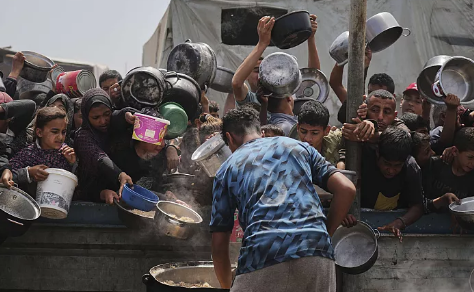
Gaza City (Web Desk): The humanitarian crisis in the Gaza Strip has reached a critical tipping point, as the United Nations World Food Programme (WFP) announced it has run out of food supplies amid an ongoing Israeli blockade preventing any humanitarian aid or commercial goods from entering the enclave.
With over two million Palestinians trapped inside and teetering on the brink of starvation, the WFP delivered its final stock to community kitchens, which are expected to run out of meals within days.
These kitchens have served as the only reliable food source for many in Gaza, even though they reached only about half of the population and provided just a quarter of the daily food requirements.
The WFP’s operations have been systematically dismantled, including the closure of 25 bakeries at the end of March due to a lack of wheat flour and fuel. Other efforts, such as food parcel distributions to families, have also halted.
The UN agency has issued urgent warnings that unless immediate action is taken to reopen borders and allow aid to flow, it may be forced to suspend all critical food assistance.
As it stands, over 116,000 metric tonnes of food—sufficient to feed a million people for up to four months—are stockpiled and ready for delivery by WFP and its partners, pending the reopening of entry points into Gaza.
This blockade, now the longest Gaza has experienced, is exacerbating the already collapsing food and market systems.
Food prices have surged by more than 1,400% since the last ceasefire, and essential items have become nearly impossible to find. Vulnerable populations, including children, pregnant and breastfeeding women, the elderly, and people with disabilities, face an escalating threat of severe malnutrition and hunger-related disease.
WFP has called on all parties involved to immediately prioritize the needs of civilians and adhere to their obligations under international humanitarian law by allowing the entry of life-saving aid.
Meanwhile, the UN human rights office in the Occupied Palestinian Territory issued a damning statement on the rapidly deteriorating situation in both Gaza and the West Bank.
It noted that hostilities, aid restrictions, and the destruction of vital infrastructure have devastated the lives of 2.2 million people in Gaza. Following the breakdown of the previous ceasefire, Israeli military activity has intensified, killing civilians and further destroying what little remains of critical infrastructure.
Displacement orders and renewed blockades have deepened the suffering, pushing communities into desperation.
Social unrest is rising as residents compete over limited food supplies, sometimes resorting to armed confrontations.
This escalation is unfolding in the context of a near-total collapse of local governance, law enforcement, and civil services, many of which have been targeted by Israeli attacks.
Between April 21 and 22 alone, 36 heavy machines used in humanitarian relief—including excavators, water trucks, and sewage vehicles—were destroyed in what the UN described as deliberate strikes across three different areas.
The loss of this equipment severely hampers rescue efforts, medical transport, access to clean water, and waste management, all of which are critical to preventing further loss of life and disease outbreaks.
The targeting of shelters and residential areas also continues. From March 18 to April 22, the UN documented 229 attacks on homes and 91 strikes on displacement tents, many resulting in civilian casualties, including women and children.
These actions represent serious violations of international humanitarian law, particularly the principles of distinction, proportionality, and precaution.
The UN human rights office said that the high number of civilian casualties over the past 18 months has not led to any meaningful change in Israel's military conduct, suggesting a blatant disregard for civilian life.
When combined with the deliberate prevention of humanitarian aid, the UN warned that these actions may be aimed at collectively punishing the population of Gaza and imposing living conditions incompatible with continued survival.
In the West Bank, the situation is also alarming. Ongoing operations by Israeli security forces and frequent settler violence continue to result in Palestinian deaths, injuries, and forced displacement. One recent incident in a village near Ramallah saw settlers injure eight Palestinian men and destroy agricultural structures.
Since October 7, 2023, 192 Palestinian children have been killed in the West Bank. Large-scale military operations in the northern regions, particularly in Jenin and Tulkarm, have now continued for over three months, with security forces still preventing residents from returning to their homes.
The UN warned that this prolonged displacement risks becoming permanent, which would amount to the forcible transfer of civilians—a grave breach of international law.
Neo News | Copyright © 2026