Thu, September 17, 2026

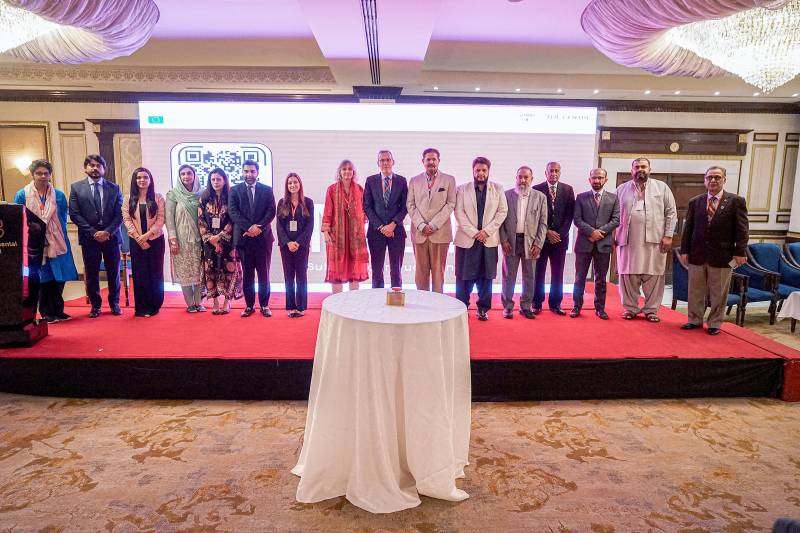
Karachi (Web Desk): The Society for the Protection of the Rights of the Child (SPARC) and The Centre for Child Rights and Business (The Centre) today launched the Child Rights Action Hub in Karachi, with funding from the European Union. The Action Hub aims to support companies in strengthening their human rights due diligence and impact on children and youth in Pakistan’s textile and leather supply chains. A second Action Hub will be inaugurated in Multan in October.
The Action Hub is designed to help businesses address some of the most complex challenges in global sourcing, ensuring that supply chains are transparent, compliant and resilient. By providing practical solutions and collective platforms for action, the Action Hub will support companies in identifying risks, building capacity and strengthening accountability throughout their operations.
At the launch event, stakeholders from government, industry associations, civil society and the private sector came together to discuss the role of responsible business in driving sustainable change. Speaking at the event, Mr. Rajvir Singh Sodha, Special Assistant to the Chief Minister Sindh on Human Rights, appreciated the efforts taken by SPARC and The Centre to work with the textile and leather sector, a priority economic sector for Pakistan. He stated that, “We are happy to support the Hub initiative, which contributes to the efforts taken by the Government of Sindh to reduce risks to children.”
Mr. Jeroen Willems, Head of Cooperation, Delegation of the European Union to Pakistan, noted: “The EU has been the largest buyer of Pakistan’s products. This is thanks to the GSP+, the unilateral trade scheme through which the EU gives to Pakistan an exemption in tariffs in the majority of products. What we expect in return is for Pakistan to ratify and implement 27 international conventions on human and labour rights as well as environmental and governance standards. And we will continue to support Pakistan for this purpose”.
Ms. Asiya Arif, Executive Director SPARC stated: “Pakistan has come a long way in decent work and adherence to European Union Human Rights Due Diligence. The Child Rights Action Hub is an effort to consolidate the work and bridge gaps among the demand and supply chain, ultimately benefiting children and the formal sector in competing with the global market.”
The Child Rights Action Hub builds on a proven model already operating in Bangladesh, Malaysia and the Democratic Republic of Congo, where businesses have joined forces with civil society and governments to improve visibility across supply chains, strengthen protections and establish remediation mechanisms.
Pakistan’s textile and leather sectors account for more than 40% of industrial employment and play a key role in global trade. Yet challenges in informal and lower-tier production, including lack of visibility, weak compliance systems and limited opportunities for young workers, pose risks for brands and suppliers striving to meet international due diligence standards.
The Action Hub will provide:
· Capacity-building for suppliers to integrate human rights safeguards into operations.
· Structured dialogue between businesses, government and civil society to enhance accountability.
· Remediation pathways and case management for rights violations.
· Vocational training and youth employment initiatives, ensuring supply chains also deliver positive social outcomes.
Dr. Ines Kaempfer, CEO of The Centre for Child Rights and Business, emphasised the importance of collaboration: “To bring about long term, sustainable people-centric development in the textile and leather sector, it is important for stakeholders to collaboratively implement tangible actions on the ground. This is the essence of the Child Rights Action Hub that we have launched today.”
Mr. Junaid Ur Rehman, Senior Vice Chairman of Towel Manufacturers Association, during the panel discussion on stakeholder perspectives on multi-stakeholder collaboration, stated that: “We need to move towards the culture of facilitation and move away from traditional approaches of penalisation to create an enabling environment for positive change.”
Mr. Kausar Eijaz Tata, Chairman Exports and Special Economic Zones, Karachi Chamber of Commerce and Industry, when asked about women’s participation in the workforce, mentioned that: “Women generally prefer to work from home in the cottage industry because of the lack of an enabling work environment. Steps taken by the industry to improve working conditions in factories would help to improve women’s participation in the labour force.”
Mr Abdul Samad Soomro, Joint Director Labour, Government of Sindh, stated, “Such initiatives like the Hub initiative are handy for solid outcomes. The Sindh Government is committed to eliminating child labour from all sectors. We are progressing towards a strong partnership with our partners for a common goal”.
By pooling resources through the Child Rights Action Hub, companies can collectively address high-risk, informal supply chain contexts that are often beyond the reach of individual compliance programmes. This not only reduces exposure to risks such as child and forced labour, but also builds stronger, more sustainable supply chains that meet evolving international standards.
Companies are invited to join as Action Hub participants by investing in the initiative, nominating suppliers, and helping extend its impact across Pakistan’s sourcing landscape.
Pakistan today marked a significant step forward in protecting children and youth in supply chains with the launch of the Child Rights Action Hub.Abu Dhabi (Web Desk): In an important Super 4 stage match of the Asia Cup T20, Pakistan has set a target of 136 runs for Bangladesh to chase. Pakistan scored 135 runs for the loss of 8 wickets in their allotted 20 overs. Muhammad Haris scored 31 runs while Muhammad Nawaz contributed 25 runs.
The match, played in Dubai, saw Bangladesh winning the toss and opting to field first, giving Pakistan the chance to bat.
Pakistan made no changes to their playing XI for this match, fielding the same players who played against Sri Lanka.
Pakistan’s top order struggled as wickets fell one after another. At the team score of 49, half of the side was already back in the pavilion. Openers Sahibzada Farhan scored 4 runs, while Saif Ayub was dismissed for a duck, marking his fourth consecutive zero in Asia Cup 2025.
Fakhar Zaman was the third wicket to fall, scoring 13 runs, followed by Hussain Talat who made 3 runs. Captain Salman Ali Agha was dismissed after scoring 19 runs. Later, Shaheen Afridi scored 19, Muhammad Haris 31, and Muhammad Nawaz 25 before getting out.
It is noteworthy that India has already qualified for the Asia Cup final. The winner of today’s match will face India in the final on Sunday. The last Super 4 match between India and Sri Lanka is scheduled for tomorrow.
Neo News | Copyright © 2026