Thu, September 17, 2026

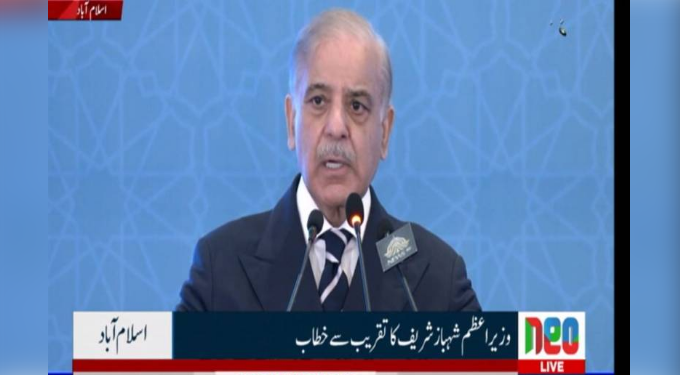
Islamabad (Web Desk): Prime Minister Shehbaz Sharif on Wednesday stressed the importance of a unified government strategy in addressing Pakistan’s ongoing economic challenges and called upon all stakeholders to work together to drive sustainable growth.
Delivering the keynote address at the opening session of the Pakistan Governance Forum 2026, the prime minister recalled that in June 2023, the country was on the verge of default.
“By the grace of Allah and through the combined efforts of all, we managed to steer Pakistan back from the edge,” he said, highlighting the collaborative work of federal and provincial governments alongside the military in stabilizing the economy within two years.
PM Shehbaz pointed to the dramatic decline in inflation, which had fallen from around 35 percent to under 7 percent, and noted that the policy rate had been adjusted to 10.5 percent.
He emphasized the enormous potential of the export sector, urging gradual growth to fully realize its capacity.
The premier highlighted that several reforms implemented by the government were entirely domestic initiatives, designed to prevent economic volatility, with no involvement from the IMF.
In the energy sector, he noted, electricity prices had been reduced by Rs9 per unit while protecting solar power investments, commending the Minister for Power and his team for their efforts.
PM Shehbaz also lamented the continued losses of Rs200 billion annually due to electricity theft, stressing that only a coordinated, government-wide approach could address the problem.
The prime minister called for shutting down Utility Stores, describing them as “centers of corruption and theft,” and criticized the Pakistan Works Department (PWD) for corruption, noting that its closure had saved billions for the nation.
He also highlighted the Ramazan Package, under which Rs38 billion was being distributed digitally to deserving citizens in a fair and transparent manner.
The event brought together chief ministers, federal and provincial ministers, experts, diplomats, investors, businessmen, and traders.
PM Shehbaz underlined the need for collaborative efforts in the economic sphere, stating, “The path ahead may be long and challenging, but we have accepted this responsibility. Pakistan will soon claim its rightful place among global economies.”
He reiterated that the government’s role was to facilitate business, support exporters and investors, and create an environment conducive to productivity and growth, rather than run businesses itself.
The prime minister highlighted initiatives to encourage exporters, investors, and entrepreneurs and expressed confidence that Pakistan’s abundant resources, combined with determined action, could propel the country forward economically in the coming years.
PM Shehbaz also stressed the importance of broadening the tax base, noting that recent measures had raised the tax-to-GDP ratio to 10.5 percent.
“Growth in production, exports, investment, foreign direct investment, and reduction of indirect taxes would remain priorities in the next fiscal budget,” the premier asserted.
He criticized the failure to remit indirect taxes collected from consumers, calling it “a major injustice to the nation,” while pointing out higher compliance in the sugar, cement, and tobacco industries.
The prime minister noted that the IT sector had grown by 34 percent but had far greater potential. He urged the youth to be trained in technical and vocational skills, emphasizing that IT and AI-driven innovation could transform other sectors of the economy.
PM Shehbaz also commended the planning minister for launching Uraan Pakistan, describing it as an important initiative within the government’s system that could deliver results.
Speaking on the occasion, Minister for Planning, Development, and Special Initiatives Ahsan Iqbal said the forum aimed to develop practical solutions through discussion and shared perspectives.
He stated that effective governance depended on setting targets and working to achieve them, and that governance should be merit-based, transparent, and centered on citizens.
Iqal further explained that Uraan Pakistan was designed as a transitional mechanism to strengthen the country’s economic structure.
Reflecting on the past two years, he said the government had successfully prevented Pakistan from sliding into bankruptcy.
The minister added that if transformational policies were fully implemented with commitment and synergy, Pakistan could become a $1 trillion economy by 2035.
Neo News | Copyright © 2026