Thu, September 17, 2026

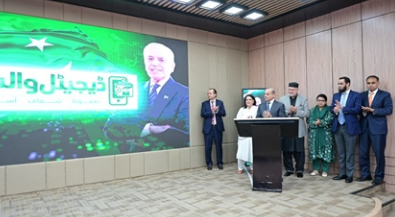
Islamabad (Web Desk): Prime Minister Shehbaz Sharif inaugurated a groundbreaking initiative on Monday, introducing 10 million digital wallets for the beneficiaries of the Benazir Income Support Programme (BISP).
This development marks a significant advancement in Pakistan’s pursuit of transparency, greater financial inclusion, and the transition towards a cashless economy.
The launch ceremony featured a symbolic palm touch by the prime minister and was attended by federal ministers, BISP officials, and international collaborators including GIZ.
In his remarks, PM Shehbaz congratulated Senator Rubina Khalid, chairperson of BISP, along with the entire BISP team and partnering organizations for implementing a decisive step aimed at protecting legitimate recipients and easing their access to assistance.
PM Shehbaz described the digital wallet system as being deeply inspired by the legacy of Shaheed Mohtarma Benazir Bhutto, noting that it empowers beneficiaries by providing them with secure, transparent, and direct access to financial aid.
He reaffirmed the vital role BISP plays in poverty alleviation and job creation but stressed the necessity of ongoing efforts to broaden its reach and impact.
Highlighting the initiative as a substantial stride toward a cashless economy, the prime minister recalled the successful digital disbursement of 78 percent of the relief package during Ramazan despite opposition from vested interests.
The premier emphasized that adopting cashless transactions is an urgent need, as they save time, eliminate corruption, and boost efficiency—factors essential for Pakistan’s rapid progress.
PM Shehbaz disclosed that he personally oversaw numerous meetings on the digitization process despite initial indifference and reluctance, underscoring his commitment to transforming all forms of government and personal transactions into digital formats.
He urged BISP leadership to introduce conditional clauses linking assistance to education and health, such that families receiving aid ensure their children attend school and engage with health initiatives.
The premier further called for shortening the current eight to ten-month implementation period to a more efficient four months.
Acknowledging the collaboration of multiple stakeholders including the State Bank of Pakistan, the Ministry of IT, Pakistani banks, and development partners, the prime minister praised their efforts, stating that this initiative is not merely about distributing aid but about empowering citizens to become active contributors to nation-building.
Prior to the launch, BISP Federal Secretary Amir Ali Ahmed explained that a high-level committee had been established under the prime minister’s directive to guarantee transparency and easy access within the digital system.
He elaborated that the digital wallets will be created using beneficiaries’ CNICs and safeguarded by biometric verification to prevent identity fraud. Additionally, 10 million free SIM cards are being rolled out, with the first phase launched in Hyderabad, Sukkur, and Rahim Yar Khan in partnership with Jazz/Mobilink.
Senator Rubina Khalid described the launch as a momentous achievement in Pakistan’s social protection efforts, emphasizing that BISP supports over 10 million impoverished families and represents more than just financial aid—it serves as a gateway to social and economic empowerment.
She pointed out that linking the benefits to women’s CNICs not only recognizes them but also integrates them into the national database, creating further opportunities enhanced by digital literacy programs for women unfamiliar with technology.
Rubina Khalid underscored that BISP continues the vision of Shaheed Benazir Bhutto for women’s empowerment, a mission sustained by President Asif Ali Zardari and now thriving under Prime Minister Shehbaz Sharif’s leadership.
Neo News | Copyright © 2026