Thu, September 17, 2026

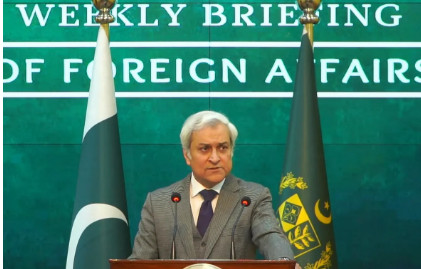
Islamabad (Web Desk): The Foreign Office (FO) on Friday said that Prime Minister Shehbaz Sharif will undertake an official visit to China from May 23 to 26 at the invitation of the Chinese government as both countries observe the 75th anniversary of their diplomatic relations.
At his weekly media briefing on Thursday, FO spokesperson Tahir Andrabi said that the visit carries considerable importance in the context of the long-standing friendship between Pakistan and China, which is rooted in mutual confidence, respect, and shared strategic interests.
He said the visit would serve as an opportunity to reaffirm the strength of the all-weather strategic cooperative partnership and to further advance the concept of a closer shared future between the two nations.
During the visit, PM Shehbaz will hold meetings with Chinese President Xi Jinping and Premier Li Qiang.
The discussions will cover a wide range of bilateral cooperation, including political relations, economic ties, and strategic collaboration, with particular focus on trade, investment, industrial cooperation, agricultural modernization, information technology, science and technology, and people-to-people exchanges.
The prime minister will begin his programme in Hangzhou, located in Zhejiang province, where he will preside over a Pakistan–China business-to-business investment conference.
The event will concentrate on sectors such as information technology, telecommunications, energy, energy storage solutions, and agriculture, with the aim of expanding commercial linkages and encouraging fresh investment opportunities.
Later in Beijing, PM Shehbaz will attend a reception organized by the Chinese People’s Association for Friendship with Foreign Countries, arranged to mark the 75th anniversary of diplomatic ties.
The FO spokesperson said the visit is anticipated to further strengthen political understanding, enhance strategic coordination, and broaden practical cooperation between the two close partners.
He also noted that although the main focus of the visit remains bilateral relations, regional issues including Iran–United States developments may also be discussed during the meetings.
In addition, he highlighted that a Chinese delegation headed by the Vice Chairman of the National People’s Congress had already arrived in Islamabad on May 20 to participate in anniversary-related events, and also met the prime minister and attended a commemorative ceremony.
Describing Pakistan–China relations as a rare example of consistent solidarity and brotherhood in international affairs, the FO spokesperson said both countries have stood by each other through various challenges over the past 75 years.
Diplomatic ties, established on May 21, 1951, have gradually expanded into diverse fields including defence cooperation, infrastructure development, economic partnership, and regional connectivity under the framework of the China-Pakistan Economic Corridor (CPEC).
On regional matters, the spokesperson said Pakistan had strongly condemned recent drone strikes targeting Saudi Arabia and the United Arab Emirates, and reiterated full solidarity with both countries.
He also emphasized that any intentional attack on nuclear installations would constitute a serious violation of international law, including the UN Charter and International Atomic Energy Agency guidelines, stressing that such facilities must remain strictly protected at all times.
Regarding Jammu and Kashmir, he paid tribute to the slain Kashmiri leaders Mirwaiz Maulvi Mohammad Farooq and Abdul Ghani Lone on their martyrdom anniversaries observed on May 21, and also remembered the 70 individuals killed during Mirwaiz Farooq’s funeral procession in 1990.
He urged the global community and the United Nations (UN) to take serious notice of the human rights situation in Indian Illegally Occupied Jammu and Kashmir (IIOJK) and to help resolve the dispute in line with UN resolutions and the aspirations of the Kashmiri people.
In response to questions, he voiced concern over politically motivated cases against Hurriyat leaders, including Yasin Malik, and called for the immediate release of Kashmiri political detainees and human rights defenders.
On the Indus Waters Treaty, the FO spokesperson welcomed the supplementary award issued by the Court of Arbitration on May 15 concerning the Kishanganga and Ratle hydropower projects.
Andrabi said that the decision reinforced Pakistan’s longstanding position that the treaty imposes clear restrictions on India’s control over western rivers and requires that run-of-the-river projects be based on realistic assumptions supported by technical evidence.
He said that Pakistan remains fully committed to the treaty and its dispute settlement mechanisms while firmly protecting its rights under it.
Responding to another question about Pakistan’s role in facilitating dialogue between Iran and the US, he said the matter holds significant national importance.
He added that PM Shehbaz, Deputy Prime Minister and Foreign Minister Ishaq Dar, Chief of Army Staff (COAS) and Chief of Defence Forces (CDF) Field Marshal Asim Munir and Interior Minister Mohsin Naqvi have all been actively engaged in efforts to promote peace and dialogue in the region, stressing that Pakistan remains committed to regional stability and discourages speculation.
Andrabi further stated that Chinese-funded projects in Pakistan are progressing without interruption and reaffirmed that the government is committed to ensuring the safety and security of all foreign nationals, especially Chinese citizens working in the country.
On reports concerning deportations of Pakistani citizens from the United Arab Emirates (UAE), he rejected claims of mass expulsions and described them as isolated cases.
The FO spokesperson said that between 2,000 and 3,000 Pakistanis had been deported, which is a relatively small figure compared to the large Pakistani community living in the UAE.
He added that the matter has already been taken up with Emirati authorities and is being pursued through diplomatic channels.
Regarding relations with Afghanistan, the FO spokesperson said that bilateral relations are currently facing challenges mainly due to Pakistan’s concerns over the use of Afghan territory for terrorist activities against Pakistan.
Neo News | Copyright © 2026