Fri, September 18, 2026

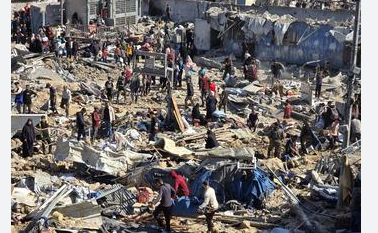
Gaza City (Web Desk): After another deadly weekend in Gaza, where at least 67 Palestinians were killed while attempting to collect food, United Nations relief teams on Monday described scenes of extreme chaos and famine across the war-torn enclave. The Israeli military, meanwhile, extended its ground operations into Deir Al-Balah for the first time.
The UN agency for Palestinian refugees, UNRWA, issued an emergency statement relaying the harrowing experiences of its staff, who themselves are barely surviving. One UNRWA worker conveyed the gravity of the situation: “We’re in the death phase,” they said. “Everything around people at the moment is death, whether it’s bombs or strikes, children wasting away in front of their eyes from malnourishment, from dehydration, and dying.”
Health workers stationed in the UN’s clinics and medical outposts reportedly remain on duty, even as they witness the worsening toll on children with no means to intervene. “Doctors and nurses… are watching children disappear and die in front of their eyes, and there’s absolutely nothing that they can do about it,” the worker added.
Over the weekend, civilians in Gaza were caught in the line of fire while trying to reach vital aid. According to the World Food Programme (WFP), many of the victims were gunned down by Israeli tanks, snipers, and gunfire as they approached aid convoys. On Sunday, July 20, a shipment of 25 aid trucks entered northern Gaza through the Zikim crossing. The convoy, destined for starving residents, encountered large crowds immediately after the final checkpoint. That’s when, according to WFP, the shooting erupted, killing an unspecified number of people.
WFP condemned the attack, stating that the casualties “were simply trying to access food to feed themselves and their families on the brink of starvation.” The organization also criticized the failure of promised safeguards: the violence occurred “despite assurances from Israeli authorities that humanitarian operational conditions would improve; including that armed forces will not be present nor engage at any stage along humanitarian convoy routes.”
The agency warned that such conditions make it nearly impossible to continue delivering essential supplies across the Gaza Strip. The statement came one day after another tragedy near a humanitarian hub in southern Gaza, reportedly operated by both Israeli and U.S. authorities, where 36 more people were killed while waiting for aid.
In Deir Al-Balah, Israeli forces issued a new evacuation directive affecting between 50,000 and 80,000 residents. This marks the first such order in that area since hostilities began on October 7, 2023.
According to the UN Office for the Coordination of Humanitarian Affairs (OCHA), “The new order cuts through Deir Al-Balah all the way to the Mediterranean Sea, further splintering the Strip. It will limit the ability of the UN and our partners to move safely and effectively within Gaza, choking humanitarian access when it is needed most.”
Despite the advancing military presence, UN personnel remain stationed across multiple facilities in Deir Al-Balah. The coordinates of these locations have been shared with both sides in the conflict. OCHA emphasized that “These locations – as with all civilian sites – must be protected, regardless of displacement orders,” even as Israeli armored units reportedly penetrated southern and eastern sectors of the city. Reports suggest that hostages taken during the Hamas-led attack on Israel last October may be held in this area.
With this latest displacement order, nearly 88% of Gaza’s territory is now either under evacuation orders or considered a militarized zone. Approximately 2.1 million residents—many of whom have already been forced to flee repeatedly—are now confined to ever-shrinking areas where infrastructure and services have collapsed.
“There’s nowhere for [Gazans] to escape. They are trapped,” said Louise Wateridge, a senior emergency officer with UNRWA. “They cannot leave the Gaza Strip. They’re trying to keep their children alive. They’re trying to keep themselves alive.”
In an interview with UN News, Wateridge described the extreme scarcity: food is nonexistent and water is available in only minimal quantities. This desperation drives thousands to risk death for even a small chance at aid. “Children are malnourished, they’re dehydrated, they are dying in front of their [parents’] eyes,” she said. “The bombs and the strikes are continuing; there’s no way to run, there’s nowhere to hide. There’s no way to escape there.”
Neo News | Copyright © 2026