Fri, September 18, 2026

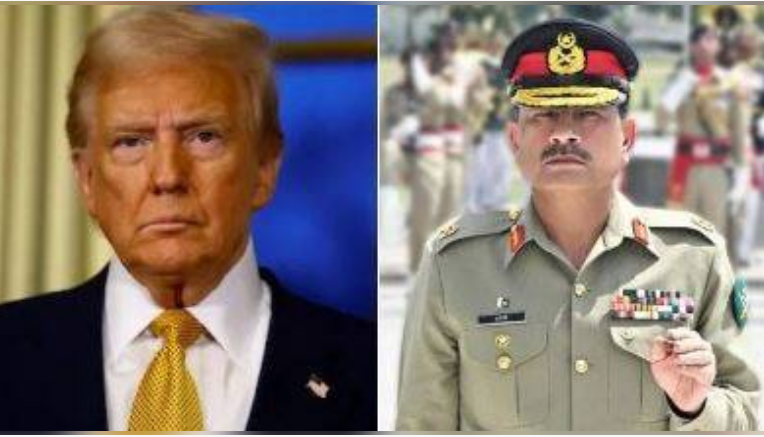
Washington (Web Desk): In a significant diplomatic development, Chief of Army Staff (COAS) Field Marshal Asim Munir held a rare and highly symbolic one-on-one meeting with US President Donald Trump over lunch at the White House.
The meeting, which took place in the Cabinet Room, is being viewed as a major step in revitalizing relations between the two countries. It follows a year marked by increased high-level interaction between Islamabad and Washington and comes shortly after a US-brokered ceasefire helped ease rising tensions between Pakistan and India.
President Trump’s involvement in mediating the ceasefire has been welcomed by Pakistan, and he has also offered to assist in resolving the long-standing Kashmir dispute—a proposal that Islamabad has responded to positively, though India has distanced itself from the idea.
Field Marshal Munir’s visit marks a shift in diplomatic strategy from Islamabad, signaling a push for a more pragmatic and multifaceted partnership with the United States (US).
The Pakistani leadership is reportedly aiming to anchor bilateral ties in geopolitical alignment, shared strategic interests, and economic cooperation.
While in Washington, Munir is also expected to hold discussions with Secretary of State Marco Rubio and Defense Secretary Pete Hegseth, further reinforcing the military and diplomatic dimensions of the visit.
The meeting is notable not just for its content but for its symbolism. Direct engagement between a Pakistani military chief and an American president at the White House is exceedingly rare and points to a recalibration of ties following years of strained relations.
Observers see this outreach as part of a broader attempt by Pakistan to maintain a delicate balance in its foreign policy—deepening its economic and defense ties with China while simultaneously re-engaging the United States on critical regional and security issues.
Earlier in the year, multiple US Congressional delegations had already met with Munir in Pakistan to explore cooperation in sectors such as counterterrorism, regional stability, and critical minerals.
This latest development at the White House appears to be a continuation of that momentum, underlining a renewed willingness on both sides to rebuild trust and pursue joint goals amid a complex global environment.
The broader implications of the visit suggest that Pakistan is striving to position itself as a relevant and responsive partner to both Eastern and Western powers.
The unusual nature of the Munir-Trump engagement is being interpreted by analysts as a reflection of shifting priorities in US foreign policy and a recognition of Pakistan’s evolving strategic role in South Asia and beyond.
Neo News | Copyright © 2026