Thu, September 17, 2026

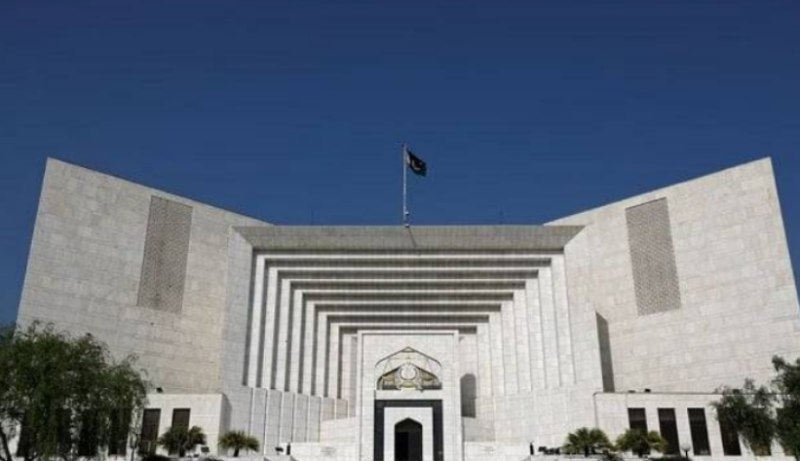
Islamabad (Web Desk): In a significant hearing at the Supreme Court (SC), Justice Naeem Akhtar Afghan, part of the top court's constitutional bench, remarked that "international law does not explicitly prohibit the court-martial of civilians."
These comments came during proceedings as a seven-member constitutional bench, chaired by Justice Amin-Ud-Din Khan, deliberated on an intra-court appeal challenging the military trials of civilians.
During the proceedings, renowned advocate Salman Akram Raja made his arguments on behalf of Arzam Junaid, the defendant who had been convicted.
Justice Jamal Khan Mandokhel raised a question regarding the consequences of a country failing to comply with international standards.
Raja stated he would complete his submission by 11 AM, but Justice Mandokhel suggested it would be better if he could wrap up in half an hour. Raja, however, insisted on being allowed to speak fully in order to finish on time.
Salman Akram Raja emphasized that the basic rights of civilians should not be compromised for the sake of court-martialing, arguing that such trials go against international standards for a fair trial.
He pointed out that international standards demand trials be public, fair, and transparent, with decisions being made openly.
The lawyer cited examples of military tribunals in other countries where decisions from such courts were often appealed in civilian courts.
He also referenced a European court ruling that forced certain countries to revise their military court procedures.
Raja further mentioned how the UN Human Rights Committee had reviewed Pakistan’s military justice system last year and expressed concerns about the lack of independence in military courts, advising the country to grant bail to those held under military custody.
Justice Mandokhel probed further into the issue, asking Raja about the consequences of violating international principles.
Salman Akram Raja responded by explaining that while some international principles are not mandatory, the principle of a fair trial is essential, especially as it is enshrined in Article 10A of Pakistan’s Constitution.
Justice Naeem Akhtar Afghan interjected, noting that "nowhere in international principles does it state that civilians cannot be court-martialed," which led to a back-and-forth between the lawyer and the bench.
Raja also made a comparison with military courts in the UK, noting that in that country, court-martials are conducted by independent judges, not military personnel.
He referenced the FB Ali case, highlighting the issue of the separation of powers in criminal trials and questioning why military personnel should have the authority to conduct such trials.
He also brought attention to the European Commission’s statement, which had deemed the court-martialing of civilians involved in the May 9th protests as incorrect, adding that this played a role in Pakistan’s GSP Plus status with the European Union (EU).
The lawyer continued by making a personal point about one of the accused in the May 9th events, who he said was deeply ashamed after breaking a TV in the protests.
He portrayed the individual as a victim of societal neglect, which led to an interesting exchange between the justices.
Justice Ameenuddin Khan advised against discussing personal matters in the courtroom, and Justice Mandokhel inquired whether Raja had personally met the individual.
Justice Naeem Akhtar Afghan humorously remarked, "No, Salman Raja has met the Pakistani Fedley," referring to a comparison Raja had made earlier with a similar case in the UK.
The session saw further lively exchanges, particularly regarding the decision to allow Kulbhushan Jadhav to appeal, which raised questions about how international law applies to espionage cases.
Additional Attorney General (AAG) Aamir Rehman confirmed that such individuals had permission from the International Court of Justice to appeal, which led to more discussions on the status of spies under Pakistani law.
Salman Raja then expressed his concerns about Justice Muneeb Akhtar’s decision, which treated military courts as a parallel judicial system.
He cautioned against the inclusion of words in the constitution that are not explicitly part of the text, calling it a dangerous precedent.
In a lighthearted moment, Justice Jamal Khan Mandokhel compared this to a sign outside a shop in Anarkali Bazaar, which someone humorously misread, prompting laughter in the courtroom.
Raja concluded by arguing that no court could truly be free unless it ensured the right to a fair hearing.
He also noted that military courts could be declared unconstitutional under certain provisions, like Article 10-A, without needing a specific constitutional amendment.
As the hearing concluded, the top court’s constitutional bench adjourned the case until
Wednesday, when the PTI founder's lawyer, Azir Bhindari, would present his arguments.
Neo News | Copyright © 2026