Fri, September 18, 2026

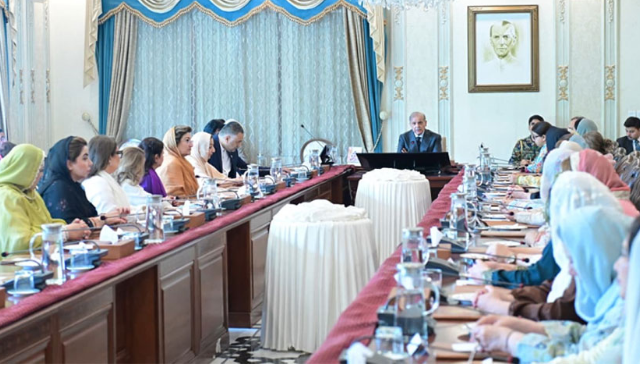
Islamabad (Web Desk): Prime Minister Shehbaz Sharif said on Wednesday that the benefits of the government’s economic strategy would ultimately reach the public once peace is fully restored in the region and normal conditions are re-established.
He made these remarks during a meeting with female members of the National Assembly belonging to the Pakistan Muslim League-Nawaz (PML-N), where he highlighted that sustainable peace in the region is a prerequisite for economic stability, growth, and national prosperity.
PM Shehbaz said that only a stable environment can ensure meaningful development and greater relief for citizens.
The prime minister appreciated the role of women parliamentarians in the ongoing budget discussions and said the government had worked to ensure maximum relief for the public in the Budget 2026–27.
He further stated that several measures had been incorporated to promote women’s empowerment and increase their participation in the country’s development process, stressing that this remained a key priority of the government.
"By the grace of Allah, regional tensions had eased significantly and peace efforts had yielded positive results. He also expressed gratitude to friendly nations for their support in helping de-escalate the situation and restore stability," PM Shehbaz
The prime minister said that from the very beginning of the tensions, the government, along with key leadership including Deputy Prime Minister and Foreign Minister Ishaq Dar, Interior Minister Mohsin Raza Naqvi, and others in the national leadership, had worked with full dedication to bring peace back to the region. He also mentioned that lasting peace, both regionally and globally, is essential for Pakistan’s economic advancement and the achievement of development targets.
He noted that over the past months, the government had made consistent efforts to protect citizens from the impact of global inflation.
He said Pakistan, unlike some other countries in the region, did not face severe disruptions such as fuel shortages or long queues, which he attributed to effective governance and planning.
He further explained that through coordinated efforts of the government, relief measures were introduced to support the middle class and vulnerable segments of society.
He highlighted that a comprehensive relief package was implemented in collaboration with federal and provincial governments.
The prime minister remarked that during the recent difficult period, even members of the cabinet and state institutions had shared the burden of sacrifices first, emphasizing that it was not appropriate for the general public to bear hardships while privileged groups remained unaffected.
He added that the government provided Rs128 billion in subsidies and also launched an austerity drive to reduce financial pressure on citizens.
He said strong coordination between the federal and provincial governments helped maintain economic balance during challenging times and expressed appreciation for the role of provincial administrations.
He also acknowledged the public’s cooperation, saying it played an important part in ensuring stability.
Despite economic challenges, he said, the government succeeded in presenting a people-friendly budget aimed at boosting industrial growth and promoting an export-oriented economy.
He added that the upcoming fiscal plan focuses on key sectors including water storage, information technology, agriculture, and minerals, which are considered essential for strengthening the national economy.
He concluded by saying that all these achievements were the result of collective efforts under “Team Pakistan,” expressing confidence that continued collaboration would help place the country among developed nations in the future.
The women parliamentarians appreciated the prime minister’s efforts in promoting peace at both regional and international levels. They also welcomed the budgetary initiatives aimed at empowering women and ensuring equal opportunities in education and development.
During the meeting, the lawmakers also shared suggestions related to ongoing development projects in their constituencies and presented recommendations regarding the budget.
Their input covered multiple sectors including education, healthcare, employment opportunities for youth, industrial development, communication infrastructure, food security, and other national priorities.
The meeting was attended by a large number of women parliamentarians including Syeda Nosheen Iftikhar, Begum Tehmina Daultana, Shaista Khan, Tahira Aurangzeb, Shaista Pervaiz, Muneeba Iqbal, Nuzhat Sadiq, Musarrat Asif Khawaja, Romina Khurshid Alam, Zeb Jaffar, Kiran Imran Dar, Zahra Wadood Fatimi, Asiya Naz Tanoli, Saba Sadiq, Farah Naz Akbar, Shehnaz Saleem Malik, Zainab Mahmood Baloch, Kiran Haider, Akhtar Bibi, Ghazala Anjum, Shaheen, Samar Haroon Bilour, Saeeda Jamshed, Tamkeen Akhtar Niazi, Saira Tarar, Huma Akhtar Chughtai, Mahjabeen Khan Abbasi, Gulnaz Shehzadi, Shumaila Rana, Shazia Fareed, Syeda Amina Batool, Rabia Naseem Farooqi, Iram Hamid Hameed, and Neelam.
Also present at the meeting were Defence Minister Khawaja Muhammad Asif, IT Minister Shaza Fatima Khawaja, Minister for Parliamentary Affairs Tariq Fazal Chaudhry, Minister for Public Affairs Unit Rana Mubashir Iqbal, Ministers of State Shizra Mansab Ali Khan Kharal and Wajeeha Qamar, as well as Special Assistant Talha Burki.
Neo News | Copyright © 2026