Thu, September 17, 2026

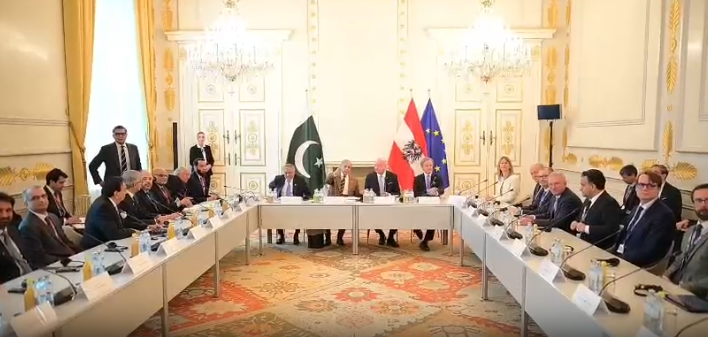
Vienna (Web Desk): Prime Minister Shehbaz Sharif on Monday reaffirmed Pakistan’s determination to strengthen trade and investment relations with Austria, pointing to significant room for collaboration in renewable energy, farming, mineral resources and skills development.
Speaking at the Pakistan-Austria Business Forum in Vienna, he described Pakistan as a predominantly agricultural country, noting that more than 60 percent of its population lives in rural communities.
PM Shehbaz invited Austrian specialists to help improve value addition in citrus and other farm products so that Pakistan could enhance its export competitiveness. He also encouraged Austrian entrepreneurs to explore investment prospects in mining, tourism and engineering.
Referring to Austria’s international reputation in engineering, clean energy, environmental innovation and advanced manufacturing, he urged Austrian companies to take part in Pakistan’s renewable power initiatives, electricity grid upgrades and broader energy-sector modernization efforts.
Extending a personal invitation to Austrian business leaders, the prime minister asked them to visit Pakistan to see its investment opportunities firsthand and experience its diverse landscape, from snow-covered mountain ranges to vibrant cultural centers.
PM Shehbaz noted that Pakistan and Austria share longstanding cordial relations, supported by decades of Austrian corporate engagement in Pakistan, particularly in cable car systems, mineral ventures and renewable energy technologies.
While acknowledging that economic exchanges between the two countries have slowed in recent years for various reasons, he emphasized that Austrian firms have continued to make meaningful contributions.
Referring to his meeting with Austrian Federal Chancellor Karl Nehammer, PM Shehbaz said their discussions were warm and constructive, and both sides agreed to maintain follow-up contacts to turn dialogue into concrete results.
Highlighting Pakistan’s demographic strength, he said nearly 60 percent of the country’s 240 million citizens are young and capable of becoming part of global industrial and technological supply chains.
PM Shehbaz explained that the government is investing in modern training initiatives, including laptop distribution, artificial intelligence education, IT-driven learning and vocational and technical programs at both federal and provincial levels.
Pakistan, he added, stands ready to provide internationally certified skilled workers to European markets where demand exists.
The prime minister also reaffirmed Pakistan’s commitment to tackling illegal migration in cooperation with partners such as Austria, Germany and France.
PM Shehbaz further announced that Islamabad will host the EU-Pakistan Business Forum at the end of April, expressing hope that Austrian participation would help deepen commercial cooperation between the two nations.
Deputy Prime Minister and Foreign Minister Ishaq Dar said that under Prime Minister Shehbaz Sharif’s leadership, Pakistan’s foreign policy has placed economic diplomacy alongside traditional statecraft. He described economic engagement as the foundation of Pakistan-Austria relations, pointing to Austria’s technological strengths and Pakistan’s dynamic and steadily stabilizing economy.
He noted that Pakistan has introduced structural reforms aimed at restoring macroeconomic stability, strengthening fiscal discipline and improving the ease of doing business.
Dar observed that current trade figures do not adequately represent the depth of friendship between the two countries and stressed that the purpose of the forum was to translate untapped potential into practical outcomes.
Earlier, Vice President of the Austrian Federal Economic Chamber, Carmen Goby, reiterated Austria’s strong interest in expanding economic cooperation with Pakistan.
Recalling her 2022 visit to Pakistan with an Austrian business delegation, she praised the hospitality extended to her team and highlighted promising sectors such as hydropower, rail infrastructure, digital transformation and emerging technologies including drones and quantum applications.
She said she sees ample scope for deeper collaboration in infrastructure development, industrial growth and digital advancement, adding that Pakistan’s geographic position makes it a crucial gateway to one of the world’s most dynamic future regions.
Carmen Goby also outlined Austria’s own role as a logistics and defense hub in Central Europe, suggesting that the complementary strengths of both countries could pave the way for mutually beneficial partnerships.
Neo News | Copyright © 2026