Fri, September 18, 2026

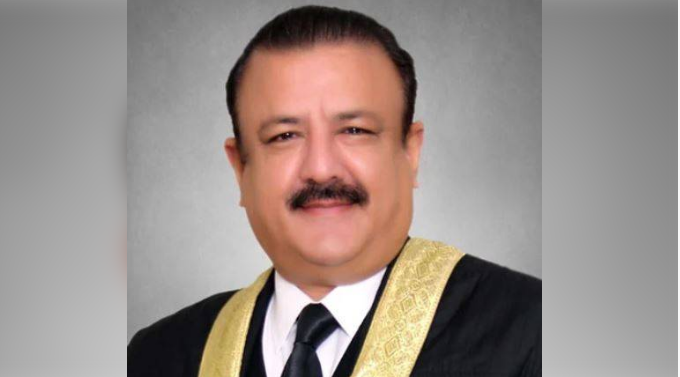
Islamabad (Web Desk): The Islamabad High Court (IHC) has turned down objections raised by Justice Tariq Mehmood Jahangiri over the formation of a divisional bench and the participation of Chief Justice Sarfraz Dogar in hearing the case.
In its written order released on Tuesday, the court explained that "Keeping in view the sensitive nature of allegations of having an invalid/fake degree levelled against a sitting judge, it was deemed conducive, proper and in fitness of things to constitute a Division Bench to hear this case instead of a Single Bench."
The court emphasized that the decision to form benches rests entirely with the chief justice and noted that creating a division bench for specific petitions was not unprecedented. Accordingly, it concluded that "The objection raised by Respondent No 1 [Justice Jahangiri] on the constitution of the Division Bench is hereby turned down having no force."
This order follows events from the previous day, when Justice Jahangiri, during a hearing on a petition filed by Advocate Mian Dawood, opposed the constitution of the division bench. He argued that "a quo warranto (by what authority/warrant) writ is never heard by a division bench but instead heard by a single bench."
The controversy revolves around Justice Jahangiri’s LLB degree, which was cancelled by the University of Karachi. The university’s notification, dated September 25, confirmed that its syndicate, in a meeting held on August 31, 2024, had approved "Resolution No 6" following the decision of the competent authority and the recommendation of the Unfair Means Committee (UFM).
Justice Jahangiri had also raised concerns about Chief Justice Dogar’s involvement in the bench, citing a conflict of interest due to a petition he had filed against the chief justice. He expressed distrust in CJ Dogar, asserting that the matter "should be given to another bench."
The IHC, however, dismissed both the objection and the expression of no confidence, pointing out that the petition against CJ Dogar had already been rejected by the Federal Constitutional Court. In support of its decision, the court cited the Supreme Court ruling in Asif Ali Zardari vs The State, noting that "a judge is a keeper of his own conscience and it is for him to decide whether to hear or not hear a matter before him."
Recognizing the unique nature of the case, the court also extended the right of audience to the Islamabad District Bar Association, Islamabad High Court Bar Association, and the Islamabad Bar Council, allowing them to participate in the proceedings.
Neo News | Copyright © 2026