Fri, September 18, 2026

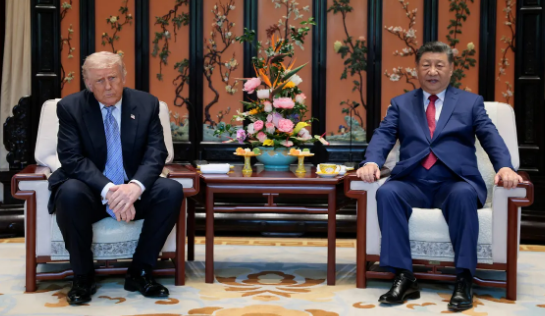
Beijing (Web Desk/Agencies): Chinese President Xi Jinping and his US counterpart Donald Trump agreed to boost coordination and maintain close communication on regional and global matters during high-level talks held in Beijing against the backdrop of the Iran conflict, Chinese officials said on Friday.
According to a statement issued by China’s foreign ministry, the two leaders engaged in an extensive discussion covering key international and bilateral issues and reached several “new common understandings” during Trump’s first trip to China since 2017.
The spokesperson said both countries agreed on a “new vision of building a constructive China-US relationship of strategic stability to provide strategic guidance for China-US relations over the next three years and beyond, promote the steady, sound and sustainable development of China-US relations, and bring more peace, prosperity and progress to the world.”
Chinese officials also stated that Trump and Xi achieved “important common understandings on handling their mutual concerns in a proper manner.”
The ministry added that ongoing exchanges between the two presidents had strengthened “mutual understanding, deepened mutual trust, advanced practical cooperation, increased benefits for the people of both countries, and injected much-needed stability and certainty into the world.”
On Thursday, during an interview with FOX News, Trump revealed that Xi had assured him China would not send military equipment to Iran and supported efforts to keep the Strait of Hormuz accessible.
“He said he’s not going to give military equipment. That’s a big statement,” Trump said.
At the same time, China stressed that extending the war involving the US, Israel and Iran was meaningless and renewed calls for diplomatic efforts to end the crisis.
“There is no point in continuing this conflict, which should not have happened in the first place,” a Chinese foreign ministry spokesperson said while responding to questions about whether Iran was discussed during the summit and Beijing’s stance on the conflict.
The spokesperson further stated that finding a swift resolution was in the interests of both Washington and Tehran, as well as countries across the region and the wider world.
China also urged all parties not to close the door on diplomacy after negotiations had resumed, calling for continued de-escalation and political dialogue aimed at resolving concerns surrounding Iran’s nuclear programme and related issues.
The spokesperson additionally highlighted the importance of restoring maritime routes quickly to ensure global supply chains remain stable and uninterrupted.
“It is important to reach a comprehensive and lasting ceasefire as soon as possible, enable peace and stability to return to the Middle East and Gulf region at an early date, and lay the foundation for building a sustainable security architecture for the region,” the spokesperson added.
Trump also said Xi appeared interested in helping facilitate a settlement. “He said, 'If I can be of any help at all, I would like to be of help.' Anybody that buys that much oil has obviously got some kind of relationship, but he'd like to see the Hormuz Strait open,” Trump added.
Xi and Trump had also met last year during the Asia-Pacific Economic Cooperation summit held in Busan, South Korea.
As part of the current visit, Xi hosted an official welcoming ceremony and banquet for Trump on Thursday. The two leaders also held talks and toured the Temple of Heaven in Beijing.
On Friday, both presidents attended a greeting ceremony and posed for a friendship photograph before Xi hosted Trump for a tea meeting followed by a working lunch.
Trump is expected to leave Beijing after the conclusion of the engagements.
The visit comes amid heightened tensions in the Middle East after US and Israeli forces carried out strikes on Iran on February 28, triggering retaliatory attacks targeting Israel and American allies in the Gulf region, along with the temporary closure of the Strait of Hormuz.
An indefinite ceasefire remains in place at present.
Neo News | Copyright © 2026